
Last letters from the living dead man
David Patterson (Spirit) Hatch
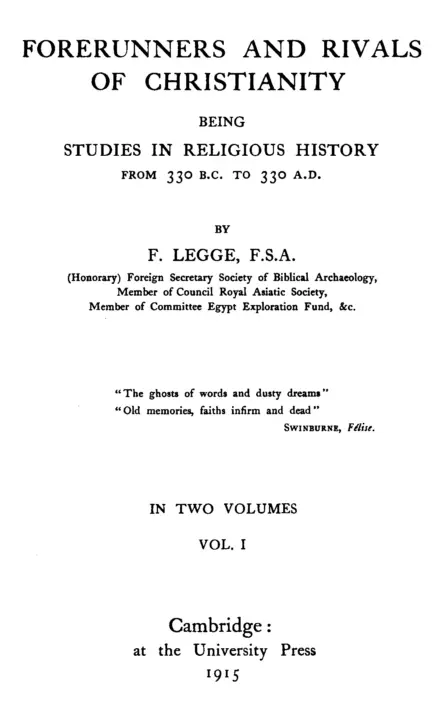
THE CLASSIC COLLECTION · 1915
"Forerunners and Rivals of Christianity: Being Studies in Religious History" by F. Legge is a scholarly historical account likely written in the early 20th century. The book explores documents crucial for understanding the origins and developments of Christianity, highlighting lesser-known religious movements and texts. Its focus is on the interplay between early Christianity and its contemporaries, including various Gnostic sects and Eastern religions. The opening of the work introduces the author's intent to compile and elucidate documents that, while previously translated, remain obscure and misunderstood in contemporary discourse. Legge expresses his desire to foster a clearer understanding of these religious fragments by providing context and commentary, which he believes will clarify their significance. He acknowledges the challenges presented by historical interpretations and notes his efforts to make these texts accessible to both scholars and the general public. Through his methodical approach, he aims to shed light on the diverse influences that shaped early Christianity.
Introduction adapted from the source catalogue; source summaries may be automatically generated.
Free to read · English · 99,528 words · No account needed
MAKE TIME FOR A GOOD BOOK
On by default. Untick to stop anonymous reading totals. Each page counts after 10 seconds in view. How this works.
Anonymous counting is on unless you have switched it off.
So the Supreme Being of Simon is androgyne.
Footnote 584:
The difficulty in deducing both male and female divinities from a male or sexless Supreme being has led to some strange mythology. The Egyptians cut the knot in an effective if coarse way. “Thus from one god I became three gods,” says the Egyptian deity “the Lord of the Universe,” in his account of the Creation. See Budge, “Papyrus of Nesi-Amsu,” and Egyptian Hieratic Papyri in the British Museum, pp. xiii, xiv and 14, 15. Was the author of the Apophasis acquainted with this story? The Clementines make Simon’s associates Egyptians or rather Alexandrians. See Clem. Hom. Bk IV. c. 6.
Footnote 585:
Hippolytus, op. cit. Bk VI. c. 1, § 18, pp. 261, 262, Cruice.
Footnote 586:
Op. cit. Bk VI. c. 1, § 9, p. 246, Cruice.
Footnote 587:
Amélineau, Gnosticisme Égyptien, p. 39, makes this perfectly clear. Cf. Ad. Franck, “Le Gnosticisme Égyptien” in Journal des Savans, Avril, 1888, pp. 212, 213. Hatch (H.L. p. 205) points out that it is the doctrine of “Philo and the Platonists.”
Footnote 588:
As will be seen later, the post-Christian Gnostics of the IInd cent. generally attributed the existence of evil to the escape of one of the syzygies from the control of her spouse and her consequent fall into matter. See Chapter VIII, infra.
Footnote 589:
The excessive reverence of the Samaritans for the Pentateuch is well brought out by Cowley in the Encyc. Bibl. s.v. Samaritans. He says it was the only part of the Jewish books which they took over and held sacred (col. 4260). Simon in the Great Announcement thought it necessary to “explain” each of the Five Books separately. See Hippolytus, op. cit. Bk VI. c. 1, §§ 15, 16, pp. 253-258, Cruice.
Footnote 590:
Throughout all the philosophical and religious literature of the time, it seems to have been sufficient to quote “Orpheus and the other theologists” to command a hearing. See Clement of Alexandria, passim, for examples.
Footnote 591:
See Chapter IV, p. 123, supra.
Footnote 592:
See especially Fr. 239 in Abel’s Orphica.
Footnote 593:
Hippolytus, op. cit. Bk VI. c. 1, § 14, pp. 252, 253, Cruice.
Footnote 594:
Ibid. Bk VI. c. 1, § 13, pp. 251, 252, Cruice.
Footnote 595:
Ibid. loc. cit. Cf. Amélineau, Gnost. Ég. p. 39.
Footnote 596:
Abel’s Orphica, pp. 186, 254, 255.
Footnote 597:
“The visible and generated Gods.” So Alcmaeon of Crotona and Xenocrates both call stars and planets gods. See Clem. Alex. Protrept. c. VI.; Plato, Timaeus, c. XV. The prophets of the Jews, indeed, blamed their co-religionists for “worshipping the sun towards the east” as Ezekiel saw them doing in the Temple, or for “serving all the host of heaven” as Jeremiah says the inhabitants of Jerusalem did; but their reproaches make it plain that the bulk of the nation were in this respect like their Gentile neighbours.
Footnote 598:
Your reading position is saved on this browser. Take it to another device with a library code. Reading pages adapt to text, rather than matching a printed edition.
BEHIND THE BOOK
This eBook is for the use of anyone anywhere in the United States and most other parts of the world at no cost and with almost no restrictions whatsoever. You may copy it, give it away or re-use it under the terms of the Project Gutenberg License included with this eBook or online at www.gutenberg.org. If you are not located in the United States, you will have to check the laws of the country where you are located before using this eBook. Read the source licence.
The original source file, including credits and licence, is retained by this library. Request an original-format copy at no charge. Please include the book title and Project Gutenberg identifier #71384.
KEEP YOUR CURIOSITY GOING
David Patterson (Spirit) Hatch

David Patterson (Spirit) Hatch

David Patterson (Spirit) Hatch
Cécile Tormay

Moritz Busch
John L. Ransom