
Last letters from the living dead man
David Patterson (Spirit) Hatch
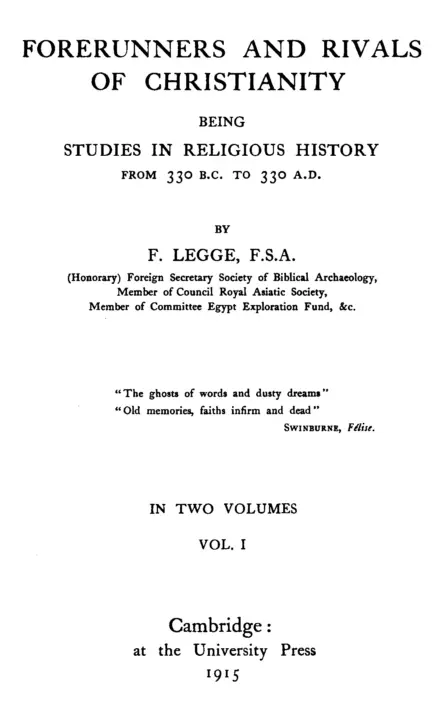
THE CLASSIC COLLECTION · 1915
"Forerunners and Rivals of Christianity: Being Studies in Religious History" by F. Legge is a scholarly historical account likely written in the early 20th century. The book explores documents crucial for understanding the origins and developments of Christianity, highlighting lesser-known religious movements and texts. Its focus is on the interplay between early Christianity and its contemporaries, including various Gnostic sects and Eastern religions. The opening of the work introduces the author's intent to compile and elucidate documents that, while previously translated, remain obscure and misunderstood in contemporary discourse. Legge expresses his desire to foster a clearer understanding of these religious fragments by providing context and commentary, which he believes will clarify their significance. He acknowledges the challenges presented by historical interpretations and notes his efforts to make these texts accessible to both scholars and the general public. Through his methodical approach, he aims to shed light on the diverse influences that shaped early Christianity.
Introduction adapted from the source catalogue; source summaries may be automatically generated.
Free to read · English · 99,528 words · No account needed
MAKE TIME FOR A GOOD BOOK
On by default. Untick to stop anonymous reading totals. Each page counts after 10 seconds in view. How this works.
Anonymous counting is on unless you have switched it off.
Like the Gold Plate of Caecilia Secundina, Chapter IV, p. 133, supra. So the Sibylline Oracles contain the acrostic ΙΧΘΥΣ which covers the name and titles of Jesus, Renan, L’Église Chrétienne, p. 535 and note. The Greeks must have caught the taste for such devices, for an acrostic is found in a treatise on astronomy by Eudoxos of Cnidos copied in the second cent. B.C. Many other instances are given by Brunet de Presle, Les Papyrus Grecs du Musée du Louvre, Paris, 1865, pp. 43, 44. He says with some reason that the practice was borrowed by the Greeks from the Jews.
Footnote 532:
Kenyon, Gk. Pap. in B. M., Papyrus CXXI, pp. 83 sqq.
Footnote 533:
Hausrath, op. cit. pp. 114-116, where many other instances are given. The explanation of “Nero(n) Caesar” as the Number of the Beast is in fact as old as Irenaeus, who remarks that the variant 616 given in some texts is due to the omission of the final n in Latin. It does not seem to be seriously disputed by any modern theologian. Isopsephism however was not the invention of the Essenes, but of the Babylonians, among whom it was in use, to judge from Berossos, in the time of Alexander. See Alexander Polyhistor in Cory, Ancient Fragments, 2nd ed. p. 25.
Footnote 534:
Charles, Book of Enoch, chap. lxix. 13-15. Cf. id., The Apoc. etc. of the O.T., II. p. 234, where he has made some verbal alterations in the reading.
Footnote 535:
Hausrath, op. et loc. cit.
Footnote 536:
Charles, A. of M. chap. ix. 1, and the note beginning on p. 35, op. cit. Hausrath, op. cit. sup. pp. 116, 117, thinks the name is arrived at by the process called Atbash.
Footnote 537:
If the authenticity of the Fragment quoted above from Philo could be established, it would seem probable that Josephus simply copied the figure from this last, and that 4000 was the number of the Essenes about 20 A.D.
Footnote 538:
Renan, L’Église Chrétienne, p. 209.
Footnote 539:
Hausrath, op. cit. pp. 116, 117, for examples. By the method called Temura he gets Romah hagedôlah for Armageddon in the Canonical Apocalypse. So Justin Martyr, Cohort. c. XXIV. says that Moses is unintelligible without mystic insight, and that the name of Christ contains a hidden meaning (2nd Apol. c. VI.).
Footnote 540:
Thus Irenaeus, Adv. Haer. Bk I. c. XII. § 11, p. 146, Harvey, makes Marcus the heresiarch show that Alpha and Omega, the name given to Jesus in Revelation, means the Dove which descended upon Him at His baptism, because it has the same numerical value (περιστερά) of 801.
Your reading position is saved on this browser. Take it to another device with a library code. Reading pages adapt to text, rather than matching a printed edition.
BEHIND THE BOOK
This eBook is for the use of anyone anywhere in the United States and most other parts of the world at no cost and with almost no restrictions whatsoever. You may copy it, give it away or re-use it under the terms of the Project Gutenberg License included with this eBook or online at www.gutenberg.org. If you are not located in the United States, you will have to check the laws of the country where you are located before using this eBook. Read the source licence.
The original source file, including credits and licence, is retained by this library. Request an original-format copy at no charge. Please include the book title and Project Gutenberg identifier #71384.
KEEP YOUR CURIOSITY GOING
David Patterson (Spirit) Hatch

David Patterson (Spirit) Hatch

David Patterson (Spirit) Hatch
Cécile Tormay

Moritz Busch
John L. Ransom