
Last letters from the living dead man
David Patterson (Spirit) Hatch
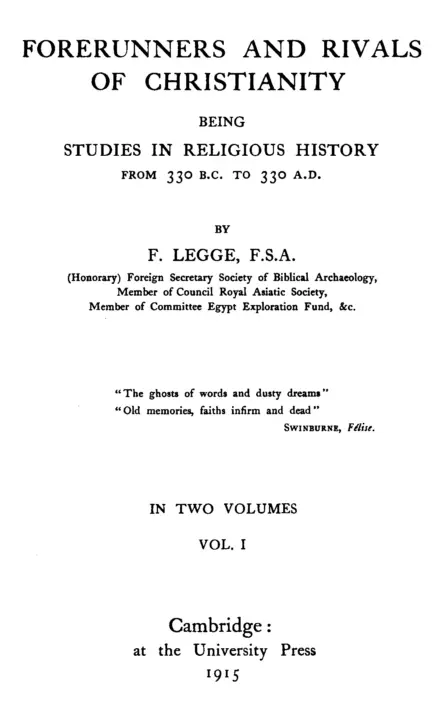
THE CLASSIC COLLECTION · 1915
"Forerunners and Rivals of Christianity: Being Studies in Religious History" by F. Legge is a scholarly historical account likely written in the early 20th century. The book explores documents crucial for understanding the origins and developments of Christianity, highlighting lesser-known religious movements and texts. Its focus is on the interplay between early Christianity and its contemporaries, including various Gnostic sects and Eastern religions. The opening of the work introduces the author's intent to compile and elucidate documents that, while previously translated, remain obscure and misunderstood in contemporary discourse. Legge expresses his desire to foster a clearer understanding of these religious fragments by providing context and commentary, which he believes will clarify their significance. He acknowledges the challenges presented by historical interpretations and notes his efforts to make these texts accessible to both scholars and the general public. Through his methodical approach, he aims to shed light on the diverse influences that shaped early Christianity.
Introduction adapted from the source catalogue; source summaries may be automatically generated.
Free to read · English · 99,528 words · No account needed
MAKE TIME FOR A GOOD BOOK
On by default. Untick to stop anonymous reading totals. Each page counts after 10 seconds in view. How this works.
Anonymous counting is on unless you have switched it off.
See note 2 p. 149, supra. The essentially Jewish tendency towards hyperbole and exaggeration in language must, however, be allowed for. As someone has said, “Jacob I have loved, and Esau I have hated,” in the mouth of a Jew means little more than that on the whole the speaker prefers Jacob to Esau. See also note 1 p. 163, supra.
Footnote 512:
Isaiah xiv. 2; lx. 10; lxi. 5. All these passages are now said to be post-Exilic by Charles, Crit. Hist. p. 115.
Footnote 513:
Charles, Apocalypse of Baruch, chap. xxx. 4, 5; chap. xxxvi. 11; 4
Esdras vii. 87.
Footnote 514:
Charles, Book of Enoch, chap. xlviii. 9; lxii. 9-12.
Footnote 515:
Op. cit. chap. xc. 30.
Footnote 516:
See note 3 p. 166, infra.
Footnote 517:
Cf. Isaiah xl. 15.
Footnote 518:
4 Esdras vi. 55-59; xv. 20, 21.
Footnote 519:
Charles, Apocalypse of Baruch, chap. lxxii. 2-6.
Footnote 520:
Charles, Book of Jubilees, chap. xv. 31, 32.
Footnote 521:
I.e. the Roman Empire.
Footnote 522:
Charles, Assumption of Moses, chap. x. 3, 5, 7, 8, 10.
Footnote 523:
Evidently a reminiscence of the Zoroastrian demon who is opposed to the Amshaspand Vohu Mano or “Good Thought.” See Chapter VI, infra.
Footnote 524:
4 Esdras vii. 91-93.
Footnote 525:
The earliest document quoted is the part of the Book of Enoch which Prof. Charles considers was written between 166-161 B.C.; the latest, the Fourth Book of Esdras, which he puts at 90 A.D. Yet he shows that the hatred of the Gentiles and the hope that they would be eternally destroyed or made slaves to Israel were present many centuries earlier and are to be found in the writings attributed to Ezekiel, Haggai, Joel, and Zachariah, as well as in Isaiah. Cf. Crit. Hist. p. 160.
Footnote 526:
Tacitus, Historia, Bk V. c. 5.
Footnote 527:
Thus Jellinek, Ueber das Buch der Jubilaen und das Noah-Buch, Leipzig, 1855, passim, says that the Book of Jubilees is of Essene origin, and Schmidt and Merx, Archiv für wissenschaftliche Erforschung des Alten Testaments, I. II. (1868) pp. 111-152, make the same claim for the Assumption of Moses and so on. For the Book of Enoch itself see above.
Footnote 528:
For the quotations from Enoch in the Testament of the XII Patriarchs see Charles, Introduction to that book, p. lix; for those in the Book of Jubilees see B. of J. pp. 13, 36, 37, 53, 62-64, 102, 134, 146, 150, 212, 213; in the Apocalypse of Baruch, see A. of B. p. 101 and notes; in the Assumption of Moses, see A. of M. x. 4, 9.
Footnote 529:
Josephus, ubi cit. in note 4 p. 151, supra, says (§ 8) that they honoured the name of Moses next after that of God Himself; and that any who blasphemed him was punished capitally.
Footnote 530:
Cf. Abel’s Orphica, Fr. 160, 161, 162, 202, 203, 204. From the Orphics the practice passed into the Mysteries and the writings of the post-Christian Gnostics. See Hatch, Hibbert Lectures, 1888, pp. 69, 74-75.
Footnote 531:
Your reading position is saved on this browser. Take it to another device with a library code. Reading pages adapt to text, rather than matching a printed edition.
BEHIND THE BOOK
This eBook is for the use of anyone anywhere in the United States and most other parts of the world at no cost and with almost no restrictions whatsoever. You may copy it, give it away or re-use it under the terms of the Project Gutenberg License included with this eBook or online at www.gutenberg.org. If you are not located in the United States, you will have to check the laws of the country where you are located before using this eBook. Read the source licence.
The original source file, including credits and licence, is retained by this library. Request an original-format copy at no charge. Please include the book title and Project Gutenberg identifier #71384.
KEEP YOUR CURIOSITY GOING
David Patterson (Spirit) Hatch

David Patterson (Spirit) Hatch

David Patterson (Spirit) Hatch
Cécile Tormay

Moritz Busch
John L. Ransom