
Last letters from the living dead man
David Patterson (Spirit) Hatch
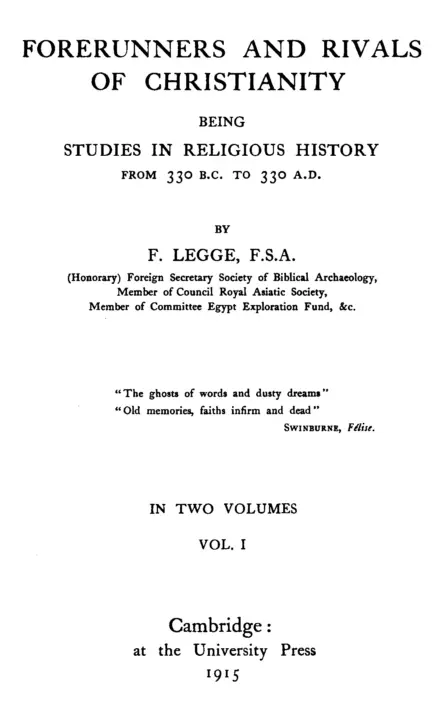
THE CLASSIC COLLECTION · 1915
"Forerunners and Rivals of Christianity: Being Studies in Religious History" by F. Legge is a scholarly historical account likely written in the early 20th century. The book explores documents crucial for understanding the origins and developments of Christianity, highlighting lesser-known religious movements and texts. Its focus is on the interplay between early Christianity and its contemporaries, including various Gnostic sects and Eastern religions. The opening of the work introduces the author's intent to compile and elucidate documents that, while previously translated, remain obscure and misunderstood in contemporary discourse. Legge expresses his desire to foster a clearer understanding of these religious fragments by providing context and commentary, which he believes will clarify their significance. He acknowledges the challenges presented by historical interpretations and notes his efforts to make these texts accessible to both scholars and the general public. Through his methodical approach, he aims to shed light on the diverse influences that shaped early Christianity.
Introduction adapted from the source catalogue; source summaries may be automatically generated.
Free to read · English · 99,528 words · No account needed
MAKE TIME FOR A GOOD BOOK
On by default. Untick to stop anonymous reading totals. Each page counts after 10 seconds in view. How this works.
Anonymous counting is on unless you have switched it off.
See Plutarch, Sulla, passim, especially cc. IX. XXVIII. and XXXVII. from which last it appears that he consulted “the Chaldaeans.”
Footnote 343:
Horace, Epode, V.
Footnote 344:
Juvenal, Sat. VI.
Footnote 345:
Renan, L’Antéchrist, Paris, 1873, p. 28, n. 4, for authorities.
Footnote 346:
Acts xiii. 8; ibid. xix. 13-19. Cf. Renan, op. cit. p. 421.
Footnote 347:
Book IV. c. 4, passim, especially the device for making sheep cut off their own heads by rubbing their necks against a sword, or for producing an earthquake by burning upon coals the dung of an ichneumon mixed with magnetic ore (pp. 99, 111, Cruice). Tertullian, de Praescript. c. 43, accuses the Gnostics of frequenting magicians and astrologers.
Footnote 348:
Philosophumena, Bk IV. c. 15, pp. 112, 113, Cruice.
Footnote 349:
Paisley, 1896, pp. 277-284.
Footnote 350:
Hypnotisme et Spiritisme, Genève, 1890, passim.
Footnote 351:
L’Automatisme Psychologique, Paris, 1899, passim.
Footnote 352:
This is treated more fully in Chap. X, infra.
Footnote 353:
Cf. “Cerinthus and the Gnostics” in the London Quarterly, Oct. 1886,
p. 132.
Footnote 354:
Thus Epiphanius had been a Nicolaitan, St Ambrose of Milan a
Valentinian, and St Augustine a Manichaean before joining the Catholic
Church.
Footnote 355:
So Hippolytus objects not only to the astrology of his time, but to the arithmetical calculations on which it was professedly based. The estimates attributed to Archimedes of the relative distances of the earth from the sun, moon and planets are marked out by him for special condemnation. Cf. Philosophumena, Bk IV. c. 1, pp. 67-76, Cruice.
Footnote 356:
P. Jensen, Die Kosmologie der Babylonier, Strassburg, 1890, pp. 140 sqq. and especially p. 295.
Footnote 357:
See the tablets made for this king and published by Sir Henry Rawlinson in the Cuneiform Inscriptions of Western Asia, vol. III. Many of these are translated by Sayce in “The Astronomy and Astrology of the Babylonians,” Trans. Soc. Bibl. Arch. vol. III. (1874), pp. 145-339. I have taken the lowest date for Sargon, on the authority of Mr King, Chronicles of Early Babylonian Kings, 1907, I. p. 17, although the well-known text of Nabonidus would make him a thousand years earlier. The origin of Babylonian astronomy is discussed by Jastrow, Religion of Babylonia and Assyria, chap. XXIII. The immense antiquity attributed to the Babylonian observations by the classical authorities quoted in Sayce’s paper may be considerably reduced if we substitute lunar for solar years; yet there seems little doubt that the star worship which arose from them went back to the “oldest period of Babylonia.” Cf. Sayce, Gifford Lectures, 1902, p. 480.
Footnote 358:
Jastrow, op. cit. pp. 365 sqq.
Footnote 359:
Your reading position is saved on this browser. Take it to another device with a library code. Reading pages adapt to text, rather than matching a printed edition.
BEHIND THE BOOK
This eBook is for the use of anyone anywhere in the United States and most other parts of the world at no cost and with almost no restrictions whatsoever. You may copy it, give it away or re-use it under the terms of the Project Gutenberg License included with this eBook or online at www.gutenberg.org. If you are not located in the United States, you will have to check the laws of the country where you are located before using this eBook. Read the source licence.
The original source file, including credits and licence, is retained by this library. Request an original-format copy at no charge. Please include the book title and Project Gutenberg identifier #71384.
KEEP YOUR CURIOSITY GOING
David Patterson (Spirit) Hatch

David Patterson (Spirit) Hatch

David Patterson (Spirit) Hatch
Cécile Tormay

Moritz Busch
John L. Ransom