
Last letters from the living dead man
David Patterson (Spirit) Hatch
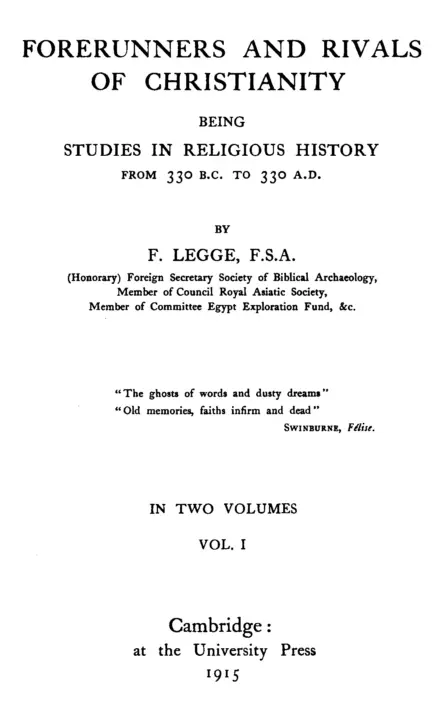
THE CLASSIC COLLECTION · 1915
"Forerunners and Rivals of Christianity: Being Studies in Religious History" by F. Legge is a scholarly historical account likely written in the early 20th century. The book explores documents crucial for understanding the origins and developments of Christianity, highlighting lesser-known religious movements and texts. Its focus is on the interplay between early Christianity and its contemporaries, including various Gnostic sects and Eastern religions. The opening of the work introduces the author's intent to compile and elucidate documents that, while previously translated, remain obscure and misunderstood in contemporary discourse. Legge expresses his desire to foster a clearer understanding of these religious fragments by providing context and commentary, which he believes will clarify their significance. He acknowledges the challenges presented by historical interpretations and notes his efforts to make these texts accessible to both scholars and the general public. Through his methodical approach, he aims to shed light on the diverse influences that shaped early Christianity.
Introduction adapted from the source catalogue; source summaries may be automatically generated.
Free to read · English · 99,528 words · No account needed
MAKE TIME FOR A GOOD BOOK
On by default. Untick to stop anonymous reading totals. Each page counts after 10 seconds in view. How this works.
Anonymous counting is on unless you have switched it off.
Because the ass was considered a Typhonic animal.
Footnote 330:
The form of hypnotism known as crystal-gazing. A full description is given in Lane’s Modern Egyptians, 1896, pp. 276 sqq. Cf. “Divination in the XVIIth Century,” National Review, 1899, pp. 93-104, for its practice in England.
Footnote 331:
See the letter of Porphyry to Anebo quoting Chaeremon. That this practice was peculiar to the Egyptian magicians is stated by Iamblichus, de Mysteriis, Bk IV. c. 7. A good instance is given by Maspero, “Sur deux Tabellae Devotionis” in Ét. Égyptol. 1893, t. II. p. 297, where a magician threatens, if his prayer be not granted, to go down into the secret places of Osiris and destroy his shroud.
Footnote 332:
Kenyon, Greek Papyri in the British Museum, pp. 79-81.
Footnote 333:
Or isopsephic, i.e. composed of letters having an equal numerical value. One of the many forms of juggling with words and letters current in the early Christian centuries. The “number of the beast” in Revelation xiii. 18, where, as is now generally admitted, 666 covers the name of Nero Caesar which has that numerical value in Hebrew, is the most familiar instance. Other instances can be found in the Epistle of Barnabas, c. 9, Hilgenfeld, N.T. extra Canonem receptum, Lips. 1884, and Hippolytus, Philosophumena, Bk VI. c. 48, p. 318, Cruice.
Footnote 334:
The context shows that a scarab set in a ring is indicated.
Footnote 335:
A rude drawing representing the magician in this attitude often appears in the margin of papyri such as that quoted in the text. See Wessely, Griech. Zauberp. p. 118.
Footnote 336:
Doubtless the index, because the Idaean Dactyli were said to be the
first of men.
Footnote 337:
This seems to be a corruption of some name like Baal-zephon. The confusion of ζ for β in these papyri is very common.
Footnote 338:
A Hebrew name meaning “Thou art our father.” It was thought especially valuable because it could be read either way.
Footnote 339:
Of these words, Iaoth Sabaoth is “Jehovah of hosts”; patoure zagoure, “who openeth and shutteth” (cf. Revelation i. 8); Baruch adonai eloai iabraam, “Blessed be the Lord God of Abraham.” All are fairly good Hebrew not very much corrupted.
Footnote 340:
Astrampsuchos appears, oddly enough, as the name of one of the celestial guardians of a heaven in one of the documents of the Bodleian Bruce Papyrus which is described in Chap. X, infra. See Amélineau, Le Papyrus Gnostique Bruce, Paris, p. 109, who transcribes it Etrempsuchos, while Schmidt (Koptisch-gnostische Schriften, Leipzig, 1905, Bd. I. p. 345) writes Strempsuchos. Hippolytus gives the name as that of one of the Powers worshipped by the Peratae, v. Philosophumena, Bk V. c. 14, p. 196, Cruice.
Footnote 341:
M. Maspero contends that this name is a corruption of an epithet of Thoth. See Ét. Égyptol. V. p. 259.
Footnote 342:
Your reading position is saved on this browser. Take it to another device with a library code. Reading pages adapt to text, rather than matching a printed edition.
BEHIND THE BOOK
This eBook is for the use of anyone anywhere in the United States and most other parts of the world at no cost and with almost no restrictions whatsoever. You may copy it, give it away or re-use it under the terms of the Project Gutenberg License included with this eBook or online at www.gutenberg.org. If you are not located in the United States, you will have to check the laws of the country where you are located before using this eBook. Read the source licence.
The original source file, including credits and licence, is retained by this library. Request an original-format copy at no charge. Please include the book title and Project Gutenberg identifier #71384.
KEEP YOUR CURIOSITY GOING
David Patterson (Spirit) Hatch

David Patterson (Spirit) Hatch

David Patterson (Spirit) Hatch
Cécile Tormay

Moritz Busch
John L. Ransom