
Last letters from the living dead man
David Patterson (Spirit) Hatch
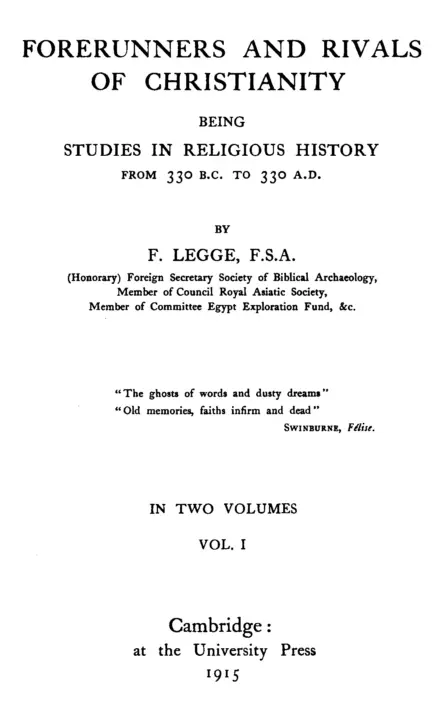
THE CLASSIC COLLECTION · 1915
"Forerunners and Rivals of Christianity: Being Studies in Religious History" by F. Legge is a scholarly historical account likely written in the early 20th century. The book explores documents crucial for understanding the origins and developments of Christianity, highlighting lesser-known religious movements and texts. Its focus is on the interplay between early Christianity and its contemporaries, including various Gnostic sects and Eastern religions. The opening of the work introduces the author's intent to compile and elucidate documents that, while previously translated, remain obscure and misunderstood in contemporary discourse. Legge expresses his desire to foster a clearer understanding of these religious fragments by providing context and commentary, which he believes will clarify their significance. He acknowledges the challenges presented by historical interpretations and notes his efforts to make these texts accessible to both scholars and the general public. Through his methodical approach, he aims to shed light on the diverse influences that shaped early Christianity.
Introduction adapted from the source catalogue; source summaries may be automatically generated.
Free to read · English · 99,528 words · No account needed
MAKE TIME FOR A GOOD BOOK
On by default. Untick to stop anonymous reading totals. Each page counts after 10 seconds in view. How this works.
Anonymous counting is on unless you have switched it off.
E.g. well-fed dogs who worry sheep, and cats who steal fish and other delicacies rather than have them given to them. The actions of the animals show in both cases that they know that what they are doing is displeasing to their owners.
Footnote 304:
Sayce, Gifford Lectures, pp. 420 sqq. For these penitential psalms generally, see Jastrow, The Religion of Babylonia and Assyria, Boston, 1898, chap. XVIII.
Footnote 305:
Il. III. ll. 280 sqq. (Lang, Leaf, and Myers trans. p. 57).
Footnote 306:
Odyss. III. ll. 373 sqq. (Butcher and Lang trans. p. 43).
Footnote 307:
According to Maspero, Ét. Égyptol. I. p. 163, this was always the case in Egypt, at least in historic times. “Prayer,” he says, “was a formula of which the terms had an imperative value, and the exact enunciation of which obliged the god to concede what was asked of him.”
Footnote 308:
Maury, Religions de la Grèce Antique, II. pp. 97 sqq.
Footnote 309:
Il. X. l. 292; Odyss. XI. l. 30, and where before quoted.
Footnote 310:
Perhaps it is to this last view that we should attribute the
well-known indifference of the Semitic peoples to mythology and
science.
Footnote 311:
E.g. the Rainbow in Genesis ix. 12-16. Erman, in his History of Egyptian Religion, p. 31, points out that Egyptian mythology is found only in magical books.
Footnote 312:
Frazer, Golden Bough, 3rd ed. pt I. vol. I. p. 52.
Footnote 313:
The principal collections of these are indicated in note 3 on p. 93, supra. Cf. “The Names of Demons in the Magic Papyri,” P.S.B.A. 1901.
Footnote 314:
Kenyon, Gk. Pap. in Brit. Mus. p. 77. This is the date of the MS. The spells themselves are probably much older.
Footnote 315:
Philosophumena, Bk IV. c. 28. Hippolytus is probably wrong in thinking this a conscious imposture. The magician, like his clients, does not connect cause and effect in such cases. Sir Alfred Lyall told Lord Avebury that he had often seen Indian sorcerers openly mixing croton oil with the ink in which their charms were written so as to produce a purgative effect when the ink was washed off and swallowed. See Lubbock, Origin of Civilization, p. 24.
Footnote 316:
P.S.B.A. XXII. (1900), pp. 121 sqq. An explanation of the name is attempted by Giraud, Ophitae, Paris, 1884, p. 91, n. 5.
Footnote 317:
Daremberg and Saglio, Dict. des Antiq. s.v. Baubo. The name Ortho perhaps suggests that of the very ancient goddess later called Artemis Orthia, whose original name seems to have been Orthia only. Cf. M. S. Thompson’s paper “The Asiatic or Winged Artemis” in J.H.S. vol. XXIX. (1909), pp. 286 sqq., esp. p. 307.
Footnote 318:
P.S.B.A. XXII. (1900), p. 121, and see Griffith and Thompson, Demotic Magical Papyrus of London and Leiden, p. 61 and note.
Footnote 319:
Your reading position is saved on this browser. Take it to another device with a library code. Reading pages adapt to text, rather than matching a printed edition.
BEHIND THE BOOK
This eBook is for the use of anyone anywhere in the United States and most other parts of the world at no cost and with almost no restrictions whatsoever. You may copy it, give it away or re-use it under the terms of the Project Gutenberg License included with this eBook or online at www.gutenberg.org. If you are not located in the United States, you will have to check the laws of the country where you are located before using this eBook. Read the source licence.
The original source file, including credits and licence, is retained by this library. Request an original-format copy at no charge. Please include the book title and Project Gutenberg identifier #71384.
KEEP YOUR CURIOSITY GOING
David Patterson (Spirit) Hatch

David Patterson (Spirit) Hatch

David Patterson (Spirit) Hatch
Cécile Tormay

Moritz Busch
John L. Ransom