
Last letters from the living dead man
David Patterson (Spirit) Hatch
THE CLASSIC COLLECTION · 1915
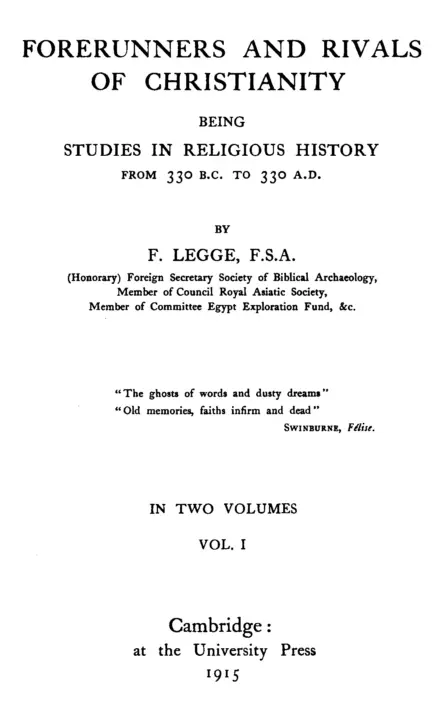
"Forerunners and Rivals of Christianity: Being Studies in Religious History" by F. Legge is a scholarly historical account likely written in the early 20th century. The book explores documents crucial for understanding the origins and developments of Christianity, highlighting lesser-known religious movements and texts. Its focus is on the interplay between early Christianity and its contemporaries, including various Gnostic sects and Eastern religions. The opening of the work introduces the author's intent to compile and elucidate documents that, while previously translated, remain obscure and misunderstood in contemporary discourse. Legge expresses his desire to foster a clearer understanding of these religious fragments by providing context and commentary, which he believes will clarify their significance. He acknowledges the challenges presented by historical interpretations and notes his efforts to make these texts accessible to both scholars and the general public. Through his methodical approach, he aims to shed light on the diverse influences that shaped early Christianity.
Introduction adapted from the source catalogue; source summaries may be automatically generated.
Free to read · English · 99,528 words · No account needed
MAKE TIME FOR A GOOD BOOK
On by default. Untick to stop anonymous reading totals. Each page counts after 10 seconds in view. How this works.
Anonymous counting is on unless you have switched it off.
Thus the German Reformation, which (whatever be its merits) was certainly accompanied by a general questioning of ideas till then considered the very basis of all religion, was followed by the terrible outbreak known as the Witch Mania of the XVIth century. See Mackay, Extraordinary Popular Delusions, 1869, pp. 101-191. Other authorities are quoted in “Witchcraft in Scotland,” Scottish Review, 1891, pp. 257-288.
Footnote 292:
Histoire des Religions et Méthode Comparative, Paris, 1912, pp.
21-61.
Footnote 293:
See note 4 on p. 91, supra. Cf. also the great increase of magical practices which followed the attempted overthrow of religion by the philosophers after Alexander.
Footnote 294:
Some instances, such as “hocus-pocus” (hoc est corpus meum), are given in P.S.B.A. XX. (1898), p. 149. An excellent example is found in a spell to cause invisibility in a magic papyrus at Berlin where the magician is directed to say among other words anok peusire penta set tako “I am that Osiris whom Set murdered”—evidently a phrase from some Egyptian ritual extinct centuries before the papyrus was written. See Parthey, Zwei griechische Zauberpapyri, 1866, p. 127, l. 252. Cf. Erman, “Die Ägyptischer Beschwörungen” in Ägyptische Zeitschrift, 1883, p. 109, n. 1.
Footnote 295:
Tylor, Primitive Culture, 1871, I. pp. 102-104. Cf. Crookes, Popular Religion and Folklore of Northern India, 1896, II. p. 283; Hubert and Mauss, op. cit. pp. 26, 27; A. Réville, Religion des Peuples non-civilisés, 1883, II. p. 173.
Footnote 296:
Crookes, op. cit. II. p. 261, says that witchcraft in Northern India is at present almost specialized among the Dravidian, or aboriginal people—of which fact Mr Rudyard Kipling makes great use in his charming story “Letting in the Jungle.”
Footnote 297:
W. W. Skeat, Malay Magic, 1900, pp. 533 sqq.
Footnote 298:
Chabas, Le Papyrus Magique Harris, 1860, pp. 151, 162 sq. Erman, Life in Ancient Egypt, Eng. ed. p. 355, while admitting that the Egyptians thought the words in question belonged to a foreign tongue, says that they were “pure inventions.” He is certainly wrong, for some of them can be identified.
Footnote 299:
Leemans, Papyri Graeci Mus. Antiq. Lugduni-Batavi; Wessely, Griechische Zauberpapyrus von Paris und London, and Neue Griechische Zauberpapyri, Wien, 1893, passim. Cf. Kenyon, Greek Papyri in the British Museum, p. 62. So in mediaeval magic, the words in the spells unintelligible to the magician are generally Greek. See Reginald Scot, Discovery of Witchcraft (1651), p. 168.
Footnote 300:
Réville, Rel. des Peuples non-civilisés, II. p. 164.
Footnote 301:
Scott in the Heart of Midlothian quotes the first story, I think, from Peter Walker, but I have not been able to find the passage. For Ignatius Loyola, see Böhmer, Les Jésuites, French ed. 1910, p. 10. Cf. Alphandéry, R.H.R. 1911, p. 110.
Footnote 302:
Asiatic Studies, 1882, p. 77.
Footnote 303:
Your reading position is saved on this browser. Take it to another device with a library code. Reading pages adapt to text, rather than matching a printed edition.
BEHIND THE BOOK
This eBook is for the use of anyone anywhere in the United States and most other parts of the world at no cost and with almost no restrictions whatsoever. You may copy it, give it away or re-use it under the terms of the Project Gutenberg License included with this eBook or online at www.gutenberg.org. If you are not located in the United States, you will have to check the laws of the country where you are located before using this eBook. Read the source licence.
The original source file, including credits and licence, is retained by this library. Request an original-format copy at no charge. Please include the book title and Project Gutenberg identifier #71384.
KEEP YOUR CURIOSITY GOING
David Patterson (Spirit) Hatch

David Patterson (Spirit) Hatch

David Patterson (Spirit) Hatch
Cécile Tormay

Moritz Busch
John L. Ransom