
Last letters from the living dead man
David Patterson (Spirit) Hatch
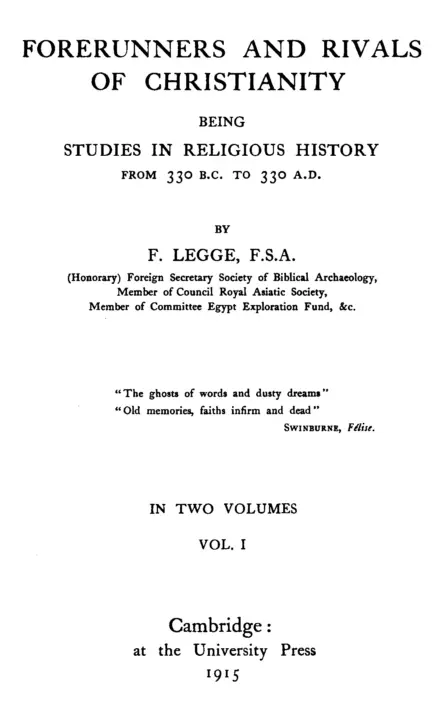
THE CLASSIC COLLECTION · 1915
"Forerunners and Rivals of Christianity: Being Studies in Religious History" by F. Legge is a scholarly historical account likely written in the early 20th century. The book explores documents crucial for understanding the origins and developments of Christianity, highlighting lesser-known religious movements and texts. Its focus is on the interplay between early Christianity and its contemporaries, including various Gnostic sects and Eastern religions. The opening of the work introduces the author's intent to compile and elucidate documents that, while previously translated, remain obscure and misunderstood in contemporary discourse. Legge expresses his desire to foster a clearer understanding of these religious fragments by providing context and commentary, which he believes will clarify their significance. He acknowledges the challenges presented by historical interpretations and notes his efforts to make these texts accessible to both scholars and the general public. Through his methodical approach, he aims to shed light on the diverse influences that shaped early Christianity.
Introduction adapted from the source catalogue; source summaries may be automatically generated.
Free to read · English · 99,528 words · No account needed
MAKE TIME FOR A GOOD BOOK
On by default. Untick to stop anonymous reading totals. Each page counts after 10 seconds in view. How this works.
Anonymous counting is on unless you have switched it off.
This idea is treated at length in “The Legend of Osiris” in the Proceedings of the Society of Biblical Archaeology, 1911, pp. 139-154. See also “The Greek Worship of Serapis and Isis,” P.S.B.A. 1914, pp. 79 sqq.
Footnote 122:
See “The Titles of the Thinite Kings” in P.S.B.A. 1908, pp. 86-94,
121-128, 163-177.
Footnote 123:
In Plutarch’s time the Ethiopians had a queen called Candace as in Acts viii. 27. Cf. Strabo, Bk XVII. c. 1, § 54. One wonders whether Plutarch in speaking of Aso did not confuse this title with an epithet of Thueris, the hippopotamus-goddess and wife of Set, who is called in a late magical text “Thueris, the great of sorcery, cat of Ethiopia.” See Griffith and Thompson, Stories of the High Priests of Memphis, Oxford, 1900, p. 91.
Footnote 124:
This is most clearly shown by M. Victor Loret in L’Égypte au Temps du Totémisme, Paris, 1906, passim. Cf. the same author’s articles in Rev. Égyptol. 1902 and 1904.
Footnote 125:
See Chapter IV, infra.
Footnote 126:
See “The Greek Worship of Serapis and Isis,” P.S.B.A. 1914, pp. 94-98, for this culture god of the Eastern Mediterranean. The original home of the myth was, possibly, Babylonia. Cf. “Legend of Osiris” in P.S.B.A. 1911, quoted above.
Footnote 127:
See the story of Ra and Isis, Budge, G.E. pp. 360 sqq.
Footnote 128:
By far the best and most consistent account of the Eleusinian Mysteries is that given by M. Paul Foucart in his three memoirs, Recherches sur l’origine et la nature des Mystères d’Éleusis, Les Grands Mystères d’Éleusis, and Le Culte de Dionysos en Attique. All these appeared in the Mémoires of the Académie des Inscriptions, tt. XXXV. (1895), XXXVII. (1900), and XXXVIII. (1904) respectively.
Footnote 129:
Foucart, Les Grands Mystères, p. 113.
Footnote 130:
Iacchos was identified with Dionysos at least as early as the time of Sophocles. Cf. Antigone, ll. 1130 sqq., and Dyer, The Gods in Greece, 1891, p. 133. Very likely, as M. Foucart suggests, he was originally the personification of the cry repeated by the procession of the initiated. See Grds. Myst. p. 122.
Footnote 131:
It had an opening in the roof for this purpose. Foucart, Grds. Myst.
p. 137.
Footnote 132:
So Clement of Alexandria, Protrepticus, c. II. The scene of the Rape is laid in many different places. The Homeric Hymn to Demeter calls it “the Mysian plain,” meaning probably Mysia in Asia Minor. A scholiast on Hesiod puts it in Sicily, Bacchylides in Crete, Orpheus in “the parts about Ocean,” Phanodemus in Attica, Demades in “woodland glades.” See Abel, Orphica, Fragm. 212, p. 239. Cf. Maury, Religions de la Grèce Antique, t. I. p. 479.
Footnote 133:
Homeric Hymn to Demeter.
Footnote 134:
Foucart, Myst. d’Él. p. 49; id. Grds. Myst. pp. 68, 69.
Your reading position is saved on this browser. Take it to another device with a library code. Reading pages adapt to text, rather than matching a printed edition.
BEHIND THE BOOK
This eBook is for the use of anyone anywhere in the United States and most other parts of the world at no cost and with almost no restrictions whatsoever. You may copy it, give it away or re-use it under the terms of the Project Gutenberg License included with this eBook or online at www.gutenberg.org. If you are not located in the United States, you will have to check the laws of the country where you are located before using this eBook. Read the source licence.
The original source file, including credits and licence, is retained by this library. Request an original-format copy at no charge. Please include the book title and Project Gutenberg identifier #71384.
KEEP YOUR CURIOSITY GOING
David Patterson (Spirit) Hatch

David Patterson (Spirit) Hatch

David Patterson (Spirit) Hatch
Cécile Tormay

Moritz Busch
John L. Ransom