
Last letters from the living dead man
David Patterson (Spirit) Hatch
THE CLASSIC COLLECTION · 1915
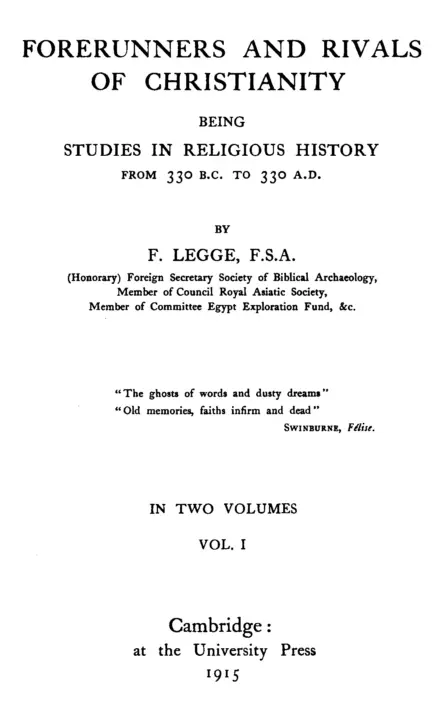
"Forerunners and Rivals of Christianity: Being Studies in Religious History" by F. Legge is a scholarly historical account likely written in the early 20th century. The book explores documents crucial for understanding the origins and developments of Christianity, highlighting lesser-known religious movements and texts. Its focus is on the interplay between early Christianity and its contemporaries, including various Gnostic sects and Eastern religions. The opening of the work introduces the author's intent to compile and elucidate documents that, while previously translated, remain obscure and misunderstood in contemporary discourse. Legge expresses his desire to foster a clearer understanding of these religious fragments by providing context and commentary, which he believes will clarify their significance. He acknowledges the challenges presented by historical interpretations and notes his efforts to make these texts accessible to both scholars and the general public. Through his methodical approach, he aims to shed light on the diverse influences that shaped early Christianity.
Introduction adapted from the source catalogue; source summaries may be automatically generated.
Free to read · English · 99,528 words · No account needed
MAKE TIME FOR A GOOD BOOK
On by default. Untick to stop anonymous reading totals. Each page counts after 10 seconds in view. How this works.
Anonymous counting is on unless you have switched it off.
Bouché-Leclercq, Histoire des Lagides, Paris, 1903, etc. t. I. p. 121. Dr Mahaffy, Empire of the Ptolemies, 1895, p. 11, thinks differently, but the importance of the city to the present day is against him.
Footnote 104:
Bouché-Leclercq, op. cit. t. I. p. 104. Cf. Mahaffy, E.P. p. 4.
Footnote 105:
Droysen, Hist. de l’Hellénisme, t. II. p. 96; Bouché-Leclercq, op. cit. t. I. pp. 13, 14; Mahaffy, E.P. p. 25.
Footnote 106:
As Demetrius the City-Taker, found to his cost. Cf. Mahaffy, E.P. p.
57.
Footnote 107:
Droysen, op. cit. I. p. 14; Bouché-Leclercq, op. cit. I. p. 15.
Footnote 108:
Droysen, op. cit. II. p. 103.
Footnote 109:
Bouché-Leclercq, Hist. des Lag. I. pp. 24, 25.
Footnote 110:
Ibid. I. p. 26.
Footnote 111:
Droysen, op. cit. I. pp. 346, 699, 670. Cf. D. G. Hogarth, Philip
and Alexander, p. 144.
Footnote 112:
As when they seized the throne of Egypt at the close of the XXth Dynasty. So in Nubia in the time of the Ptolemies, the king was a mere puppet in the hands of the priests, who used to send him word when they thought that he had reigned long enough. For the story of Ergamenes (Ark-amen), who put an end to their rule, see Diodorus Siculus, III. 6. 3, or Budge, History of Egypt, 1899, vol. VIII. pp. 166 sqq.
Footnote 113:
See Breasted, History of Egypt, New York, 1909, passim; cf. Budge,
op. cit.
Footnote 114:
Wiedemann, The Ancient Egyptian Doctrine of the Immortality of the Soul, 1895, p. viii; Maspero, Ét. Égyptol. I. pp. 123, 167; ibid. II. p. 196, n. 1.
Footnote 115:
Budge, Gods of the Egyptians, 1904, I. pp. 148, 149; Erman, Handbook of Egyptian Religion, 1906, p. 81.
Footnote 116:
Erman, op. cit. p. 188. The fusion of Osiris with Ptah and Seker was a good deal older than the Saites. Cf. Wiedemann, Religion of the Ancient Egyptians, 1897, pp. 134, 135; Budge, Osiris and the Egyptian Resurrection, New York, 1911, I. p. 45.
Footnote 117:
Budge, Gods of the Egyptians, II. p. 196.
Footnote 118:
Budge, G.E. II. pp. 118, 156, 264. So Naville, Journal of Egyptian Archaeology, 1914, pp. 7, 8. M. Maspero thinks Apuat was originally god of Siut and only a temple-companion of Osiris at Abydos, Rev. Critique, 1904, pt. 2, pp. 194, 195.
Footnote 119:
Steindorff, Religion of the Ancient Egyptians, New York, 1905, p. 53; Erman, H.E.R. pp. 56, 57; Naville, The Old Egyptian Faith, 1906, pp. 146, 147.
Footnote 120:
Amélineau, Essai sur le Gnosticisme Égyptien, Paris, 1887, p. 144; Budge, “Papyrus of Nesi-Amsu,” in Archaeologia, 1890, pt 2, p. 404; Maspero, The Dawn of Civilization, 1894, pp. 172-174; Erman, H.E.R. p. 32; Budge, G.E. II. p. 150. Manifest allusions to the legend are to be found in the Pyramid Texts. Cf. Maspero, Les Inscriptions des Pyramides de Saqqarah, Paris, 1894, pp. 105 sqq.
Footnote 121:
Your reading position is saved on this browser. Take it to another device with a library code. Reading pages adapt to text, rather than matching a printed edition.
BEHIND THE BOOK
This eBook is for the use of anyone anywhere in the United States and most other parts of the world at no cost and with almost no restrictions whatsoever. You may copy it, give it away or re-use it under the terms of the Project Gutenberg License included with this eBook or online at www.gutenberg.org. If you are not located in the United States, you will have to check the laws of the country where you are located before using this eBook. Read the source licence.
The original source file, including credits and licence, is retained by this library. Request an original-format copy at no charge. Please include the book title and Project Gutenberg identifier #71384.
KEEP YOUR CURIOSITY GOING
David Patterson (Spirit) Hatch

David Patterson (Spirit) Hatch

David Patterson (Spirit) Hatch
Cécile Tormay

Moritz Busch
John L. Ransom