
Last letters from the living dead man
David Patterson (Spirit) Hatch
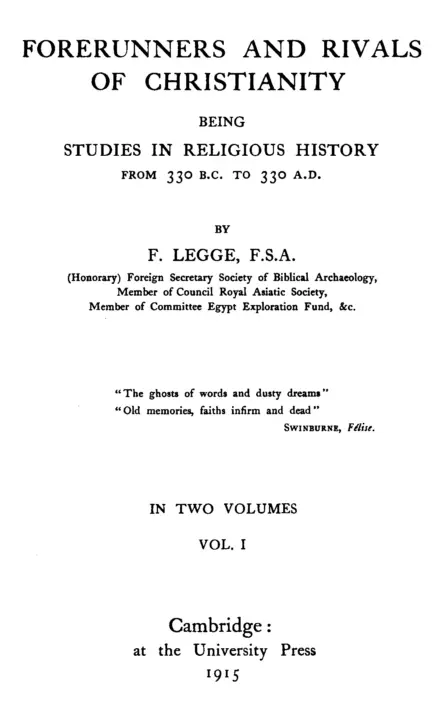
THE CLASSIC COLLECTION · 1915
"Forerunners and Rivals of Christianity: Being Studies in Religious History" by F. Legge is a scholarly historical account likely written in the early 20th century. The book explores documents crucial for understanding the origins and developments of Christianity, highlighting lesser-known religious movements and texts. Its focus is on the interplay between early Christianity and its contemporaries, including various Gnostic sects and Eastern religions. The opening of the work introduces the author's intent to compile and elucidate documents that, while previously translated, remain obscure and misunderstood in contemporary discourse. Legge expresses his desire to foster a clearer understanding of these religious fragments by providing context and commentary, which he believes will clarify their significance. He acknowledges the challenges presented by historical interpretations and notes his efforts to make these texts accessible to both scholars and the general public. Through his methodical approach, he aims to shed light on the diverse influences that shaped early Christianity.
Introduction adapted from the source catalogue; source summaries may be automatically generated.
Free to read · English · 99,528 words · No account needed
MAKE TIME FOR A GOOD BOOK
On by default. Untick to stop anonymous reading totals. Each page counts after 10 seconds in view. How this works.
Anonymous counting is on unless you have switched it off.
Thus Alexander’s coming gave an enormous impulse to that monarchical principle of government which from his time onward was to reign supreme for nearly two thousand years. Philosophers and sophists hastened to declare that democracy—as was indeed the fact—had proved itself incapable of governing, and that in the rule of one man was to be found the natural order of things and the only security for a well-ordered State[66]. Every one of the Diadochi or Successors of Alexander hurried in turn to assume the diadem, and Rome had no sooner contrived to crush her rival republic of Carthage than she too fell under the sway, first of dictators whose power was admittedly despotic, and then of emperors whose constitutional limitations were about the same as those of Alexander. That this was certain in time to react upon the universal conception of the Divine, followed directly from the law underlying religious phenomena which had been enunciated by Aristotle: but, before this could make way among the Greeks, thus suddenly promoted to the position of the ruling race, it was necessary that their own gods should be assimilated to those of their eastern fellow-subjects, or in other words, should be shown to be the same divinities under different names. Now, a movement with this object, even before Alexander’s coming, had been set on foot in Greece itself, and was in fact the natural outcome of the ideas as to the origin and governance of the universe brought there by the philosophers of Ionia[67]. It was all very well for the masses—then as now, much given to pragmatism or the reduction of every abstract idea to its most material and practical expression—to believe that the power of every god was limited to an area of so many square feet surrounding his image or sanctuary; but how could such a notion be held by philosophers who had sought out the causes of things, by travellers who had visited neighbouring countries in pursuit of knowledge, or by soldiers who had fought there, and had found it necessary to pay reverence to gods other than their own? It is said that in naturalistic religions like those of Greece, there is always a tendency to consider as identical divinities with the same or like characteristics—to consider for instance all gods with solar attributes as but different forms of the sun-god—and the Greeks of the fourth century B.C. had thus taken many foreign gods into their pantheon. It was, as Socrates found out to his cost, an offence to bring the worship of new gods into the city; but the difficulty was got over by the theory that the foreign divinity was only another form of some god already worshipped by the citizens[68], and by keeping his cult as private as possible. Later, when the popularity of the new deity seemed to be assured, an oracle of Delphi was generally secured authorizing the adoption of his worship under the name of his nearest Greek analogue, and in this way many foreign worships were brought into Athens itself[69]. Bendis, the moon-goddess of Thrace, had there from early times a temple or Bendideion[70], and the Syrian Adonis was publicly wailed for in the city when Alcibiades was setting out for Sicily[71]. This, too, was the more natural because the Greeks always acknowledged that their older divinities originally came to them from foreign parts. The myths in which the traditions of their origins were preserved gave Crete or Asia Minor as the birthplace of Zeus, an island in the Aegean as that of Apollo and Artemis, and the whole scene of the earthly trials of Demeter and Persephone was laid partly in Eleusis and partly in Asia[72]. As for Africa, Herodotus boldly asserts that the “names” of almost all the gods worshipped by the Greeks came from Egypt[73], and, although this is certainly not literally true, it gave him an excuse for identifying all the Egyptian deities of whom he had any knowledge with the Greek divinities whom he thought they resembled. But when Alexander’s conquests had made the different subject nations really acquainted with each other’s religion, the process of theocrasia or the fusion of one god with another received an impulse that carried it beyond all bounds[74]. The divinities of Asia Minor were naturally the first to be taken into the Greek pantheon, especially by the Athenians, always mindful of their Ionian kinship; and the many-breasted goddess of Ephesus, Cybele of Pessinus with her consort Atys or Attis, and the Sidonian Astarte, were all worshipped in Greece after identification with different Greek deities in the manner that had served to naturalize the “Thracian” or Thessalian Dionysos, and the (probably) Egyptian Hermes[75]. As we shall see later, the Phrygian Sabazius and the Cretan Zagreus had already preceded them in secret, and Persian, Jewish, and perhaps Indian gods were to follow. From Greece, the passion for theocrasia spread both eastward and westward. The Greek kings of Upper India found it necessary to identify on their monuments the gods of their native subjects with the divinities of Homer[76], and those of the Central Provinces and of Asia Minor did the same with such effect that it is almost impossible for us to distinguish their many Artemises, Aphrodites, and different forms of Zeus from the gods worshipped under similar names in ancient Greece[77]. As for the West, the Romans, even before they became the masters of the world, took over the Greek pantheon en bloc by the simple process of calling their own Italian deities by Greek names; and if we still speak of Zeus as Jupiter, Athena as Minerva, Ares as Mars, and Hermes as Mercury, it is by reason of the syncretism brought into fashion by Alexander’s conquests.
Your reading position is saved on this browser. Take it to another device with a library code. Reading pages adapt to text, rather than matching a printed edition.
BEHIND THE BOOK
This eBook is for the use of anyone anywhere in the United States and most other parts of the world at no cost and with almost no restrictions whatsoever. You may copy it, give it away or re-use it under the terms of the Project Gutenberg License included with this eBook or online at www.gutenberg.org. If you are not located in the United States, you will have to check the laws of the country where you are located before using this eBook. Read the source licence.
The original source file, including credits and licence, is retained by this library. Request an original-format copy at no charge. Please include the book title and Project Gutenberg identifier #71384.
KEEP YOUR CURIOSITY GOING
David Patterson (Spirit) Hatch

David Patterson (Spirit) Hatch

David Patterson (Spirit) Hatch
Cécile Tormay

Moritz Busch
John L. Ransom