
Last letters from the living dead man
David Patterson (Spirit) Hatch
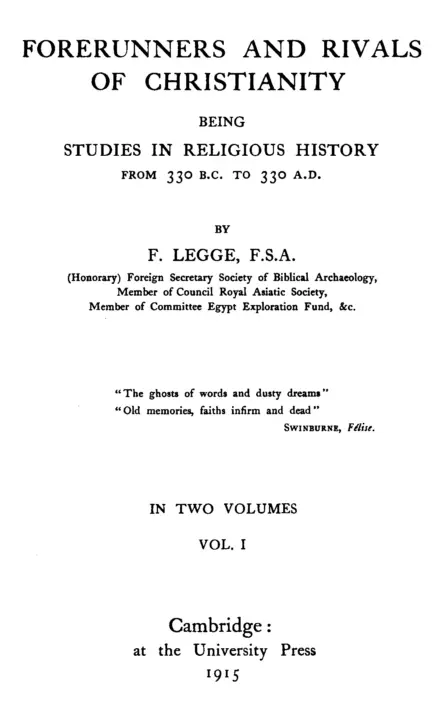
THE CLASSIC COLLECTION · 1915
"Forerunners and Rivals of Christianity: Being Studies in Religious History" by F. Legge is a scholarly historical account likely written in the early 20th century. The book explores documents crucial for understanding the origins and developments of Christianity, highlighting lesser-known religious movements and texts. Its focus is on the interplay between early Christianity and its contemporaries, including various Gnostic sects and Eastern religions. The opening of the work introduces the author's intent to compile and elucidate documents that, while previously translated, remain obscure and misunderstood in contemporary discourse. Legge expresses his desire to foster a clearer understanding of these religious fragments by providing context and commentary, which he believes will clarify their significance. He acknowledges the challenges presented by historical interpretations and notes his efforts to make these texts accessible to both scholars and the general public. Through his methodical approach, he aims to shed light on the diverse influences that shaped early Christianity.
Introduction adapted from the source catalogue; source summaries may be automatically generated.
Free to read · English · 99,528 words · No account needed
MAKE TIME FOR A GOOD BOOK
On by default. Untick to stop anonymous reading totals. Each page counts after 10 seconds in view. How this works.
Anonymous counting is on unless you have switched it off.
It is evident, therefore, that the great mass of Alexander’s subjects, whether Asiatics, Egyptians or Greeks, would require something more than the sublime theorizing of the philosophers before their religious ideas could be turned in the direction of monotheism. Nine hundred years before, Amenhotep IV of Egypt had indeed been led by his adoration of the material sun to put forward a religious reform which had as its principal feature the proclaiming abroad that there was only one God, in whose sight all mankind was equal; but the sole effect of this premature attempt to elevate the religion of his people was the loss of the external possessions of Egypt, and the posthumous branding of his own memory as that of a criminal. Possibly, too, the Hebrew Psalmists and Prophets had formed a like conception of the Deity when they asserted that among the gods there was none like unto Yahweh[59]; but that this idea seldom penetrated to their hearers is plain from their incessant denunciation of these last for “whoring after” other gods. The mere announcement of the unity of God had therefore in itself an insufficient attraction for the masses, and for the doctrine to be popular they had to be led to it by other ways than those of argument or authority. Now Aristotle noted with his usual shrewdness of observation that the form of religion in a state generally follows with fair closeness that of its temporal government[60], so that men will be more inclined to believe in what the Greeks called “monarchy,” or the active rule of One First Cause, if they live under a despot or absolute king than if they are members of a democracy. But when did the world either before or after his time see such a beneficent and godlike despot as Alexander? The robber-kings of Assyria had been accustomed to sweep across Western Asia leaving behind them, as they boasted in their inscriptions, a trail of vassal rulers impaled or flayed alive, of burnt cities, and of plundered peoples. The Persians, as has been said, had more idea of the rights of their inferiors, and did not regard their subject territories as mere fields for exploitation; but the life of sensual luxury into which their kings sooner or later subsided had its natural outcome in harem intrigues and assassinations which deprived the central power of a great part of its otherwise effective control over its satraps. But Alexander was in this, as in all other respects, the perfect type of the benevolent master who thinks more of his servants’ welfare than of his own personal gratification. Neither his mother Olympias, domineering and masterful as she was, nor his first mistress Barsine the widow of Memnon, nor his wife Roxana of whom he is said to have been enamoured, nor the Persian princess Statira to whom he gave his hand out of policy, could boast that they ever influenced by one hairsbreadth the direction of his sovereign will. As for his justice, the swift punishment that he measured out on his return from India to those of his officers whom he found guilty of oppression and malversation showed that under his far-seeing eye there would be none of those abuses of delegated power from which the satrapial system had suffered under his predecessors[61]. Modern historians have sometimes called him cruel; but in political matters severity is often the truest mercy, and the blood that he shed at Thebes and in Bactria probably saved a hundred times the number of lives which unchecked rebellion would have made it necessary to sacrifice; while the accidental and unpremeditated death of Clitus may well be pardoned to one who found not only his dignity as man but his royal authority wantonly outraged by a friend whom he had distinguished by exceptional marks of kindness. In every other respect his record is stainless. Although opposed at every step of his short career by orators and demagogues who saw in him the only obstacle to their unrestrained plunder of the fatherland, no legend has survived to his dishonour. On the contrary, all that we hear of him shows us for the first time in the world’s history a conqueror who was at the same time a just and wise ruler, merciful to his fallen foe, scorning even in war to take mean advantage[62], and chivalrous to the weak to a degree that his age could neither understand nor imitate[63]. And with all this, he united in his own person those superficial advantages which have always been quick to win for their possessor the devotion of the mob. To a talent for generalship which neither Hannibal, Caesar, nor any modern general has equalled, he joined a personal bravery which often reached the level of recklessness and was always to be found in the forefront of the hottest battle. Whether we see him charging at the head of the Companion cavalry in the three great battles with Darius, pursuing with a handful of his guard the routed Persian army after Arbela, or first over the wall at Mooltan, Alexander is always performing these feats of hardihood which in a leader strike more than anything the imagination of his soldiers. Add to this a generosity which made him willing to strip himself of his possessions to enrich his friends, a personal delight in that pomp and pageantry which forms the most direct road to the hearts of the proletariat, and a form, face and figure so distinguished that their one defect was for centuries after imitated by all who wished to be thought models of manly beauty[64], and we can no longer wonder that his contemporaries looked upon him as more than human. This wise and provident ruler of the world that he had conquered was at the same time a youth beautiful as Apollo, chivalrous as Bayard, clean as Galahad. Is it surprising that his name alone of all the conquerors of the East has endured through all changes of creed and culture, that the fierce chiefs of the Central Asian tableland still boast of him as their progenitor, and that the whole Mahommedan world still hold him the king of the believing Genii? No Caesar, Attila, or Genghiz Khan has ever thus impressed the imagination of future ages[65].
Your reading position is saved on this browser. Take it to another device with a library code. Reading pages adapt to text, rather than matching a printed edition.
BEHIND THE BOOK
This eBook is for the use of anyone anywhere in the United States and most other parts of the world at no cost and with almost no restrictions whatsoever. You may copy it, give it away or re-use it under the terms of the Project Gutenberg License included with this eBook or online at www.gutenberg.org. If you are not located in the United States, you will have to check the laws of the country where you are located before using this eBook. Read the source licence.
The original source file, including credits and licence, is retained by this library. Request an original-format copy at no charge. Please include the book title and Project Gutenberg identifier #71384.
KEEP YOUR CURIOSITY GOING
David Patterson (Spirit) Hatch

David Patterson (Spirit) Hatch

David Patterson (Spirit) Hatch
Cécile Tormay

Moritz Busch
John L. Ransom