
Last letters from the living dead man
David Patterson (Spirit) Hatch
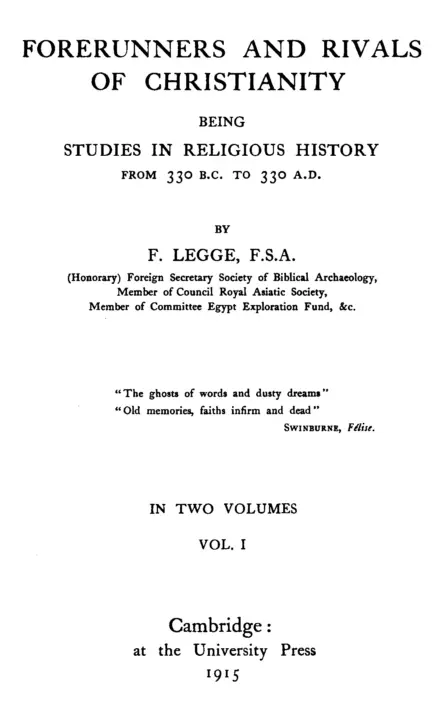
THE CLASSIC COLLECTION · 1915
"Forerunners and Rivals of Christianity: Being Studies in Religious History" by F. Legge is a scholarly historical account likely written in the early 20th century. The book explores documents crucial for understanding the origins and developments of Christianity, highlighting lesser-known religious movements and texts. Its focus is on the interplay between early Christianity and its contemporaries, including various Gnostic sects and Eastern religions. The opening of the work introduces the author's intent to compile and elucidate documents that, while previously translated, remain obscure and misunderstood in contemporary discourse. Legge expresses his desire to foster a clearer understanding of these religious fragments by providing context and commentary, which he believes will clarify their significance. He acknowledges the challenges presented by historical interpretations and notes his efforts to make these texts accessible to both scholars and the general public. Through his methodical approach, he aims to shed light on the diverse influences that shaped early Christianity.
Introduction adapted from the source catalogue; source summaries may be automatically generated.
Free to read · English · 99,528 words · No account needed
MAKE TIME FOR A GOOD BOOK
On by default. Untick to stop anonymous reading totals. Each page counts after 10 seconds in view. How this works.
Anonymous counting is on unless you have switched it off.
De Natura Deorum, c. XXVIII. The statement is put into the mouth of Balbus whose arguments Cicero declares to have in his opinion “the greater probability.” See also Athenagoras, Legatio, c. XXII. and Minucius Felix, c. XIX. With such interpretations or mythoplasms, Philo of Alexandria was familiar. Cf. F. C. Conybeare, Apology of Apollonius, 1894, p. 9.
Footnote 15:
Dill, Roman Society from Nero to Marcus Aurelius, 1904, p. 419.
Footnote 16:
De Iside et Osiride, c. XXV.
Footnote 17:
Hatch, Hibbert Lectures, p. 124.
Footnote 18:
Origen, contra Celsus, t. III. c. 44. Cf. Hatch, where last quoted.
Footnote 19:
Cf. Dill, Roman Society in the Last Century of the Western Empire, 1899, p. 38, n. 4. See also the edict of Constantine quoted in the concluding chapter, infra. The steps which led up to the policy are well summarized by Walter Johnson, Byways of British Archaeology, 1912, p. 25.
Footnote 20:
See Chap. VII infra.
Footnote 21:
See Chap. XIII infra.
Footnote 22:
Langlois, Collection des Historiens de l’Arménie, Paris, 1868, t. I.
p. 388.
Footnote 23:
The late Dr Salmon’s theory that writers like Hippolytus may have been taken in by a forger who made one document do duty for many different sects is given in Chap. VII infra, but the arguments in its favour are not conclusive.
Footnote 24:
See Chap. X infra.
Footnote 25:
Sir Gaston Maspero, “Sur l’Ennéade,” R.H.R. Jan.-Fev. 1892, p. 8, says that the Egyptians regarded Osiris as the First Man, and Jéquier repeats the statement in his Livre de ce qu’il y a dans l’Hadès, Paris, 1894, pp. 9-10. Yet there seems no evidence that the Egyptians ever knew him under that name.
Footnote 26:
De Is. et Os. c. XLVI.
Footnote 27:
See (Mdlle) D. Menant, “Parsis et Parsisme,” Conférences au Musée Guimet, 1904, and Prof. Williams-Jackson as there quoted. The same date is accepted with some hesitation by Prof. Hope Moulton in his Early Zoroastrianism (Hibbert Lectures), 1913, pp. 17 sqq.
Footnote 28:
See H. G. Jacobi, “The Antiquity of Vedic Culture,” Journal of the Royal Asiatic Society, 1909, pp. 720 sqq., where the texts relied upon are given and discussed. The correspondence which followed upon this paper (see J.R.A.S. 1909, 1910) is full of interest. Fossey, “Les Fouilles Allemandes à Boghaz-Keui,” Journal des Savans, July, 1909, p. 316, would make the date of the inscription about 1900 B.C.
Footnote 29:
Your reading position is saved on this browser. Take it to another device with a library code. Reading pages adapt to text, rather than matching a printed edition.
BEHIND THE BOOK
This eBook is for the use of anyone anywhere in the United States and most other parts of the world at no cost and with almost no restrictions whatsoever. You may copy it, give it away or re-use it under the terms of the Project Gutenberg License included with this eBook or online at www.gutenberg.org. If you are not located in the United States, you will have to check the laws of the country where you are located before using this eBook. Read the source licence.
The original source file, including credits and licence, is retained by this library. Request an original-format copy at no charge. Please include the book title and Project Gutenberg identifier #71384.
KEEP YOUR CURIOSITY GOING
David Patterson (Spirit) Hatch

David Patterson (Spirit) Hatch

David Patterson (Spirit) Hatch
Cécile Tormay

Moritz Busch
John L. Ransom