
Last letters from the living dead man
David Patterson (Spirit) Hatch
THE CLASSIC COLLECTION · 1915
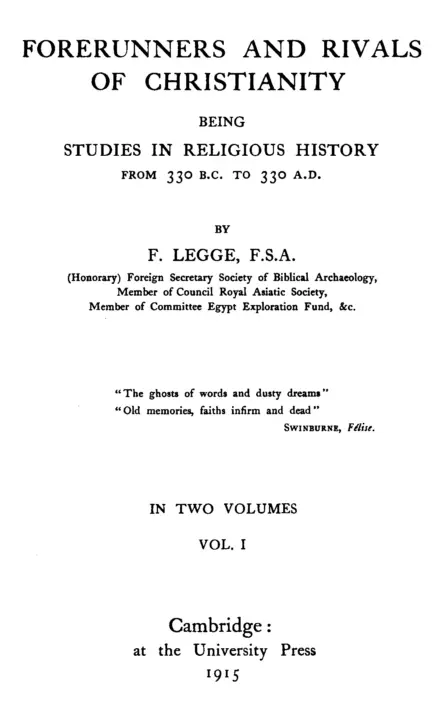
"Forerunners and Rivals of Christianity: Being Studies in Religious History" by F. Legge is a scholarly historical account likely written in the early 20th century. The book explores documents crucial for understanding the origins and developments of Christianity, highlighting lesser-known religious movements and texts. Its focus is on the interplay between early Christianity and its contemporaries, including various Gnostic sects and Eastern religions. The opening of the work introduces the author's intent to compile and elucidate documents that, while previously translated, remain obscure and misunderstood in contemporary discourse. Legge expresses his desire to foster a clearer understanding of these religious fragments by providing context and commentary, which he believes will clarify their significance. He acknowledges the challenges presented by historical interpretations and notes his efforts to make these texts accessible to both scholars and the general public. Through his methodical approach, he aims to shed light on the diverse influences that shaped early Christianity.
Introduction adapted from the source catalogue; source summaries may be automatically generated.
Free to read · English · 99,528 words · No account needed
MAKE TIME FOR A GOOD BOOK
On by default. Untick to stop anonymous reading totals. Each page counts after 10 seconds in view. How this works.
Anonymous counting is on unless you have switched it off.
For the pre-Christian centuries, the rise of ethical religions like that of the Greek Isis (see Chap. II infra) and of Mithras (see Chap. XII) is perhaps sufficient proof of this. For the post-Christian, see Tertullian’s remarks as to the interest excited among the heathens by problems like the origin of evil (de Praescript. c. VII.). As to their striving after morality, see Eugène de Faye, “Formation d’une Doctrine de Dieu au IIme Siècle,” Rev. Hist. Rel. t. LXIII. (Jan.-Fev. 1911) pp. 1, 2, for authorities. See, too, Hatch, Hibbert Lectures, 1890, pp. 291, 292 and Harnack as there quoted.
Footnote 2:
W. M. Ramsay, The Church in the Roman Empire, 1893, pp. 263, 264.
Footnote 3:
Tiele, in his Gifford Lectures delivered in 1895, remarks on the ridicule with which the learned Hellenists of his youth received the efforts of those whom they called the comparativi. See Elements of the Science of Religion, 1897, vol. I. p. 7.
Footnote 4:
No better proof can be given of the change in public opinion in such matters than the comparison of Gibbon’s words with regard to “the miraculous powers ascribed to the primitive Church” (Decline and Fall, Bury’s edition, vol. II. p. 2) and the way the subject is treated in the article “Wonders” in Cheyne’s Encyclopedia Biblica, 1903.
Footnote 5:
The definition is that of Ira W. Howerth, International Journal of
Ethics, 1903, p. 205.
Footnote 6:
See Tiele, op. cit. vol. I. pp. 5 sqq. The controversies raging round Darwin’s theory when first put forward are well summarized by F. W. Hutton in his Darwinism and Lamarckism, 1899, passim. Cf. Delage and Goldsmith, Les Thèoriesé de l’Évolution, Paris, 1909, pp. 28, 29.
Footnote 7:
See Hutton, op. cit. p. 111.
Footnote 8:
Tiele, op. cit. vol. I. p. 11.
Footnote 9:
F. B. Jevons, Introduction to the Study of Comparative Religion,
1908, p. 18.
Footnote 10:
Like the late Dean Stanley, who in his Lectures on the History of the Jewish Church, talked about the synagogue of the Jewish settlement in Rome under the first Emperors “fascinating the proud Roman nobles by the glimpse it gave of a better world” (vol. III. p. 410).
Footnote 11:
According to Josephus (Antiq. XVIII. i. 3, 4) they did not amount to more than 6000 men distributed throughout the whole of Palestine. Morrison thinks that “the Pharisaic party had no attraction for the great bulk of the population,” The Jews under Roman Rule 1890, p. 307.
Footnote 12:
See Chap. V infra.
Footnote 13:
See Neander, General Hist. of the Christian Religion and Church, Eng. ed. 1853, vol. I. p. 126.
Footnote 14:
Your reading position is saved on this browser. Take it to another device with a library code. Reading pages adapt to text, rather than matching a printed edition.
BEHIND THE BOOK
This eBook is for the use of anyone anywhere in the United States and most other parts of the world at no cost and with almost no restrictions whatsoever. You may copy it, give it away or re-use it under the terms of the Project Gutenberg License included with this eBook or online at www.gutenberg.org. If you are not located in the United States, you will have to check the laws of the country where you are located before using this eBook. Read the source licence.
The original source file, including credits and licence, is retained by this library. Request an original-format copy at no charge. Please include the book title and Project Gutenberg identifier #71384.
KEEP YOUR CURIOSITY GOING
David Patterson (Spirit) Hatch

David Patterson (Spirit) Hatch

David Patterson (Spirit) Hatch
Cécile Tormay

Moritz Busch
John L. Ransom