
The lost dirigible
Ralph Henry Barbour
THE CLASSIC COLLECTION · 1911
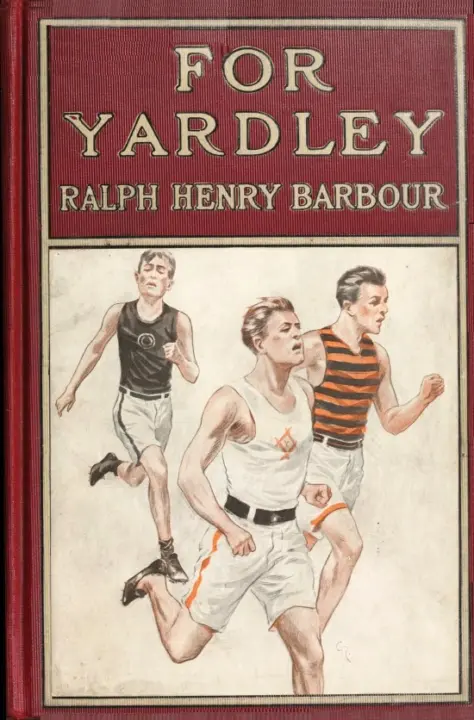
"For Yardley: A Story of Track and Field" by Ralph Henry Barbour is a novel written in the early 20th century. This fiction work focuses on the life and athletic challenges faced by students at Yardley Hall, specifically highlighting the dynamics of friendship, competition, and personal growth in the realm of track and field events. The main characters introduced include Alf Loring, a talented quarter-back and athlete, along with his friends Tom Dyer and Gerald Pennimore, who demonstrate a mix of ambition and camaraderie as they navigate their school experience. The opening of the narrative establishes a rainy and dreary Saturday at Yardley Hall, where Alf Loring is feeling particularly restless. He and his roommate Tom Dyer share playful banter about the weather and their studies while eagerly anticipating the start of the spring sports season. Thoughts of track tryouts bring young Gerald Pennimore into their conversation, illustrating his enthusiasm for joining the team. As the boys discuss their aspirations for track and field success, an underlying sense of competition and friendship emerges, setting the stage for the events that will unfold throughout their school year. This blend of light-hearted camaraderie and the seriousness of athletic commitment creates an engaging backdrop for the unfolding story.
Introduction adapted from the source catalogue; source summaries may be automatically generated.
Free to read · English · 59,953 words · No account needed
MAKE TIME FOR A GOOD BOOK
On by default. Untick to stop anonymous reading totals. Each page counts after 10 seconds in view. How this works.
Anonymous counting is on unless you have switched it off.
“It’s a peach of a night,” said Alf, approvingly, “but I hope Mr. Moon will take a sneak when we get to Broadwood.”
“Oh, the moon shines bright
On my old Kentucky home,”
sang Durfee, and the others joined in softly:
“On my old Kentucky home
So far away!”
They went on, singing, Alf setting a pace that if adhered to would cover the three miles to Broadwood in short time. Presently the old Cider Mill came into sight, a tumble-down two-story affair beyond whose empty casements the moonlight, entering through holes in the sagging roof, played strange pranks with the imagination. The old mill was popularly supposed to be haunted, and it quite lived up to its reputation so far as appearances were concerned. Weeds choked the doorways, and even grew from the rotting sills. Behind the mill lay the marsh, and a little stream that had once turned the stones murmured eerily as it wandered through the sluice.
“Why didn’t you find a more cheerful place to stow the things?” asked Dan as they drew up in front of the mill. “I’ll bet I saw a ghost in there then.”
“Bet you it’s full of them,” said Roeder with a shiver. “I wouldn’t go in there for a thousand dollars.”
“Don’t be an ass,” muttered Alf, crossly. “Nobody asked you to go in. I left the things just inside the door, and I’ll get them myself.”
“Well, hurry up, then,” said Tom.
Alf started through the waist-high growth of dead weeds, but paused before he had gone more than a dozen steps.
“I can’t carry them all,” he grumbled. “One of you fellows come and
help me.”
“Oh, go ahead,” laughed Dan, “don’t be scared.”
“I’m not scared,” replied Alf, indignantly. “But one of you chaps might help lug the stuff out.”
“Don’t all speak at once,” begged Harry Durfee. Joe Chambers responded to the call and followed Alf to the door. Presently they came back with two poles about seven feet long, each sharpened at one end, and a roll of cotton sheeting. Alf also carried a smaller bundle which, when opened, revealed two dozen sandwiches.
“Refreshments,” he announced. “Who wants a sandwich?”
Everybody did. Alf opened the package and laid it on a rock by the roadside, and they stood around and munched the sandwiches. Suddenly Tom said:
“Look up the road, Dan. Don’t you see something near the fence there?”
Dan looked and so did the others, and there was a moment’s silence.
Then,
“Sure,” said Roeder, “there’s something moving up there. Maybe it’s a
fox.”
Your reading position is saved on this browser. Take it to another device with a library code. Reading pages adapt to text, rather than matching a printed edition.
Ralph Henry Barbour
Ralph Henry Barbour

Ralph Henry Barbour

Ralph Henry Barbour
BEHIND THE BOOK
This eBook is for the use of anyone anywhere in the United States and most other parts of the world at no cost and with almost no restrictions whatsoever. You may copy it, give it away or re-use it under the terms of the Project Gutenberg License included with this eBook or online at www.gutenberg.org. If you are not located in the United States, you will have to check the laws of the country where you are located before using this eBook. Read the source licence.
The original source file, including credits and licence, is retained by this library. Request an original-format copy at no charge. Please include the book title and Project Gutenberg identifier #59043.
KEEP YOUR CURIOSITY GOING
Coulson Kernahan

Maurice Baring
Frances Wright
Cécile Tormay

Frederic Jesup Stimson

W. H. P. (William Henry Pope) Jarvis