
The lost dirigible
Ralph Henry Barbour
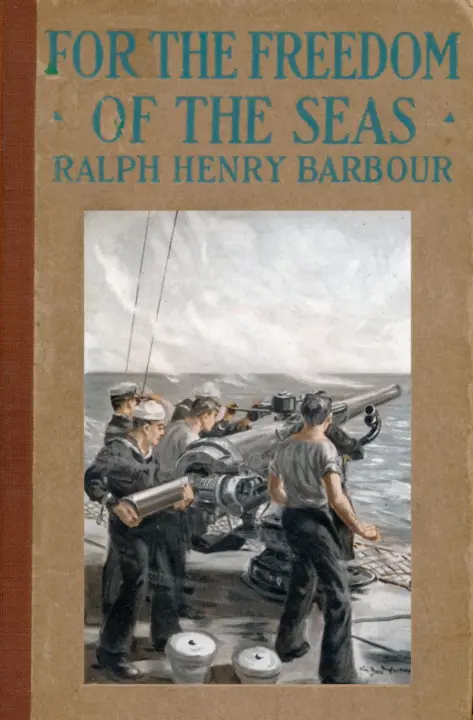
THE CLASSIC COLLECTION · 1918
"For the Freedom of the Seas" by Ralph Henry Barbour is a historical adventure novel written in the early 20th century. The story unfolds against the backdrop of World War I, exploring themes of heroism, loyalty, and the maritime experiences of its characters. The main character, Nelson Troy, embarks on a journey marked by his father's mysterious disappearance and his own determination to serve in the Navy. The opening of the narrative introduces the reader to the schooner "Jonas Clinton" and its crew, including Nelson, who is aboard as an apprentice. As they embark on a homeward voyage, the tension escalates when the ship is suddenly attacked by an unseen enemy, resulting in an explosion that leaves the vessel critically damaged. Amidst the chaos, Nelson panics about the fate of his father, Captain Troy, who goes missing during the ordeal. The gripping beginning sets the stage for an intense adventure where Nelson seeks to uncover the truth and fulfill his duty, entangled in a world of naval warfare.
Introduction adapted from the source catalogue; source summaries may be automatically generated.
Free to read · English · 62,186 words · No account needed
MAKE TIME FOR A GOOD BOOK
On by default. Untick to stop anonymous reading totals. Each page counts after 10 seconds in view. How this works.
Anonymous counting is on unless you have switched it off.
“Quite so, old dear, quite so! That was their mistake, wasn’t it? Took an American prisoner aboard, Troy, as a member of the crew. Funny thing, I say, but I heard months ago that they were having a hard time manning the subs. Well, he cooked their goose for them, what?”
“What are you talking about?” asked Nelson. “Do you mean that there was an American aboard that boat?”
“Just so! And he did something to their tanks――――”
“Broke the valves, probably,” corrected Martin. “Don’t see just how he could, either. Still, they say he did. If he had――――”
“You mean he fixed the boat so it couldn’t dive?”
“That’s the way we got it. One of your fellows was talking to a petty officer and he says this American――――”
“But how did an American come to be in the crew?”
“Oh, he was a prisoner and they needed men and just took him. Suppose they told him he’d have to do it or be shot. That’s about the way they’d put it, I fancy. I dare say he agreed in the hope that some time he’d either be able to escape or”――Tip shrugged his shoulders――“drown himself and the rest of them. That’s what I’d do if they put it to me like that.”
“An American!” exclaimed Nelson. “Did you see him?”
“Not close. They took him back to the Old Man. He’s there yet, I guess.” Martin looked back along the deck. “They’ve got the officers there, too. One of them――――”
“What is it, Troy?” cried Tip. “I say, you don’t think――――”
“I――I don’t know,” muttered Nelson, wide-eyed, tremulous.
Martin stared uncomprehendingly for an instant. Then: “By Jove!” he exclaimed awedly. “Nep, it couldn’t be, could it? Listen! This man’s tall and thin; looked sort of half-starved; grayish hair, I think――――”
“Gray?” faltered Nelson. Then he shook his head, and: “It probably isn’t,” he said. “Dad’s hair is brown, about like mine. I thought――maybe――――”
“Hold up!” cried Tip. “Anyone’s hair might be gray after a year in a German prison camp!”
“That’s so!” agreed Martin.
Nelson looked from one to the other anxiously. “Do you think――it could be?” he whispered.
“I wouldn’t hope too hard,” muttered Martin.
Nelson stared thoughtfully at his grimy hands and then over toward where the Antietam lay, the smoke lessening about her torn deck. Finally: “I guess I’ll go and――and make sure,” he murmured.
“Right-o!” said Tip cheerfully. “Like me to go along, old man?”
Your reading position is saved on this browser. Take it to another device with a library code. Reading pages adapt to text, rather than matching a printed edition.
Ralph Henry Barbour
Ralph Henry Barbour

Ralph Henry Barbour

Ralph Henry Barbour
BEHIND THE BOOK
This eBook is for the use of anyone anywhere in the United States and most other parts of the world at no cost and with almost no restrictions whatsoever. You may copy it, give it away or re-use it under the terms of the Project Gutenberg License included with this eBook or online at www.gutenberg.org. If you are not located in the United States, you will have to check the laws of the country where you are located before using this eBook. Read the source licence.
The original source file, including credits and licence, is retained by this library. Request an original-format copy at no charge. Please include the book title and Project Gutenberg identifier #70522.
KEEP YOUR CURIOSITY GOING
Wilfrid Scawen Blunt
Wilfrid Scawen Blunt

E. W. (Edgar Watson) Howe
Cécile Tormay

Moritz Busch
Coulson Kernahan