
The lost dirigible
Ralph Henry Barbour
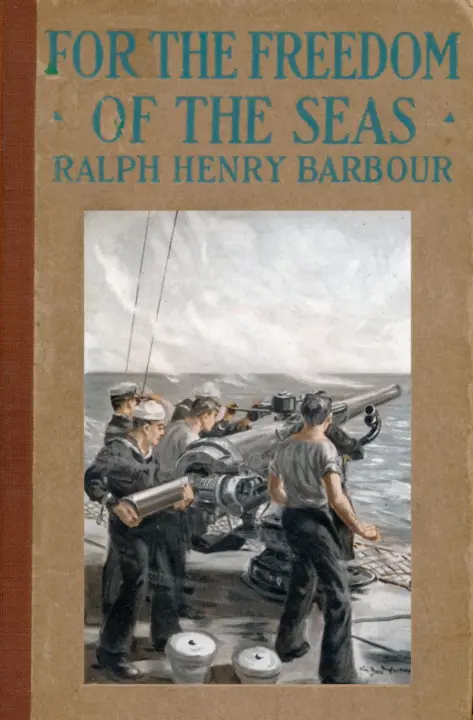
THE CLASSIC COLLECTION · 1918
"For the Freedom of the Seas" by Ralph Henry Barbour is a historical adventure novel written in the early 20th century. The story unfolds against the backdrop of World War I, exploring themes of heroism, loyalty, and the maritime experiences of its characters. The main character, Nelson Troy, embarks on a journey marked by his father's mysterious disappearance and his own determination to serve in the Navy. The opening of the narrative introduces the reader to the schooner "Jonas Clinton" and its crew, including Nelson, who is aboard as an apprentice. As they embark on a homeward voyage, the tension escalates when the ship is suddenly attacked by an unseen enemy, resulting in an explosion that leaves the vessel critically damaged. Amidst the chaos, Nelson panics about the fate of his father, Captain Troy, who goes missing during the ordeal. The gripping beginning sets the stage for an intense adventure where Nelson seeks to uncover the truth and fulfill his duty, entangled in a world of naval warfare.
Introduction adapted from the source catalogue; source summaries may be automatically generated.
Free to read · English · 62,186 words · No account needed
MAKE TIME FOR A GOOD BOOK
On by default. Untick to stop anonymous reading totals. Each page counts after 10 seconds in view. How this works.
Anonymous counting is on unless you have switched it off.
Nelson was watching the disembarkation of the prisoners after breakfast when an orderly tapped him on the arm. “Report to the Exec, Troy,” he said.
“What? Where is he?”
“Where would he be? Sitting on the for’ard funnel warming his feet, of course. Get a move on!”
Nelson didn’t find the Executive Officer where the orderly said, perhaps because he didn’t look for him there. Instead, he went aft and paused before a door opening from the wardroom passage, brushing an imaginary speck from his overshirt and adjusting a gauze bandage which, running diagonally across his forehead above his right eye, gave him a somewhat reckless look. Then, the door being open, he saluted and: “Ordered to report to you, sir,” he announced.
“Come in. What’s the name?”
“Troy, sir.”
“Right.” The lieutenant-commander swung about in his swivel chair and scrutinized Nelson swiftly. “You are trainer of Number Four gun crew?”
“Yes, sir.”
“You are mentioned in the Gunnery Officer’s report, Troy. Tell me what happened yesterday morning on your station.”
“The enemy got a five-inch shell into us, sir, about thirty feet forward of Number Four gun. The explosion killed two of our crew, Hoskins and Maynard, and wounded our division officer and four men.”
“I see. Your gun captain was wounded, too, wasn’t he?”
“Yes, sir, but he’s doing finely.”
“After that shell came aboard you were minus six of your number then: plugman, pointer, two shellmen――――”
“Sight setter, sir, and one powderman.”
“What happened then?”
Nelson hesitated. “The injured were removed, sir――――”
“The gun was not damaged?”
“Firing circuit was broken, but we got that repaired pretty quick.”
“I see.” The Executive Officer glanced at a paper that lay on the deck beside him. “And after making repairs you and others continued to serve the gun until the end of the engagement?”
“Yes, sir.”
“Who took command?”
“I did, sir. I seemed to be――I thought it was up to me, sir.”
“How many were with you?”
“Three, sir, until they got word that we were short-handed. Then they sent us four more men.”
“How long were you short-handed, Troy?”
“I don’t know, sir. About twenty minutes, maybe.”
“Make any hits during that time?”
“Yes, sir, we didn’t miss many. We were firing pretty slow, though, because Scott, one of the powdermen, who took the plug, didn’t understand it at first. And we had no shellman.”
“What did you do?”
“I pointed, sir, and Jennings trained; and we all helped at loading.”
“You were hurt, too?”
“Not much, sir. A bit of shell cut my head a little.”
Your reading position is saved on this browser. Take it to another device with a library code. Reading pages adapt to text, rather than matching a printed edition.
Ralph Henry Barbour
Ralph Henry Barbour

Ralph Henry Barbour

Ralph Henry Barbour
BEHIND THE BOOK
This eBook is for the use of anyone anywhere in the United States and most other parts of the world at no cost and with almost no restrictions whatsoever. You may copy it, give it away or re-use it under the terms of the Project Gutenberg License included with this eBook or online at www.gutenberg.org. If you are not located in the United States, you will have to check the laws of the country where you are located before using this eBook. Read the source licence.
The original source file, including credits and licence, is retained by this library. Request an original-format copy at no charge. Please include the book title and Project Gutenberg identifier #70522.
KEEP YOUR CURIOSITY GOING
Wilfrid Scawen Blunt
Wilfrid Scawen Blunt

E. W. (Edgar Watson) Howe
Cécile Tormay

Moritz Busch
Coulson Kernahan