THE CLASSIC COLLECTION✦My diaries, being a personal narrative of events 1888-1914, Part 2 (1900-1914)CLASSIC FREE BOOKS
My diaries, being a personal narrative of events 1888-1914, Part 2 (1900-1914)
Wilfrid Scawen Blunt
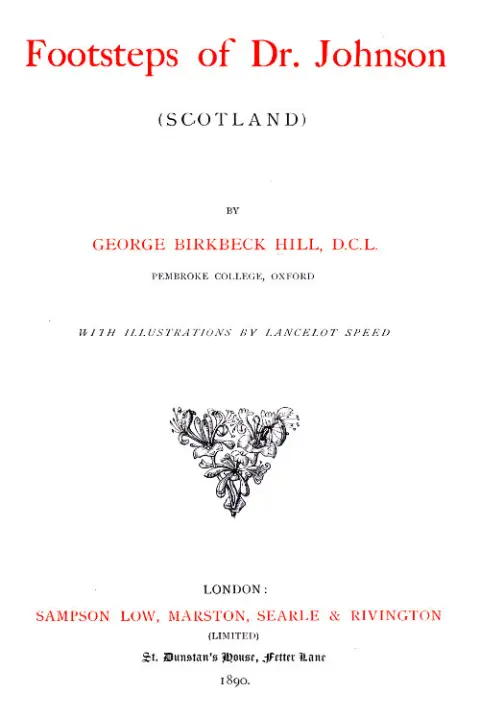
THE CLASSIC COLLECTION · 1890
"Footsteps of Dr. Johnson (Scotland)" by George Birkbeck Hill is a historical account written in the late 19th century. The work focuses on the journey of Dr. Samuel Johnson through Scotland, detailing the various places he visited and the cultural nuances he observed during his travels. The author aims to bring to light the Scotland that Johnson experienced, emphasizing the social customs and traditions rather than the scenic beauty of the landscape. At the start of the book, the author explains his motivation for writing, sparked by his desire to document the sites associated with Johnson's travels as described in his letters and travel journals. Hill notes the existence of multiple accounts of Johnson's journey, including those by Boswell, and expresses his intention to weave these narratives into a cohesive account that honors the daily life and customs of the people Johnson encountered. The opening also hints at the fondness Johnson had for anecdotes and the rich traditions surrounding his legacy in Scotland, establishing a groundwork for exploring both Johnson's perspectives and the landscape he traversed.
Introduction adapted from the source catalogue; source summaries may be automatically generated.
Free to read · English · 123,782 words · No account needed
MAKE TIME FOR A GOOD BOOK
On by default. Untick to stop anonymous reading totals. Each page counts after 10 seconds in view. How this works.
Anonymous counting is on unless you have switched it off.
[517] Wesley’s Journal, iii. 461.
[518] Pennant’s Tour, i. 121.
[519] Early Letters of J. W. Carlyle, p. 45.
[520] A Journey through Part of England, &c., p. 134.
[521] Wesley’s Journal, iii. 461. The lessons were Numbers xxiii., xxiv., and Matthew i. In these chapters Balak and begat come over and over again.
[522] Chambers’s History of the Rebellion of 1745 (ed. 1827), ii. 339.
[523] Scotland and Scotsmen in the Eighteenth Century, i. 525-8.
[524] Arnot’s History of Edinburgh, p. 227.
[525] G. M. Berkeley’s Poems, p. dxxxviii.
[526] Scots Magazine for 1788, pp. 250, 357.
[527] Dunbar’s Social Life in Former Days, i. 10.
[528] A Scotch merk was about thirteen pence of English money.
[529] Dunbar’s Social Life in Former Days, i. 7.
[530] Forbes’s Life of Beattie, p. 160.
[531] Northcote’s Life of Reynolds (ed. 1819), i. 300.
[532] Johnson’s Works, viii. 479.
[533] In 1786 the post despatched from Aberdeen on Monday reached London on Saturday. Travellers could reach Edinburgh in a day and a half by the Aberdeen and Edinburgh Fly, which set out from the New Inn at four o’clock in the morning, and arrived at Edinburgh next day to dinner; fare, £2 2s. Scottish Notes and Queries, i. 31.
[534] Piozzi Letters, i. 387.
[535] Ray’s History of the Rebellion, p. 310.
[536] Lockhart’s Life of Scott, iv. 186.
[537] Bound up with them were some interesting and unpublished autograph letters and documents connected with many generations of the earls of Errol. It is greatly to be desired that the present earl, to whose courtesy I am much indebted, would have them edited.
[538] Chambers’s History of the Rebellion, ed. 1869, p. 309.
[539] Forbes’s Life of Beattie, Appendix D. At the time of the rebellion of 1745 the Errol title was held by a woman.
[540] Walpole’s Letters, iii. 438.
[541] Forbes’s Life of Beattie, Appendix D.
[542] Walpole’s Letters, ii. 38.
[543] Bouilloire. According to Dr. Murray the word is connected with “the Swedish buller, a noise, roar. But,” he adds, “the influence of boil is manifest.” I remember when I visited the place in my youth I heard it also called Lord Errol’s Punch-bowl. The tale was told that a former earl had made a seizure in it of a smuggling ship laden with spirits, and had had the kegs emptied into the water.
[544] Lockhart’s Life of Scott, iv. 188.
[545] Dun Buy means the Yellow Rock. It gets its name, it is said, from the colour given to it by the dung of the sea-birds.
[546] James Ray’s History of the Rebellion of 1745, p. 311.
[547] Wesley’s Journal, iii. 182.
Your reading position is saved on this browser. Take it to another device with a library code. Reading pages adapt to text, rather than matching a printed edition.
BEHIND THE BOOK
This eBook is for the use of anyone anywhere in the United States and most other parts of the world at no cost and with almost no restrictions whatsoever. You may copy it, give it away or re-use it under the terms of the Project Gutenberg License included with this eBook or online at www.gutenberg.org. If you are not located in the United States, you will have to check the laws of the country where you are located before using this eBook. Read the source licence.
The original source file, including credits and licence, is retained by this library. Request an original-format copy at no charge. Please include the book title and Project Gutenberg identifier #57715.
KEEP YOUR CURIOSITY GOING
Wilfrid Scawen Blunt
Wilfrid Scawen Blunt

E. W. (Edgar Watson) Howe
Cécile Tormay

Moritz Busch
John L. Ransom