THE CLASSIC COLLECTION✦My diaries, being a personal narrative of events 1888-1914, Part 2 (1900-1914)CLASSIC FREE BOOKS
My diaries, being a personal narrative of events 1888-1914, Part 2 (1900-1914)
Wilfrid Scawen Blunt
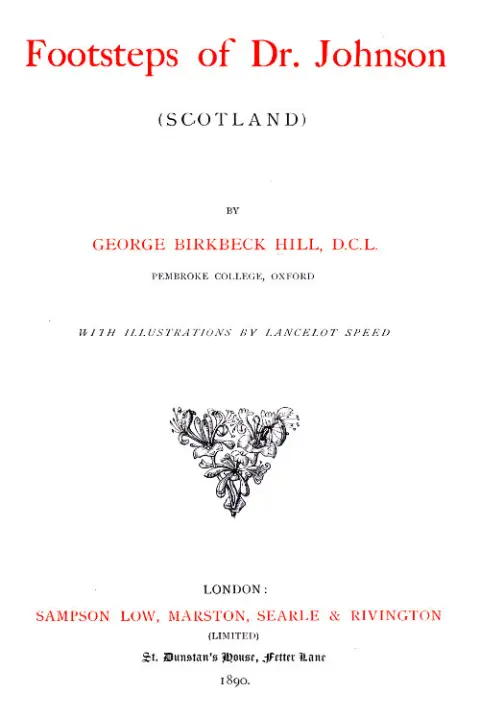
THE CLASSIC COLLECTION · 1890
"Footsteps of Dr. Johnson (Scotland)" by George Birkbeck Hill is a historical account written in the late 19th century. The work focuses on the journey of Dr. Samuel Johnson through Scotland, detailing the various places he visited and the cultural nuances he observed during his travels. The author aims to bring to light the Scotland that Johnson experienced, emphasizing the social customs and traditions rather than the scenic beauty of the landscape. At the start of the book, the author explains his motivation for writing, sparked by his desire to document the sites associated with Johnson's travels as described in his letters and travel journals. Hill notes the existence of multiple accounts of Johnson's journey, including those by Boswell, and expresses his intention to weave these narratives into a cohesive account that honors the daily life and customs of the people Johnson encountered. The opening also hints at the fondness Johnson had for anecdotes and the rich traditions surrounding his legacy in Scotland, establishing a groundwork for exploring both Johnson's perspectives and the landscape he traversed.
Introduction adapted from the source catalogue; source summaries may be automatically generated.
Free to read · English · 123,782 words · No account needed
MAKE TIME FOR A GOOD BOOK
On by default. Untick to stop anonymous reading totals. Each page counts after 10 seconds in view. How this works.
Anonymous counting is on unless you have switched it off.
[479] Berkeley and his friend, the young Laird of Kincaldrum, raised “a very noble subscription” for the poor lad.
[480] G. M. Berkeley’s Poems, p. cccxlviii.
[481] “On my observing to Dr. Johnson that some of the modern libraries of the university were more commodious and pleasant for study (than the library of Trinity College), as being more spacious and airy, he replied, ‘Sir, if a man has a mind to prance, he must study at Christ Church and All Souls.’” Boswell’s Johnson, ii. 67, n. 2.
[482] Scotland and Scotsmen in the Eighteenth Century, i. 269, 547. The youngster was Jerome Stone, the author of a poem called Albin and the Daughter of Mey, mentioned by Boswell in his Life of Johnson, v. 171.
[483] It was probably a sycamore, for, as was pointed out by a writer in the Gentleman’s Magazine for 1837, p. 343, what the Scotch call sycamores we call planes.
[484] The other tree, according to Sir Walter Scott, was probably the Prior Letham plane, measuring about twenty feet round. It stood in a cold exposed situation apart from every other tree. Croker’s Boswell, p. 286.
[485] G. M. Berkeley’s Poems, p. ccxii.
[486] This piece of information I owe to the kindness of Mr. J. Maitland Anderson, the Librarian of the University.
[487] In G. M. Berkeley’s Poems, p. lvi, a story is told of some people who were at St. Andrews for only one night, and who, rather than miss the ruins, saw them “by the light of an old horn lantern.”
[488] Written in 1889.
[489] Boswell’s Johnson, iii. 405.
[490] Paterson’s Itinerary, ii. 567, 581.
[491] Or Aberbrothock, as it is called in Southey’s Ballad of the Inchcape Bell. The name is now written Arbroath, in accordance with the pronunciation.
[492] Wesley’s Journal, iii. 397.
[493] Defoe’s Tour, p. 179.
[494] James Ray’s History of the Rebellion, p. 288.
[495] Scots Magazine, 1772, p. 25.
[496] Pennant’s Tour, ii. 278.
[497] Chalmers’s Life of Ruddiman, p. 24.
[498] This information I owe to the kindness of my friend Mr. Arthur
Galton.
[499] Ancient Metaphysics, iv. 45.
[500] Ib. p. 48.
[501] Ib. p. 55.
[502] Hannah More’s Memoirs, i. 252.
[503] Ancient Metaphysics, vi. 212.
[504] Origin of Language, v. 274.
[505] Scots Magazine, 1799, pp. 729-731.
[506] Ancient Metaphysics, v. 307.
[507] Croker’s Boswell, p. 288.
[508] This anecdote I had from Lord Monboddo’s great grandson, Captain Burnett, of Monboddo House, to whose courtesy I am much indebted.
[509] “In Scotland judges on the circuit are obliged to stay five nights at every town where they open their commission.” Howard’s State of Prisons, ed. 1777, p. 103.
[510] Scots Magazine, Oct. 1773, 556.
[511] F. Douglas’s General Description of the East Coast of Scotland,
p. 91.
[512] F. Douglas’s General Description, &c., p. 89.
[513] G. M. Berkeley’s Poems, p. cclxxiv.
[514] Vol. ii. p. 99.
[515] Gentleman’s Magazine, 1766, p. 210.
[516] Cox’s Recollections of Oxford (ed. 1868), p. 156.
Your reading position is saved on this browser. Take it to another device with a library code. Reading pages adapt to text, rather than matching a printed edition.
BEHIND THE BOOK
This eBook is for the use of anyone anywhere in the United States and most other parts of the world at no cost and with almost no restrictions whatsoever. You may copy it, give it away or re-use it under the terms of the Project Gutenberg License included with this eBook or online at www.gutenberg.org. If you are not located in the United States, you will have to check the laws of the country where you are located before using this eBook. Read the source licence.
The original source file, including credits and licence, is retained by this library. Request an original-format copy at no charge. Please include the book title and Project Gutenberg identifier #57715.
KEEP YOUR CURIOSITY GOING
Wilfrid Scawen Blunt
Wilfrid Scawen Blunt

E. W. (Edgar Watson) Howe
Cécile Tormay

Moritz Busch
John L. Ransom