THE CLASSIC COLLECTION✦Principles and practice of agricultural analysis. Volume 3 (of 3), Agricultural productsCLASSIC FREE BOOKS
Principles and practice of agricultural analysis. Volume 3 (of 3), Agricultural products
Harvey Washington Wiley
THE CLASSIC COLLECTION · 1907
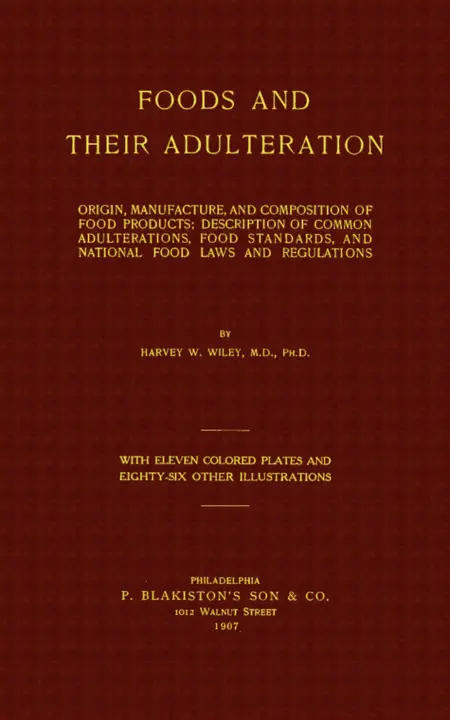
"Foods and Their Adulteration" by Harvey Washington Wiley is a scientific publication written in the early 20th century. This comprehensive work investigates the origin, manufacture, and composition of food products, while highlighting common adulterations, food standards, and national food laws and regulations. It aims to educate consumers and manufacturers alike on the integrity and safety of food, creating awareness about the potential hazards of adulterated food products. The opening of the book lays the groundwork for its intended purpose, emphasizing the significance of understanding food composition and the prevalence of misleading claims regarding food quality. It outlines the structure of the manual, which will cover various food types, including meats, dairy, and beverages, and describes the importance of scientific knowledge in ensuring food safety and purity. Additionally, Wiley addresses the consumer's right to know about the food they consume, including its preparation and any potential health implications stemming from adulteration.
Introduction adapted from the source catalogue; source summaries may be automatically generated.
Free to read · English · 274,959 words · No account needed
MAKE TIME FOR A GOOD BOOK
On by default. Untick to stop anonymous reading totals. Each page counts after 10 seconds in view. How this works.
Anonymous counting is on unless you have switched it off.
(b) A general guaranty be filed with the Secretary of Agriculture by the manufacturer or dealer and be given a serial number, which number shall appear on each and every package of goods sold under such guaranty with the words, “Guaranteed under the food and drugs act, June 30, 1906.”
(c) The following form of guaranty is suggested:
I (we) the undersigned do hereby guarantee that the articles of foods or drugs manufactured, packed, distributed, or sold by me (us) [specifying the same as fully as possible] are not adulterated or misbranded within the meaning of the food and drugs act, June 30, 1906.
(Signed in ink.)
[Name and place of business of wholesaler, dealer, manufacturer,
jobber, or other parties.]
(d) If the guaranty be not filed with the Secretary of Agriculture as above, it should identify and be attached to the bill of sale, invoice, bill of lading, or other schedule giving the names and quantities of the articles sold.
(Section 7.)
(a) Mineral substances of all kinds (except as provided in Regulation 15) are specifically forbidden in confectionery whether they be poisonous or not.
(b) Only harmless colors or flavors shall be added to confectionery.
(c) The term “narcotic drugs” includes all the drugs mentioned in section 8, food and drugs act, June 30, 1906, relating to foods, their derivatives and preparations, and all other drugs of a narcotic nature.
(Section 7, under “Foods.”)
No substance may be mixed or packed with a food product which will reduce or lower its quality or strength. Not excluded under this provision are substances properly used in the preparation of food products for clarification or refining, and eliminated in the further process of manufacture.
(Section 7, under “Foods.”)
(a) Only harmless colors may be used in food products.
(b) The reduction of a substance to a powder to conceal inferiority in character is prohibited.
(c) The term “powdered” means the application of any powdered substance to the exterior portion of articles of food, or the reduction of a substance to a powder.
(d) The term “coated” means the application of any substance to the exterior portion of a food product.
(e) The term “stain” includes any change produced by the addition of any substance to the exterior portion of foods which in any way alters their natural tint.
(Section 7, paragraph 5, under “Foods.”)
Any food product which contains naturally a poisonous or deleterious ingredient does not come within the provisions of the food and drugs act, June 30, 1906, except when the presence of such ingredient is due to filth, putrescence, or decomposition.
Your reading position is saved on this browser. Take it to another device with a library code. Reading pages adapt to text, rather than matching a printed edition.
Harvey Washington Wiley
Harvey Washington Wiley
Harvey Washington Wiley
BEHIND THE BOOK
This eBook is for the use of anyone anywhere in the United States and most other parts of the world at no cost and with almost no restrictions whatsoever. You may copy it, give it away or re-use it under the terms of the Project Gutenberg License included with this eBook or online at www.gutenberg.org. If you are not located in the United States, you will have to check the laws of the country where you are located before using this eBook. Read the source licence.
The original source file, including credits and licence, is retained by this library. Request an original-format copy at no charge. Please include the book title and Project Gutenberg identifier #66164.
KEEP YOUR CURIOSITY GOING

John Muir

Asa Gray
Asa Gray

Florence Nightingale
Elizabeth Robins Pennell
Denison Olmsted