THE CLASSIC COLLECTION✦Principles and practice of agricultural analysis. Volume 3 (of 3), Agricultural productsCLASSIC FREE BOOKS
Principles and practice of agricultural analysis. Volume 3 (of 3), Agricultural products
Harvey Washington Wiley
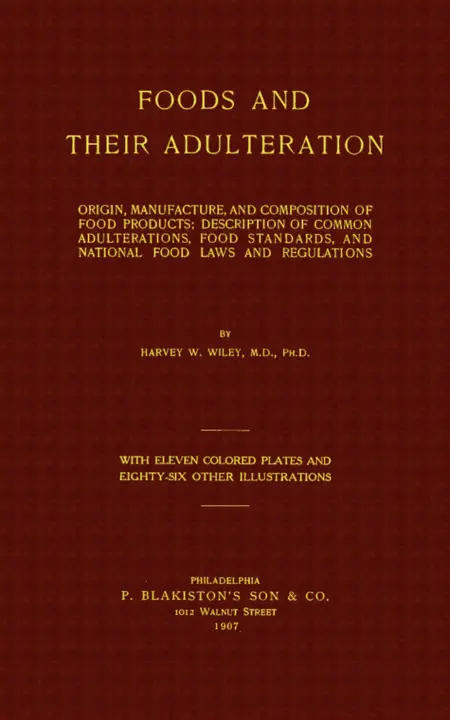
THE CLASSIC COLLECTION · 1907
"Foods and Their Adulteration" by Harvey Washington Wiley is a scientific publication written in the early 20th century. This comprehensive work investigates the origin, manufacture, and composition of food products, while highlighting common adulterations, food standards, and national food laws and regulations. It aims to educate consumers and manufacturers alike on the integrity and safety of food, creating awareness about the potential hazards of adulterated food products. The opening of the book lays the groundwork for its intended purpose, emphasizing the significance of understanding food composition and the prevalence of misleading claims regarding food quality. It outlines the structure of the manual, which will cover various food types, including meats, dairy, and beverages, and describes the importance of scientific knowledge in ensuring food safety and purity. Additionally, Wiley addresses the consumer's right to know about the food they consume, including its preparation and any potential health implications stemming from adulteration.
Introduction adapted from the source catalogue; source summaries may be automatically generated.
Free to read · English · 274,959 words · No account needed
MAKE TIME FOR A GOOD BOOK
On by default. Untick to stop anonymous reading totals. Each page counts after 10 seconds in view. How this works.
Anonymous counting is on unless you have switched it off.
8. Oatmeal is meal made from hulled oats and contains not more than twelve (12) percent of moisture, not more than one and five-tenths (1.5) percent of crude fiber, not less than two and twenty-four hundredths (2.24) percent of nitrogen, and not more than two and two-tenths (2.2) percent of ash.
9. Rye flour is the fine, clean, sound product made by bolting rye meal and contains not more than thirteen and one-half (13.5) percent of moisture, not less than one and thirty-six hundredths (1.36) percent of nitrogen, and not more than one and twenty-five hundredths (1.25) percent of ash.
10. Buckwheat flour is bolted buckwheat meal and contains not more than twelve (12) percent of moisture, not less than one and twenty-eight hundredths (1.28) percent of nitrogen, and not more than one and seventy-five hundredths (1.75) percent of ash.
a. FRUIT AND FRUIT PRODUCTS.
(Except fruit juices, fresh, sweet, and fermented, and vinegars.)
1. Fruits are the clean, sound, edible, fleshy fructifications of plants, distinguished by their sweet, acid, and ethereal flavors.
2. Dried fruit[39] is the clean, sound product made by drying mature, properly prepared, fresh fruit in such a way as to take up no harmful substance, and conforms in name to the fruit used in its preparation; sun-dried fruit is dried fruit made by drying without the use of artificial means; evaporated fruit is dried fruit made by drying with the use of artificial means.
[39] The subject of sulfurous acid in dried fruits is reserved for consideration in connection with the schedule “Preservatives and Coloring Matters.”
3. Evaporated apples are evaporated fruit made from peeled and cored apples, and contain not more than twenty-seven (27) percent of moisture determined by the usual commercial method of drying for four (4) hours at the temperature of boiling water.
(Standards for other dried fruits are in preparation.)
4. Canned fruit is the sound product made by sterilizing clean, sound, properly matured and prepared fresh fruit, by heating, with or without sugar (sucrose) and spices, and keeping in suitable, clean, hermetically sealed containers and conforms in name to the fruit used in its preparation.
5. Preserve[40] is the sound product made from clean, sound, properly matured and prepared fresh fruit and sugar (sucrose) sirup, with or without spices or vinegar, and conforms in name to that of the fruit used, and in its preparation not less than forty-five (45) pounds of fruit are used to each fifty-five (55) pounds of sugar.
6. Honey preserve[40] is preserve in which honey is used in place of
sugar (sucrose) sirup.
7. Glucose preserve[40] is preserve in which a glucose product is used in place of sugar (sucrose) sirup.
Your reading position is saved on this browser. Take it to another device with a library code. Reading pages adapt to text, rather than matching a printed edition.
Harvey Washington Wiley
Harvey Washington Wiley
Harvey Washington Wiley
BEHIND THE BOOK
This eBook is for the use of anyone anywhere in the United States and most other parts of the world at no cost and with almost no restrictions whatsoever. You may copy it, give it away or re-use it under the terms of the Project Gutenberg License included with this eBook or online at www.gutenberg.org. If you are not located in the United States, you will have to check the laws of the country where you are located before using this eBook. Read the source licence.
The original source file, including credits and licence, is retained by this library. Request an original-format copy at no charge. Please include the book title and Project Gutenberg identifier #66164.
KEEP YOUR CURIOSITY GOING

John Muir

Asa Gray
Asa Gray

Florence Nightingale
Elizabeth Robins Pennell
Denison Olmsted