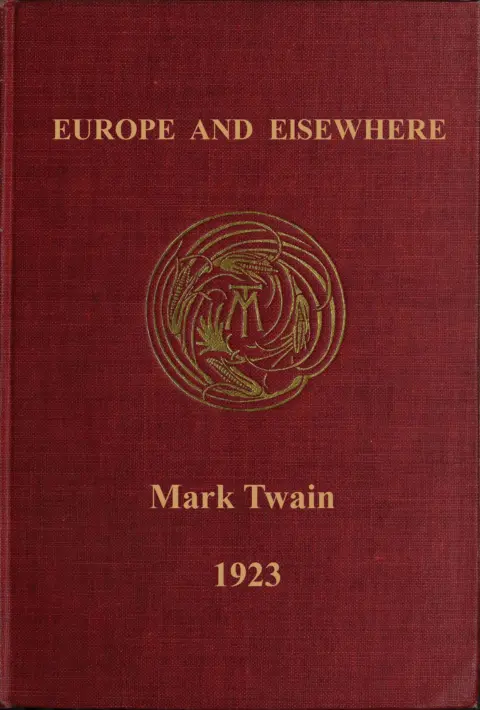
Europe and elsewhere
Mark Twain

THE CLASSIC COLLECTION · 1897
"Following the Equator: A Journey Around the World" by Mark Twain is a travelogue published in 1897. Facing bankruptcy after a failed business investment, the sixty-year-old Twain embarked on a lecture tour across the British Empire to escape $100,000 in debt. This non-fiction work chronicles his journey, blending perceptive observations about cultures, politics, religion, and customs with characteristic social commentary and satire. Notably, Twain weaves fictional stories into this otherwise factual account of his global adventure.
Introduction adapted from the source catalogue; source summaries may be automatically generated.
Free to read · English · 188,986 words · No account needed
MAKE TIME FOR A GOOD BOOK
On by default. Untick to stop anonymous reading totals. Each page counts after 10 seconds in view. How this works.
Anonymous counting is on unless you have switched it off.
“Ah, there it is, you see! You are going in the 5 o'clock by Castlemaine—twelve miles—instead of the 7.15 by Ballarat—in order to save two hours of fooling along the road. Now then, don't interrupt—let me have the floor. You're going to save the government a deal of hauling, but that's nothing; your ticket is by Ballarat, and it isn't good over that twelve miles, and so——”
“But why should the government care which way I go?”
“Goodness knows! Ask of the winds that far away with fragments strewed the sea, as the boy that stood on the burning deck used to say. The government chooses to do its railway business in its own way, and it doesn't know as much about it as the French. In the beginning they tried idiots; then they imported the French—which was going backwards, you see; now it runs the roads itself—which is going backwards again, you see. Why, do you know, in order to curry favor with the voters, the government puts down a road wherever anybody wants it—anybody that owns two sheep and a dog; and by consequence we've got, in the colony of Victoria, 800 railway stations, and the business done at eighty of them doesn't foot up twenty shillings a week.”
“Five dollars? Oh, come!”
“It's true. It's the absolute truth.”
“Why, there are three or four men on wages at every station.”
“I know it. And the station-business doesn't pay for the sheep-dip to sanctify their coffee with. It's just as I say. And accommodating? Why, if you shake a rag the train will stop in the midst of the wilderness to pick you up. All that kind of politics costs, you see. And then, besides, any town that has a good many votes and wants a fine station, gets it. Don't you overlook that Maryborough station, if you take an interest in governmental curiosities. Why, you can put the whole population of Maryborough into it, and give them a sofa apiece, and have room for more. You haven't fifteen stations in America that are as big, and you probably haven't five that are half as fine. Why, it's perfectly elegant. And the clock! Everybody will show you the clock. There isn't a station in Europe that's got such a clock. It doesn't strike—and that's one mercy. It hasn't any bell; and as you'll have cause to remember, if you keep your reason, all Australia is simply bedamned with bells. On every quarter-hour, night and day, they jingle a tiresome chime of half a dozen notes—all the clocks in town at once, all the clocks in Australasia at once, and all the very same notes; first, downward scale: mi, re, do, sol—then upward scale: sol, si, re, do—down again: mi, re, do, sol—up again: sol, si, re, do—then the clock—say at midnight clang—clang—clang—clang—clang—clang—clang—clang—clang —clang—clang—clang——and, by that time you're—hello, what's all this excitement about? Oh I see—a runaway—scared by the train; why, you wouldn't think this train could scare anything. Well, of course, when they build and run eighty stations at a loss and a lot of palace-stations and clocks like Maryborough's at another loss, the government has got to economize somewhere hasn't it? Very well look at the rolling stock. That's where they save the money. Why, that train from Maryborough will consist of eighteen freight-cars and two passenger-kennels; cheap, poor, shabby, slovenly; no drinking water, no sanitary arrangements, every imaginable inconvenience; and slow?—oh, the gait of cold molasses; no air-brake, no springs, and they'll jolt your head off every time they start or stop. That's where they make their little economies, you see. They spend tons of money to house you palatially while you wait fifteen minutes for a train, then degrade you to six hours' convict-transportation to get the foolish outlay back. What a rational man really needs is discomfort while he's waiting, then his journey in a nice train would be a grateful change. But no, that would be common sense—and out of place in a government. And then, besides, they save in that other little detail, you know—repudiate their own tickets, and collect a poor little illegitimate extra shilling out of you for that twelve miles, and——”
Your reading position is saved on this browser. Take it to another device with a library code. Reading pages adapt to text, rather than matching a printed edition.
BEHIND THE BOOK
This eBook is for the use of anyone anywhere in the United States and most other parts of the world at no cost and with almost no restrictions whatsoever. You may copy it, give it away or re-use it under the terms of the Project Gutenberg License included with this eBook or online at www.gutenberg.org. If you are not located in the United States, you will have to check the laws of the country where you are located before using this eBook. Read the source licence.
The original source file, including credits and licence, is retained by this library. Request an original-format copy at no charge. Please include the book title and Project Gutenberg identifier #2895.
KEEP YOUR CURIOSITY GOING
Wilfrid Scawen Blunt
Wilfrid Scawen Blunt

E. W. (Edgar Watson) Howe
Francis Greenleaf Allinson & Anne C. E. (Anne Crosby Emery) Allinson
Cyrenus Cole

John Martineau