
The lost dirigible
Ralph Henry Barbour
THE CLASSIC COLLECTION · 1924
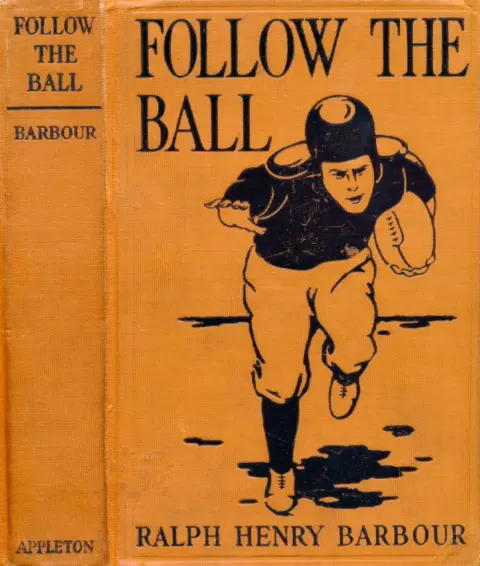
"Follow the Ball" by Ralph Henry Barbour is a sports-themed novel likely written in the early 20th century. The story revolves around the life of Joe Kenton, a talented baseball player at Holman's School, as he navigates the complexities of friendships, rivalries, and the significance of teamwork. The book explores themes of loyalty, personal sacrifice, and the passion for sports through the lens of adolescent experiences. The opening of the book introduces Joe Kenton, who is reflecting on his past school year and his relationship with his roommate Hal Norwin. As the school year approaches its end, Joe grapples with missed opportunities for academic achievements and social connections, particularly with Hal, with whom he shares a strained friendship. A pivotal moment occurs when Hal sneaks into their dormitory and is caught by the proctor, and Joe heroically takes the blame to protect Hal's chance to play in an important upcoming baseball game. This act of sacrifice sets the stage for the evolving dynamics between the characters and foreshadows the challenges they will face both on and off the field.
Introduction adapted from the source catalogue; source summaries may be automatically generated.
Free to read · English · 57,928 words · No account needed
MAKE TIME FOR A GOOD BOOK
On by default. Untick to stop anonymous reading totals. Each page counts after 10 seconds in view. How this works.
Anonymous counting is on unless you have switched it off.
“Hello!”
“Babe” Linder, the big catcher of the Holman’s School nine, turned in the operation of pulling on his huge mitt and observed the speaker with mild interest. “Hello, son,” he returned gravely. “Is it natural or did science achieve that brilliant result?”
“What yer mean?” asked the other, earnest and anxious.
“Your hair, son. How did you get it that way?”
“It’s always been red,” answered the smaller youth, unoffended, but dropping his steady gaze a moment while he dug in the dirt in front of the bench with one scuffed shoe.
“You can’t beat Nature, can you?” sighed Babe.
The boy looked doubtful, but after a moment of hesitation gave a nod of agreement. Three or four other members of the team came around the corner of the stand, followed by the coach, Gus Cousins, and, subsequently, by Cicero Brutus Robinson, pushing a wheelbarrow containing base sacks, bat bag, protector, mask and the daily paraphernalia of practice. Cicero, who was extremely black, very squat and interestingly bandy-legged, deposited his vehicle at the end of the bench and, wiping his glittering ebony forehead with the sleeve of a faded blue shirt, lifted the base sacks from the wheelbarrow and ambled leisurely away with them. A smallish, attenuated boy who had entered on Cicero’s heels, dragged the bat bag forth and unstrapped it. More players arrived, accompanied by a studious looking senior in street attire who clutched a large score-book in one hand and a box of balls in the other. Babe Linder gave greetings to the newcomers and, thudding the big mitten approvingly, even affectionately, moved along the bench. Unnoted by him, the red-haired youth kept close beside him. Babe selected a discolored baseball from among the dozen in the bottom of a fiber bucket and――
“Say!”
Babe looked down. “Son,” he asked gently, “do I owe you money, or what?”
“No, sir.” Two deep blue eyes looked appealingly up from a tanned and freckled face. “Say, do you want a bat boy?”
“A bat boy? No. I couldn’t use one.”
“I mean the team, sir.”
“Oh! Why, we’ve got one, son. That’s he over there.”
“Yeah, I seen him.” There was much contempt in the boy’s tone. “He ain’t no good, sir.”
“Eh? Well, confidentially, I agree with you, but there he is, what?” Dave Cochran, dean of the pitching staff, joined them and Babe addressed him gravely. “This young gentleman, Davy, seeks a position on the team.”
Dave studied the boy smilingly. “Well, we sure do need a catcher,” he said. “Can you catch, kid?”
Your reading position is saved on this browser. Take it to another device with a library code. Reading pages adapt to text, rather than matching a printed edition.
Ralph Henry Barbour
Ralph Henry Barbour

Ralph Henry Barbour

Ralph Henry Barbour
BEHIND THE BOOK
This eBook is for the use of anyone anywhere in the United States and most other parts of the world at no cost and with almost no restrictions whatsoever. You may copy it, give it away or re-use it under the terms of the Project Gutenberg License included with this eBook or online at www.gutenberg.org. If you are not located in the United States, you will have to check the laws of the country where you are located before using this eBook. Read the source licence.
The original source file, including credits and licence, is retained by this library. Request an original-format copy at no charge. Please include the book title and Project Gutenberg identifier #60540.
KEEP YOUR CURIOSITY GOING
Coulson Kernahan

Maurice Baring
Frances Wright
Cécile Tormay

Frederic Jesup Stimson

W. H. P. (William Henry Pope) Jarvis