THE CLASSIC COLLECTION✦An outlaw’s diary: the CommuneCLASSIC FREE BOOKS
An outlaw’s diary: the Commune
Cécile Tormay
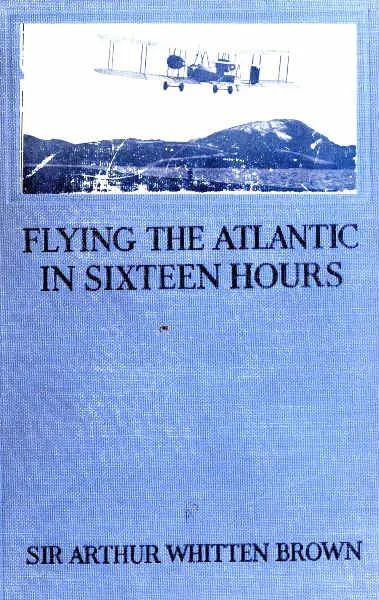
THE CLASSIC COLLECTION · 1920
"Flying the Atlantic in Sixteen Hours" by Sir Arthur Whitten Brown is a historical account written in the early 20th century. The narrative revolves around the momentous event of the first non-stop transatlantic flight, undertaken by Brown and his pilot, Sir John Alcock, in a Vickers-Vimy bomber. This remarkable achievement not only exemplifies the ingenuity and bravery of early aviators but also marks a pivotal moment in the development of aviation. The opening of the work introduces readers to Brown's reflections on the historical significance of their flight and pays tribute to the pioneers of aviation who came before them. Brown shares his humble thoughts on being a part of such a historic event while recounting the preparation and excitement leading up to the flight. We learn about his background, his partnership with Alcock, and the challenges they faced in getting their aircraft ready for the journey. The narrative is filled with anticipation and a sense of adventure as they prepare to set out on an unprecedented endeavor that will change the landscape of air travel forever.
Introduction adapted from the source catalogue; source summaries may be automatically generated.
Free to read · English · 33,701 words · No account needed
MAKE TIME FOR A GOOD BOOK
On by default. Untick to stop anonymous reading totals. Each page counts after 10 seconds in view. How this works.
Anonymous counting is on unless you have switched it off.
Cost Chargeable per Crossing: Taking the total number of crossings per year as 200 (London-New York)-- Proportion of annual charges per crossing $25,000 Petrol per trip, 30 tons at $125 per ton. 3,750 Oil per trip, 2 tons at $200 per ton 400 Hydrogen used, 750,000 cu. ft. at $2.50 per 1,000 cu. ft. 1,875 Cost of food per trip for crew of 19 and 100 passengers 2,000 -------- Total charge per crossing (London-New York) $33,025
The weight available for passengers and mails on each airship of the type projected would be fifteen tons. This permits the carrying of one hundred and forty passengers and effects, or ten tons of mails and fifty passengers. To cover the working costs and interest, passengers would have to be charged $240 per head and mails $2,025 per ton for the voyage London-New York.
This charge for passengers is already less than that for the more expensive berths on transatlantic liners. Without a doubt, with the coming of cheaper fuel, lower insurance rates and larger airships, it will be reduced eventually to the cheapest rate for first-class passages on sea liners.
With a fleet of four airships, a service of two trips each way per week is easily possible. For aëroplanes with a total load of forty tons the weight available for passengers and mails is 2.1 tons. If such a craft were to carry the same weekly load as the service of airships--thirty tons each way--it would be necessary to have fourteen machines continually in commission. Allowing for one hundred per cent. spare craft as standby for repairs and overhaul, twenty-eight aëroplanes would be required. The approximate cost of such a service is:
Capital Charges: 28 aëroplanes at $600,000 each $16,750,000 28 aëroplane sheds at $50,000 each 1,400,000 Land for 4 aërodromes 500,000 Workshops and equipments 100,000 Spare parts, etc. 500,000 Wireless equipment 50,000 ----------- Total capital required $19,300,000 Annual charge at 10% interest $1,930,000
Depreciation and Insurance:
Aëroplanes.
Useful life, say 3 years, as for airships.
Obsolete value, say, $30,000 per
machine. Average total depreciation
per annum for 28 machines $5,250,000
Aëroplane Sheds.
Total annual charge 60,000
Workshops and Plant.
Depreciation at 3% per annum 3,000
Total annual charge for depreciation 5,314,000
Total annual insurance charges on machinery
and plant 1,152,000
Annual Establishment Expenses: Salaries of 36 pilots at $3,000 per annum $108,000 Salaries of 36 engineers at $2,000 per annum 72,000 Salaries of 12 stewards at $1,500 per annum 18,000 Salaries of establishment-- Management and staff 25,000 Workshop hands and storekeepers, etc., 100 off 100,000 -------- Total annual establishment expenses $323,000
Repairs and Maintenance: Sheds and plant, annual charge, say $25,000 Repairs and overhaul to machines 50,000 -------- Total. $75,000 ---------- Total annual charges on above basis $8,792,500
Cost chargeable per crossing: Proportion of annual charges per crossing $7,250 Petrol used per trip, 28 tons at $125 per ton 3,500 Oil per trip, 2 tons at $200 per ton 400 Cost of food per trip for 29 passengers and crew of seven 500 ------- $11,650
Your reading position is saved on this browser. Take it to another device with a library code. Reading pages adapt to text, rather than matching a printed edition.
BEHIND THE BOOK
This eBook is for the use of anyone anywhere in the United States and most other parts of the world at no cost and with almost no restrictions whatsoever. You may copy it, give it away or re-use it under the terms of the Project Gutenberg License included with this eBook or online at www.gutenberg.org. If you are not located in the United States, you will have to check the laws of the country where you are located before using this eBook. Read the source licence.
The original source file, including credits and licence, is retained by this library. Request an original-format copy at no charge. Please include the book title and Project Gutenberg identifier #47129.
KEEP YOUR CURIOSITY GOING
Cécile Tormay

Moritz Busch
John L. Ransom
Frances Wright
Cécile Tormay

Mabel Potter Daggett