THE CLASSIC COLLECTION✦An outlaw’s diary: the CommuneCLASSIC FREE BOOKS
An outlaw’s diary: the Commune
Cécile Tormay
THE CLASSIC COLLECTION · 1920
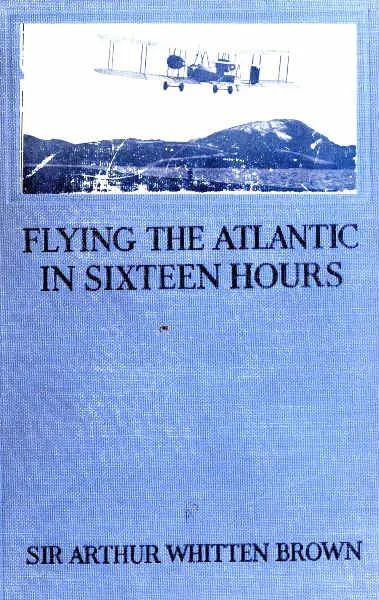
"Flying the Atlantic in Sixteen Hours" by Sir Arthur Whitten Brown is a historical account written in the early 20th century. The narrative revolves around the momentous event of the first non-stop transatlantic flight, undertaken by Brown and his pilot, Sir John Alcock, in a Vickers-Vimy bomber. This remarkable achievement not only exemplifies the ingenuity and bravery of early aviators but also marks a pivotal moment in the development of aviation. The opening of the work introduces readers to Brown's reflections on the historical significance of their flight and pays tribute to the pioneers of aviation who came before them. Brown shares his humble thoughts on being a part of such a historic event while recounting the preparation and excitement leading up to the flight. We learn about his background, his partnership with Alcock, and the challenges they faced in getting their aircraft ready for the journey. The narrative is filled with anticipation and a sense of adventure as they prepare to set out on an unprecedented endeavor that will change the landscape of air travel forever.
Introduction adapted from the source catalogue; source summaries may be automatically generated.
Free to read · English · 33,701 words · No account needed
MAKE TIME FOR A GOOD BOOK
On by default. Untick to stop anonymous reading totals. Each page counts after 10 seconds in view. How this works.
Anonymous counting is on unless you have switched it off.
As regards comparative speed the heavy type of aëroplane necessary to carry an economical load for long distances would not be capable of much more than eighty-five to ninety miles an hour. The difference between this and the present airship speed of sixty miles an hour would be reduced by the fact that an aëroplane must land at intermediate stations for fuel replenishment. Any slight advantage in speed that such heavier-than-air craft possess will disappear with the future production of larger types of dirigible, capable of cruising speeds varying from seventy-five to ninety miles an hour. For the airship service London-New York direct, the approximate time under normal conditions should be fifty hours. For the aëroplane service London-Ireland-Newfoundland-New York the time would be at least forty-six hours.
Perhaps the most convincing argument in favor of airships as against aëroplanes for trans-ocean aviation is that of comparative cost. All air estimates under present conditions must be very approximate; but I put faith in the carefully prepared calculations of experts of my acquaintance. These go to show that, with the equipment likely to be available during the next few years, a regular and effective air service between London and New York will need (again emphasizing the factor of approximation) the following capital and rates:
Aëroplane
Airship Service[1] Service[2]
Capital required $13,000,000 $19,300,000
Passenger rate:
London-New York $240 $575
Rate per passenger:
Mile 8 cents 18 cents
Mails per ounce:
London-New York 6-1/4 cents 15-1/2 cents
These figures for an airship service are based on detailed calculations, of which the more important are:
Capital Charges: Four airships of 3,500,000 cu. ft. capacity, at $2,000,000 each $8,000,000 Two double airship sheds at $1,500,000 each 3,000,000 Land for two sheds and aërodromes at $150,000 each 300,000 Workshops, gas plants, and equipment 750,000 Working capital, including spare parts, stores, etc. 850,000 Wireless equipment 50,000 Miscellaneous accessories 50,000 ----------- Total capital required $13,000,000 ----------- Annual charge, interest at 10% $1,300,000
Depreciation and Insurance:
Airships.
Useful life, about 3 years.
Obsolete value, about $100,000 per ship.
Total depreciation per ship, $1,900,000 in three years.
Average total depreciation per annum for four ships
for 3 years, $2,535,000.
Airship sheds. Total annual charge $90,000 Workshops and plant. Depreciation at 5% per annum 17,500 Total annual charge for depreciation 2,650,000 Total annual insurance charges on airships and plant 617,500
Annual Establishment Expenses: Salaries of Officers and Crews-- 4 airship commanders $20,000 8 airship officers 30,000 Total number crew hands (64) 80,000 $130,000 ------------------ $130,000 Salaries of Establishment-- Management and Staff $25,000 Workshop hands, storekeepers, etc. (50 at each shed--total 100) 100,000 $125,000 ------------------ Total annual establishment expenses $255,000
Repairs and Maintenance:
Sheds and plant, annual charge, say, $25,000
Repairs and overhaul of airships 100,000 Total charge $125,000 ---------- Total annual charges on above basis $4,947,500 Say $5,000,000
Your reading position is saved on this browser. Take it to another device with a library code. Reading pages adapt to text, rather than matching a printed edition.
BEHIND THE BOOK
This eBook is for the use of anyone anywhere in the United States and most other parts of the world at no cost and with almost no restrictions whatsoever. You may copy it, give it away or re-use it under the terms of the Project Gutenberg License included with this eBook or online at www.gutenberg.org. If you are not located in the United States, you will have to check the laws of the country where you are located before using this eBook. Read the source licence.
The original source file, including credits and licence, is retained by this library. Request an original-format copy at no charge. Please include the book title and Project Gutenberg identifier #47129.
KEEP YOUR CURIOSITY GOING
Cécile Tormay

Moritz Busch
John L. Ransom
Frances Wright
Cécile Tormay

Mabel Potter Daggett