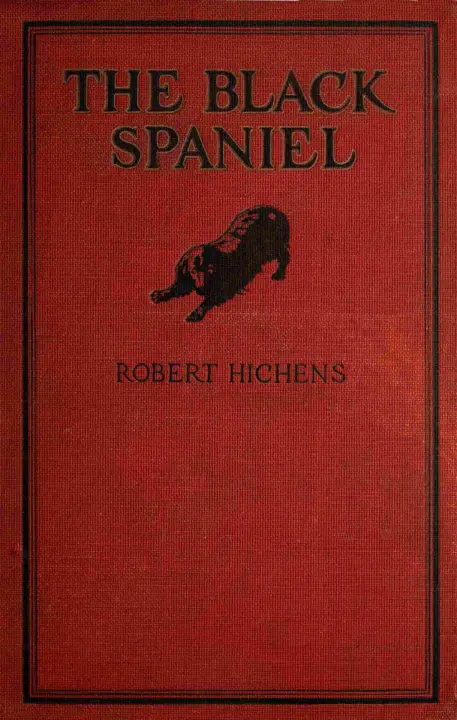
The black spaniel, and other stories
Robert Hichens
THE CLASSIC COLLECTION · 1897
"Flames" by Robert Hichens is a novel written in the late 19th century. The story revolves around Valentine Cresswell, a young man who grapples with the concept of virtue and desire. Set against the backdrop of modern London, Valentine is portrayed as almost saintly in his refinement, preferring intellectual pleasures over physical ones, and is often puzzled by the desires of his contemporaries. The narrative explores themes of existential longing, temptation, and the juxtaposition of good and evil through Valentine and his friend Julian Addison. The opening of the book introduces us to Valentine Cresswell, who is characterized by his asceticism and detachment from common vices. As he reflects on why he lacks the desires that seem to govern the lives of others, he expresses a sense of isolation in his pureness, feeling like a "saint" in modern society. His friendship with Julian Addison, who embodies the opposite temperament, sets the stage for deep conversations about morality, temptation, and the human experience. The two friends engage in an experiment to exchange souls, leading to a pursuit of greater understanding of each other's contrasting natures. This initial setup establishes the philosophical undertones and internal conflicts that will likely develop as the story progresses.
Introduction adapted from the source catalogue; source summaries may be automatically generated.
Free to read · English · 171,527 words · No account needed
MAKE TIME FOR A GOOD BOOK
On by default. Untick to stop anonymous reading totals. Each page counts after 10 seconds in view. How this works.
Anonymous counting is on unless you have switched it off.
The doctor was standing up by a bright fire; he looked very grave.
"I am very sorry to have kept you," he said, "very sorry. I did not think you could get here so quickly."
Cuckoo cleared her throat.
"I wish I hadn't," she answered bluntly.
"Why?"
"It don't matter. I started directly your wire came."
"That was good of you. Please sit down."
Cuckoo sat with a straight back in the straightest chair she could perceive. The doctor still remained standing by the fire. He appeared to be thinking deeply. His eyes looked downward at his gaily shining boots. After a minute or two he said:
"I speak to you now in strict confidence, trusting your secrecy
implicitly."
The back of Cuckoo became less straight. Even a gentle curve made it more gracious if less admirable from the dancing-mistress point of view.
"Honour!" she interjected rapidly, like a schoolboy.
The doctor looked up at her and a smile came to his lips. And as he looked up he noticed the neatness of her black gown, the simplicity of her hat, the absence of paint and powder. Being, after all, only a man, he was surprised at Cuckoo's appearance of propriety. The four ladies had been surprised at her appearance of impropriety. But the doctor, seeing her so much better than usual, thought her--in looks--quite well, as indeed she was in comparison with the tout ensemble of her usual days. He looked from her black gloves, which held the thick black veil, to the winter sunshine sparkling, like a dancing, eager child, at the window.
"Do you like driving?" he said.
"What?"
"Driving--do you like it?"
"Pretty well, if the horse don't come down," said Cuckoo, at once
concentrated on cabs.
"My horses won't."
"Yours!"
"Yes. I have no more patients to-day. I have a half-holiday and I want to talk to you. Shall we go for a drive to Hampstead and talk out in the open air and the sunshine?"
The four ladies, the illustrateds, the cough, dry as Sahara, were instantly forgotten. Cuckoo became all curves, almost like Jessie in moments of supreme emotion.
"Me and you?" she exclaimed. "Oh yes!"
The doctor rang the bell.
"Take this lady to the dining-room and give her some lunch," he said to Lawler. "And please order the victoria round at once."
"Yes, sir."
"While you lunch," he said to Cuckoo, "I'll just get through two letters that must be written, and then we'll start."
Cuckoo followed Lawler with a sense of airy wonder and delight.
Your reading position is saved on this browser. Take it to another device with a library code. Reading pages adapt to text, rather than matching a printed edition.
BEHIND THE BOOK
This eBook is for the use of anyone anywhere in the United States and most other parts of the world at no cost and with almost no restrictions whatsoever. You may copy it, give it away or re-use it under the terms of the Project Gutenberg License included with this eBook or online at www.gutenberg.org. If you are not located in the United States, you will have to check the laws of the country where you are located before using this eBook. Read the source licence.
The original source file, including credits and licence, is retained by this library. Request an original-format copy at no charge. Please include the book title and Project Gutenberg identifier #14253.
KEEP YOUR CURIOSITY GOING

David Patterson (Spirit) Hatch
Coulson Kernahan

Ralph Waldo Emerson

Maurice Baring
Frances Wright
Cécile Tormay