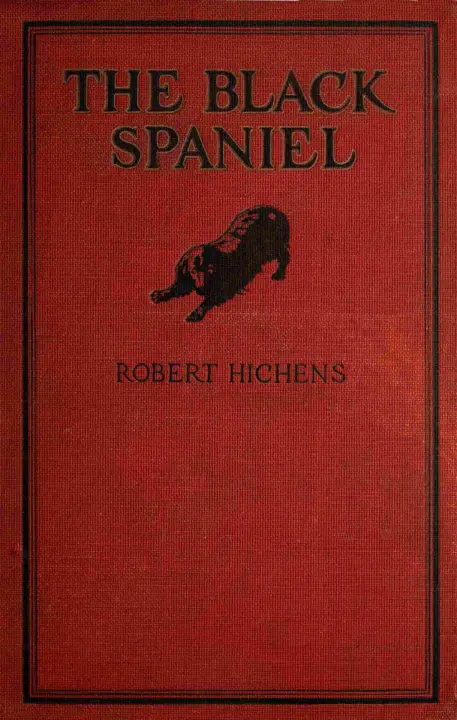
The black spaniel, and other stories
Robert Hichens
THE CLASSIC COLLECTION · 1897
"Flames" by Robert Hichens is a novel written in the late 19th century. The story revolves around Valentine Cresswell, a young man who grapples with the concept of virtue and desire. Set against the backdrop of modern London, Valentine is portrayed as almost saintly in his refinement, preferring intellectual pleasures over physical ones, and is often puzzled by the desires of his contemporaries. The narrative explores themes of existential longing, temptation, and the juxtaposition of good and evil through Valentine and his friend Julian Addison. The opening of the book introduces us to Valentine Cresswell, who is characterized by his asceticism and detachment from common vices. As he reflects on why he lacks the desires that seem to govern the lives of others, he expresses a sense of isolation in his pureness, feeling like a "saint" in modern society. His friendship with Julian Addison, who embodies the opposite temperament, sets the stage for deep conversations about morality, temptation, and the human experience. The two friends engage in an experiment to exchange souls, leading to a pursuit of greater understanding of each other's contrasting natures. This initial setup establishes the philosophical undertones and internal conflicts that will likely develop as the story progresses.
Introduction adapted from the source catalogue; source summaries may be automatically generated.
Free to read · English · 171,527 words · No account needed
MAKE TIME FOR A GOOD BOOK
On by default. Untick to stop anonymous reading totals. Each page counts after 10 seconds in view. How this works.
Anonymous counting is on unless you have switched it off.
Doctor Levillier grew more puzzled day by day. His observation of Valentine taught him only one thing certainly, and beyond possibility of doubt and that was the death of the youth he had once loved, the living presence of a youth whom he could not love, whom he could only shrink from and even fear. He held to the theory that this radical and ghastly change must be caused by some obscure dementia, some secret overturning of the mind; but he was obliged to confess to himself that he held to it only because, otherwise, he would be floating helpless, and without a spar, upon a tide of perplexity and confusion. He could not honestly say that he was able to put his finger upon any definite signs of madness exhibited by Valentine, any that would satisfy a mad-doctor. He could only say that Valentine's character had been strangely beautiful and was now strangely evil, and that the soul of Julian was following rapidly the soul of Valentine. The more closely he watched Valentine, the more astounded did he become and the more eager to detach Julian from him. But the strangest thing of all, as the doctor allowed in one of his frequent self-communings, was, that though formerly he had loved Valentine better than Julian, it never occurred to him that the work of rescue might be undertaken on behalf of the former. His mind dismissed the new Valentine into a region that was beyond his scope and power. He felt instinctively that here was a soul, a will, that his soul could not turn from its ends or detach from its pursuits. The new Valentine was a law to himself. What moved the doctor to such horror was that the new Valentine was a law to Julian. And there was something peculiarly dreadful in the idea which he held, that Julian, once under the beautiful influence of Valentine's sanity, was now under the baneful influence of his insanity. The doctor had gone the length of deciding, in his own mind, that Valentine's sane period of life and insane period lay one on each side of a fixed gulf, and that fixed gulf was his long trance succeeding the final sitting of the two young men. This conclusion was arrived at with ease, once the theory of a subtle lunacy was accepted as a fact. For, on sending his mind back along the ways of recollection, the doctor was able to recall hints of the new Valentine dating from that very night, but never before it. The first hint was Rip's manifested fear, and this led on to others which have been already mentioned. Having made up his mind that this trance was the motive power of Valentine's supposed madness, the doctor sought in every direction to increase his knowledge on the subject of simulations of death by the human body. He looked up again the cases of innumerable hysterical patients whom he had himself treated, sometimes with success, sometimes with failure. He consulted other doctors, of course without mentioning the object of his research. He endeavoured to apply to Valentine's case standards by which he was quickly able to form a satisfactory opinion on the cases of others. He even went so far as to examine as closely as possible into the history of table-turning, the uses ascribed to it by its votaries, and the results obtained from it by credible--as opposed to merely credulous--witnesses. But he found no case that seemed in any way analogous to the strange case of Valentine. As was only natural, the doctor did not forget the possibility of hypnotism, which had struck him during his second conversation with the lady of the feathers. Her confused declarations on the subject of Valentine and Marr being one person, if they were really a true account of what Valentine had said to her--which seemed very doubtful--could only be made clear by accepting as a fact that the dead Marr had laid a hypnotic spell upon Valentine, which continued to exist actively long after its weaver slept in the grave. But Marr and Valentine had never met. This fact seemed fully established. Valentine had always denied any knowledge of him before the trance. Julian had always assumed that only he of the two friends had any acquaintance with Marr. And again, when the doctor, one day, quite casually, said to Valentine, "By the way, you never did meet Marr, did you?" Valentine replied, "Never, till I saw him lying dead in the Euston Road."
Your reading position is saved on this browser. Take it to another device with a library code. Reading pages adapt to text, rather than matching a printed edition.
BEHIND THE BOOK
This eBook is for the use of anyone anywhere in the United States and most other parts of the world at no cost and with almost no restrictions whatsoever. You may copy it, give it away or re-use it under the terms of the Project Gutenberg License included with this eBook or online at www.gutenberg.org. If you are not located in the United States, you will have to check the laws of the country where you are located before using this eBook. Read the source licence.
The original source file, including credits and licence, is retained by this library. Request an original-format copy at no charge. Please include the book title and Project Gutenberg identifier #14253.
KEEP YOUR CURIOSITY GOING

David Patterson (Spirit) Hatch
Coulson Kernahan

Ralph Waldo Emerson

Maurice Baring
Frances Wright
Cécile Tormay