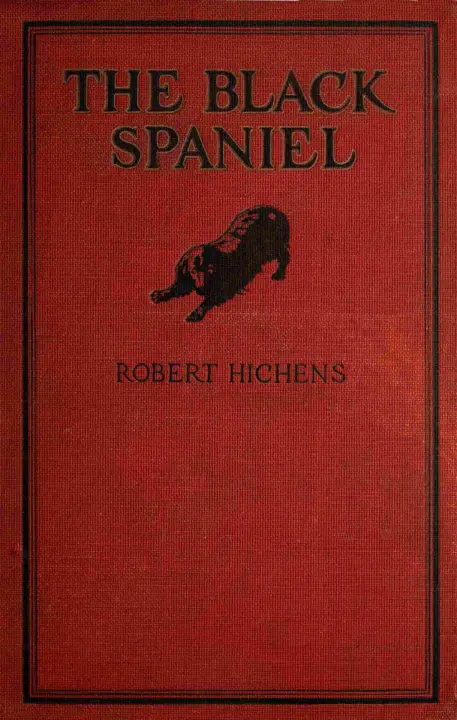
The black spaniel, and other stories
Robert Hichens
THE CLASSIC COLLECTION · 1897
"Flames" by Robert Hichens is a novel written in the late 19th century. The story revolves around Valentine Cresswell, a young man who grapples with the concept of virtue and desire. Set against the backdrop of modern London, Valentine is portrayed as almost saintly in his refinement, preferring intellectual pleasures over physical ones, and is often puzzled by the desires of his contemporaries. The narrative explores themes of existential longing, temptation, and the juxtaposition of good and evil through Valentine and his friend Julian Addison. The opening of the book introduces us to Valentine Cresswell, who is characterized by his asceticism and detachment from common vices. As he reflects on why he lacks the desires that seem to govern the lives of others, he expresses a sense of isolation in his pureness, feeling like a "saint" in modern society. His friendship with Julian Addison, who embodies the opposite temperament, sets the stage for deep conversations about morality, temptation, and the human experience. The two friends engage in an experiment to exchange souls, leading to a pursuit of greater understanding of each other's contrasting natures. This initial setup establishes the philosophical undertones and internal conflicts that will likely develop as the story progresses.
Introduction adapted from the source catalogue; source summaries may be automatically generated.
Free to read · English · 171,527 words · No account needed
MAKE TIME FOR A GOOD BOOK
On by default. Untick to stop anonymous reading totals. Each page counts after 10 seconds in view. How this works.
Anonymous counting is on unless you have switched it off.
"We are very cosey here," Julian continued, gazing at the small fire that was sputtering in the grate.
The lady looked gratified. She felt that the meagre abode which she must name home had received the hallmark of a "toff's" approval.
"Now I am going to ask you something," Julian said. "Will you let me have tea with you to-day, and--and--come out with me some evening to the Empire or somewhere, instead?"
The lady nodded her fringed head.
"Certainly, my dear," she responded. "Proud to give you tea, I'm sure."
Suddenly she bounced up, scattering Jessie over the floor. She promenaded to the door, opened it and yelled:
"Mrs. Brigg! Mrs. Brigg!"
The expostulating feet of the old person ascended wearily from the lower
depths of the house.
"Lord! Lord! Whatever is it now?" she wheezed.
"Please bring up tea for me and this gentleman."
The lady assumed the voice of a sucking dove.
"Tea! Why, I thought you'd be out to--"
The lady shot into the passage and shut the door behind her. After a moment she put her head in and said to Julian:
"I'll be back in a minute. She's in a rare tantrum. I must go down and
help her. Pardon."
And she vanished like a flash.
Julian sat feeling rather guilty. To distract himself he got up and looked at the photographs on the mantelpiece. Most of them were of men, but there were two or three girls in tights, and there was one of a stout and venerable woman, evidently highly respectable, seated in an arm-chair, with staring bead-like eyes, but a sweet and gentle mouth. Her hair was arranged in glossy bands. Her hands held a large book, probably a Bible. Julian looked at her and wondered a little how she chanced to be in this galère. Then he started and almost exclaimed aloud. For there, at the end of the mantelpiece, was a cabinet photograph of Marr. He was right then in his suspicion. The lady of the feathers was also the lady at the "European."
"Sorry to keep you waiting," said a voice behind him.
There was a clatter of crockery. His hostess entered bearing a tray, which held a teapot, cups, a large loaf of bread, and some butter, and a milk-jug and sugar-basin. She plumped it down on the table.
"Mrs. Brigg wouldn't make toast," she explained. "And I didn't like to
keep you."
"Let's make some ourselves," said Julian, with a happy inspiration.
He felt that to perform a common and a cosey act must draw them together, and awaken in the lady's breast a happy and progressive confidence. She was evidently surprised at the suggestion.
Your reading position is saved on this browser. Take it to another device with a library code. Reading pages adapt to text, rather than matching a printed edition.
BEHIND THE BOOK
This eBook is for the use of anyone anywhere in the United States and most other parts of the world at no cost and with almost no restrictions whatsoever. You may copy it, give it away or re-use it under the terms of the Project Gutenberg License included with this eBook or online at www.gutenberg.org. If you are not located in the United States, you will have to check the laws of the country where you are located before using this eBook. Read the source licence.
The original source file, including credits and licence, is retained by this library. Request an original-format copy at no charge. Please include the book title and Project Gutenberg identifier #14253.
KEEP YOUR CURIOSITY GOING

David Patterson (Spirit) Hatch
Coulson Kernahan

Ralph Waldo Emerson

Maurice Baring
Frances Wright
Cécile Tormay