THE CLASSIC COLLECTION✦An outlaw’s diary: the CommuneCLASSIC FREE BOOKS
An outlaw’s diary: the Commune
Cécile Tormay
THE CLASSIC COLLECTION · 1896
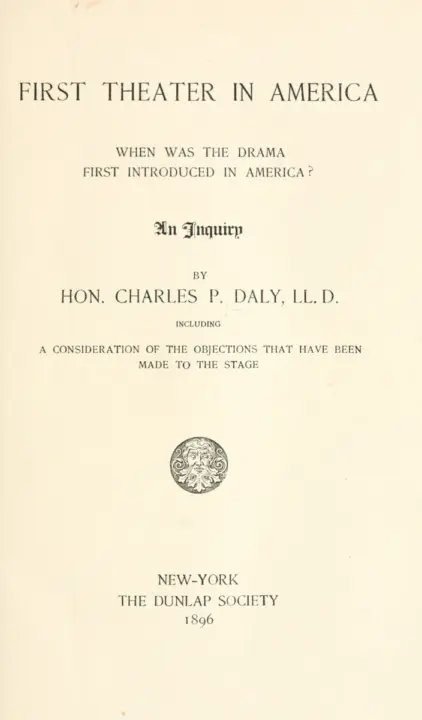
"First Theater in America" by Charles P. Daly is a historical account written in the late 19th century. The work investigates the origins of drama in the United States, particularly focusing on the establishment of theaters and performances in the colonial period. It discusses significant figures and events, aiming to unravel the often-misunderstood timeline of theatrical developments in early America. The opening of this work presents Daly's introduction to the topic, detailing his initial research that sparked his inquiry into the history of theater in America. He recounts an early debate about the introduction of drama, acknowledging the contributions of notable figures like William Hallam, who is often credited with leading the first theatrical company to America. As Daly dives into archival newspaper references from the colonial period, he begins to illuminate evidence of theatrical performances that predate Hallam's arrival. Throughout this opening section, Daly lays the groundwork for a comprehensive exploration of the dramatic arts’ evolution in America, setting up a detailed chronicle of significant events, plays, and individuals involved in the establishment of the American stage.
Introduction adapted from the source catalogue; source summaries may be automatically generated.
Free to read · English · 30,704 words · No account needed
MAKE TIME FOR A GOOD BOOK
On by default. Untick to stop anonymous reading totals. Each page counts after 10 seconds in view. How this works.
Anonymous counting is on unless you have switched it off.
[23] I consulted Dr. Dickerman, the most eminent Egyptologist in this country, upon this subject, and his observation was this: The state of mind and the condition of society of the ancient Egyptians were not such as would incline them to theatrical representations. They had athletic sports, games, such as draughts or checkers, and games of chance, but not such a disposition as brought people together to witness anything. None of the buildings whose ruins have been studied indicate that any were constructed with reference to the assembling of people, except the processions, with priests, in the temples, and that the Labyrinth, moreover, in the twelfth dynasty, contemporary with Abraham, had meetings of the delegates from the different nomes, or provinces, to discuss the political affairs of the kingdom.
[24] Smith’s Dictionary, Vol. iii, p. 997.
[25] Gibbon says the Roman people considered the circus as their home, their temple, and the seat of the republic. The impatient crowd rushed at the dawn of day to secure their places; and there were many who passed sleepless and anxious nights in the adjacent porticos. From the morning to the evening, careless of the sun or of the rain, the spectators, who sometimes amounted to the number of four hundred thousand, remained in eager attention; their eyes fixed on the horses and charioteers, their minds agitated with hope and fear, for the success of the colors which they espoused and the happiness of Rome appeared to hang on the event of a race. “Gibbon’s Decline and Fall,” Vol. iv. pp. 87, 88. London edition of 1848.
[26] Collier, 256, 1st. ed.
[27] Prof. A. W. Ward.
[28] Jeremy Collier’s “View of the English Stage,” 1st ed., p. 258.
[29] Bossuet’s Works, Vol. xxxii. Calcraft’s “Defence of the Stage,” p.
12.
[30] Gifford’s “Jonson,” Vol. iii., pp. 162, 163.
[31] Calcraft, p. 61.
[32] Smith’s “Dictionary,” Vol. i, p. 42; Calcraft, 67.
Transcriber’s Notes
A few minor errors in punctuation have been fixed.
Page 14: “had ben formed” changed to “had been formed”
Page 29: “high healed-shoes” changed to “high heeled-shoes” “at the Appolo” changed to “at the Apollo”
Page 39: “who looked radidiantly” changed to “who looked radiantly”
Page 50: “a tradgedy” changed to “a tragedy”
Page 65: “not heard her” changed to “not heard of her”
Page 80: “with pledty of material” changed to “with plenty of material”
Page 83: “either for stage represention” changed to “either for stage
representation”
Page 93: The spelling of Euripides was fixed.
The author appears to have made a few errors while transcribing sections of other works. These have been left as in the original.
Your reading position is saved on this browser. Take it to another device with a library code. Reading pages adapt to text, rather than matching a printed edition.
BEHIND THE BOOK
This eBook is for the use of anyone anywhere in the United States and most other parts of the world at no cost and with almost no restrictions whatsoever. You may copy it, give it away or re-use it under the terms of the Project Gutenberg License included with this eBook or online at www.gutenberg.org. If you are not located in the United States, you will have to check the laws of the country where you are located before using this eBook. Read the source licence.
The original source file, including credits and licence, is retained by this library. Request an original-format copy at no charge. Please include the book title and Project Gutenberg identifier #67716.
KEEP YOUR CURIOSITY GOING
Cécile Tormay

Moritz Busch
John L. Ransom
Frances Wright
Cécile Tormay

Mabel Potter Daggett