
Switch off
Oliver Optic
THE CLASSIC COLLECTION · 1893
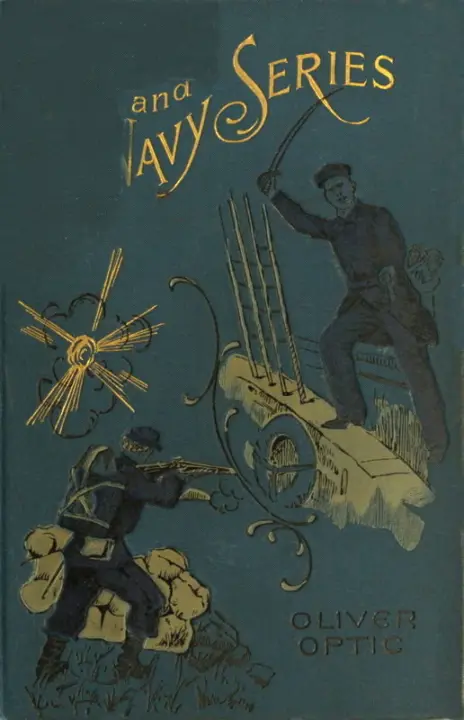
"Fighting Joe; Or, The Fortunes of a Staff Officer. A Story of the Great Rebellion" by Oliver Optic is a historical novel written in the mid-19th century. The book follows Captain Thomas Somers, a staff officer in the Union Army, during the tumultuous period of the American Civil War, highlighting his adventures and encounters in the field. The novel not only focuses on action and conflict but also emphasizes themes of loyalty, patriotism, and moral courage, embodying the spirit of the soldiers of that era. The opening of the narrative introduces Captain Thomas Somers as he navigates his way through uncertain territory while on a mission for the Army of the Potomac. Accompanied by his colored servant Alick, Somers experiences a mix of anxiety and duty as he prepares for potential skirmishes with Confederate forces. Their journey leads them to an encounter with two fellow officers, which quickly escalates into an unexpected confrontation with a group of guerillas. This initial clash highlights Somers's bravery and resourcefulness, setting the tone for his character and the challenges he will face throughout the book. The opening portion establishes a sense of urgency and foreshadows the intense military engagements that will define Somers's experiences as a staff officer.
Introduction adapted from the source catalogue; source summaries may be automatically generated.
Free to read · English · 69,878 words · No account needed
MAKE TIME FOR A GOOD BOOK
On by default. Untick to stop anonymous reading totals. Each page counts after 10 seconds in view. How this works.
Anonymous counting is on unless you have switched it off.
“Third question evaded. You are a lady; and as such, under ordinary circumstances, you are entitled to be treated with the delicacy and consideration due to your sex. But as you have ceased to be a non-combatant,—which you were sorely against your will, and are now actively engaged in the war, conducting the business of capturing a prisoner,—under these circumstances, would it not be entirely fair for me to treat you as a combatant, precisely the same as though you had not unsexed yourself, and were a man?”
“You seem to have already forgotten what is due to a lady,” replied she, her cheek flushed with anger.
“Fourth question evaded.”
“Sir, I decline to hear any more of this coarse abuse!” exclaimed she,
stamping her foot.
“Indulge me for one moment more, and I will endeavor as much as possible to avoid talking through my nose, and making pretensions as a hero of the Yankee army, or a down-east pink of chivalry.”
Perhaps the imperial beauty thought that these expressions, borrowed from her own elegant discourse, were not especially refined for a lady to use; it may be that they sounded coarse on a repetition, but she made no acknowledgment to that effect.
“Your silence consents: thank you. Miss Hasbrouk, you speak with chivalrous contempt of what you are pleased to term ‘Yankee tricks;’ at the same time, you were thrown into spasms of laughter by the apparent success of one of your own tricks. Now, permit me to ask whether you would equally appreciate—fifth question—a trick quite as smart as your own?”
“You have insulted me long enough, sir!” replied she, haughtily. “Now,
sir—”
“Fifth question evaded. I have no more to ask.”
“Now, sir, I will hand you over to your masters,” said she, moving a
step towards the door.
“Excuse me if I take the liberty to decline being handed over to my masters,” said Somers, stepping between her and the door, and now occupying a position between the lady and the discomfited major.
“Sir, what do you mean?” demanded the lady, her bosom heaving with angry emotions, as she found herself confronted by the young officer, who looked as firm and immovable as a mountain of granite.
“I mean all that I say, and much more,” answered he, with an emphasis which she could not fail to understand.
“Sir, I desire to pass out at that door.”
“I positively forbid your passing out at that door.”
“Sir!” gasped she, almost overcome by her angry passions.
“Miss Hasbrouk!” replied he, bowing.
“You are no gentleman!”
Your reading position is saved on this browser. Take it to another device with a library code. Reading pages adapt to text, rather than matching a printed edition.
BEHIND THE BOOK
This eBook is for the use of anyone anywhere in the United States and most other parts of the world at no cost and with almost no restrictions whatsoever. You may copy it, give it away or re-use it under the terms of the Project Gutenberg License included with this eBook or online at www.gutenberg.org. If you are not located in the United States, you will have to check the laws of the country where you are located before using this eBook. Read the source licence.
The original source file, including credits and licence, is retained by this library. Request an original-format copy at no charge. Please include the book title and Project Gutenberg identifier #59429.
KEEP YOUR CURIOSITY GOING
Cécile Tormay

Moritz Busch
Coulson Kernahan
John L. Ransom

Maurice Baring
Frances Wright
