
Switch off
Oliver Optic
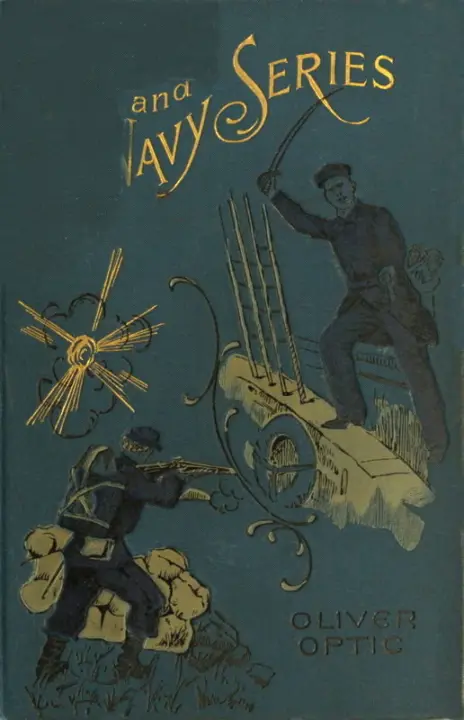
THE CLASSIC COLLECTION · 1893
"Fighting Joe; Or, The Fortunes of a Staff Officer. A Story of the Great Rebellion" by Oliver Optic is a historical novel written in the mid-19th century. The book follows Captain Thomas Somers, a staff officer in the Union Army, during the tumultuous period of the American Civil War, highlighting his adventures and encounters in the field. The novel not only focuses on action and conflict but also emphasizes themes of loyalty, patriotism, and moral courage, embodying the spirit of the soldiers of that era. The opening of the narrative introduces Captain Thomas Somers as he navigates his way through uncertain territory while on a mission for the Army of the Potomac. Accompanied by his colored servant Alick, Somers experiences a mix of anxiety and duty as he prepares for potential skirmishes with Confederate forces. Their journey leads them to an encounter with two fellow officers, which quickly escalates into an unexpected confrontation with a group of guerillas. This initial clash highlights Somers's bravery and resourcefulness, setting the tone for his character and the challenges he will face throughout the book. The opening portion establishes a sense of urgency and foreshadows the intense military engagements that will define Somers's experiences as a staff officer.
Introduction adapted from the source catalogue; source summaries may be automatically generated.
Free to read · English · 69,878 words · No account needed
MAKE TIME FOR A GOOD BOOK
On by default. Untick to stop anonymous reading totals. Each page counts after 10 seconds in view. How this works.
Anonymous counting is on unless you have switched it off.
The house was surrounded by rebel cavalry; that was no joke to him; it could be no joke to the major, for he was an officer in the Maryland Home Brigade, “on detached service,” and what proved dangerous or fatal to one must prove dangerous or fatal to the other. But Riggleston did not seem to be in the least disturbed by the circumstance that the house was environed by Confederate cavalry. He stood looking at his lady-love, as though he was waiting her next move in the development of the game.
“What are you laughing at, Maud?” asked he, when he had watched her until his own patience was somewhat tried, and that of Somers had become decidedly shaky.
“Isn’t it funny?” gasped she, struggling for utterance between the
spasms of laughter.
“Yes, it is, very funny,” replied he, obediently, though it was quite plain that he did not regard the scene as so excruciatingly amusing as the lady did.
“Why don’t you laugh, then?”
“I would if I had time; but I must proceed to business.”
“Don’t spoil the scene yet,” said she, with difficulty.
“Hurry it up, then, Maud.”
“Captain Somers,” added she, repressing her laughter to a more reasonable limit, “I am your most obedient servant.”
“Thank you, Miss Hasbrouk,” replied he, beginning to apprehend, for the first time, that he was individually and personally responsible for the joke which had so excited the lady’s risibles. “If you are, you will oblige me by informing me what you are laughing at.”
The lady broke forth anew, and peal on peal of laughter rang through the room. Somers tried to think what he had said or done that was so astoundingly funny, satisfied that his humor would certainly make his fortune when given a wider field of operations. It was evident that it would not do for him to be as funny as he could thereafter in the presence of ladies, or one of them might yet die of hysterics.
“Do you really wish to know what I am laughing at, Captain Somers?” asked she, at another brief interval of apparent sanity.
“That is what I particularly desire.”
“I am laughing at the situation. Do you know that there is something irresistibly ludicrous in situations, captain? I delight in situations—funny situations I mean.”
“Really, I don’t see anything very amusing in the present situation,” replied the puzzled staff officer.
“Don’t you, indeed? Well, I’m afraid you won’t appreciate the situation from your stand-point. What a pity we haven’t a photographer to give us the scene for future inspection!”
Your reading position is saved on this browser. Take it to another device with a library code. Reading pages adapt to text, rather than matching a printed edition.
BEHIND THE BOOK
This eBook is for the use of anyone anywhere in the United States and most other parts of the world at no cost and with almost no restrictions whatsoever. You may copy it, give it away or re-use it under the terms of the Project Gutenberg License included with this eBook or online at www.gutenberg.org. If you are not located in the United States, you will have to check the laws of the country where you are located before using this eBook. Read the source licence.
The original source file, including credits and licence, is retained by this library. Request an original-format copy at no charge. Please include the book title and Project Gutenberg identifier #59429.
KEEP YOUR CURIOSITY GOING
Cécile Tormay

Moritz Busch
Coulson Kernahan
John L. Ransom

Maurice Baring
Frances Wright
