
Switch off
Oliver Optic
THE CLASSIC COLLECTION · 1893
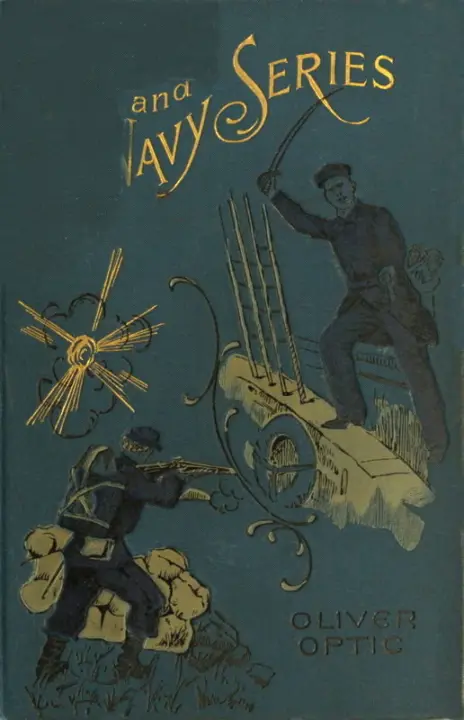
"Fighting Joe; Or, The Fortunes of a Staff Officer. A Story of the Great Rebellion" by Oliver Optic is a historical novel written in the mid-19th century. The book follows Captain Thomas Somers, a staff officer in the Union Army, during the tumultuous period of the American Civil War, highlighting his adventures and encounters in the field. The novel not only focuses on action and conflict but also emphasizes themes of loyalty, patriotism, and moral courage, embodying the spirit of the soldiers of that era. The opening of the narrative introduces Captain Thomas Somers as he navigates his way through uncertain territory while on a mission for the Army of the Potomac. Accompanied by his colored servant Alick, Somers experiences a mix of anxiety and duty as he prepares for potential skirmishes with Confederate forces. Their journey leads them to an encounter with two fellow officers, which quickly escalates into an unexpected confrontation with a group of guerillas. This initial clash highlights Somers's bravery and resourcefulness, setting the tone for his character and the challenges he will face throughout the book. The opening portion establishes a sense of urgency and foreshadows the intense military engagements that will define Somers's experiences as a staff officer.
Introduction adapted from the source catalogue; source summaries may be automatically generated.
Free to read · English · 69,878 words · No account needed
MAKE TIME FOR A GOOD BOOK
On by default. Untick to stop anonymous reading totals. Each page counts after 10 seconds in view. How this works.
Anonymous counting is on unless you have switched it off.
They were absent but a few moments before the major returned. If he had been gone seven years, and passed through a Parisian polishing school in the interim, his tone and his manner could not have been more effectually changed. He looked and acted more like the Major Riggleston of yesterday. He was all suavity now; and, what was vastly more remarkable, his memory was as perfect as though he had made mnemonics the study of a lifetime. He remembered all about the skirmish on the road, and even recalled incidents connected with that affair of which Somers was profoundly ignorant.
“Captain Somers, that was the hardest fight for a little one I ever happened to be in,” said the major, after the event had been thoroughly rehearsed.
“It was sharp for a few moments. By the way, major, what is your opinion of Alick now?” asked Somers.
“Well, I was rather surprised to see him go in as he did. He is a brave
fellow.”
“So he is; I did not know whether he would fight or not; but I thought
he would.”
“O, I was sure of it.”
“Were you? Before the fight you seemed to be of the opinion that he was
of no account.”
“That was said concerning niggers in general. I always had a great deal of confidence in Alick. When he fired his gun I knew what the boy meant.”
“His pistol, you mean; he had no gun.”
“You are right; it was a pistol,” said the major, with more confusion than this trifling inaccuracy justified.
“In the pursuit of the guerillas—”
“Yes, in the pursuit Alick was splendid,” continued Riggleston, taking the words out of Somers’s mouth.
“You forget, major; you conducted the pursuit alone,” mildly added the
staff officer.
“O, yes! so I did. I am mixing up this matter with another affair, in which my boy Mingo chased the Yankees—”
“Chased the what?” interposed Somers, confounded by this singular and
inappropriate remark.
“The guerillas, I said,” laughed the major. “What did you think I said?”
“I understood you to say the Yankees.”
“O, no! Yankees? No; I am one myself. I said guerillas.”
“If you did, I misunderstood you.”
“Of course I didn’t say Yankees. That is quite impossible.”
Somers was disposed to be polite, even at the sacrifice of the point of veracity; therefore he did not contradict his companion, though he felt entirely certain in regard to the language used.
“Of course you could not have meant Yankees, whatever you said,” added
Somers.
“Certainly not. Do you know why I didn’t catch those—those guerillas?” continued the major.
Your reading position is saved on this browser. Take it to another device with a library code. Reading pages adapt to text, rather than matching a printed edition.
BEHIND THE BOOK
This eBook is for the use of anyone anywhere in the United States and most other parts of the world at no cost and with almost no restrictions whatsoever. You may copy it, give it away or re-use it under the terms of the Project Gutenberg License included with this eBook or online at www.gutenberg.org. If you are not located in the United States, you will have to check the laws of the country where you are located before using this eBook. Read the source licence.
The original source file, including credits and licence, is retained by this library. Request an original-format copy at no charge. Please include the book title and Project Gutenberg identifier #59429.
KEEP YOUR CURIOSITY GOING
Cécile Tormay

Moritz Busch
Coulson Kernahan
John L. Ransom

Maurice Baring
Frances Wright
