
Switch off
Oliver Optic
THE CLASSIC COLLECTION · 1893
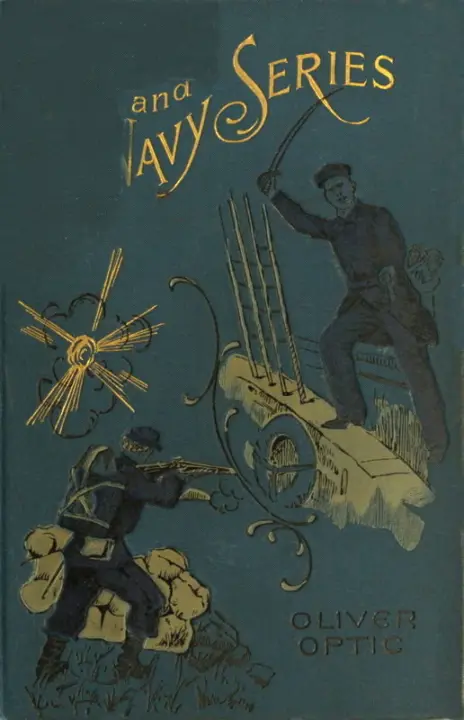
"Fighting Joe; Or, The Fortunes of a Staff Officer. A Story of the Great Rebellion" by Oliver Optic is a historical novel written in the mid-19th century. The book follows Captain Thomas Somers, a staff officer in the Union Army, during the tumultuous period of the American Civil War, highlighting his adventures and encounters in the field. The novel not only focuses on action and conflict but also emphasizes themes of loyalty, patriotism, and moral courage, embodying the spirit of the soldiers of that era. The opening of the narrative introduces Captain Thomas Somers as he navigates his way through uncertain territory while on a mission for the Army of the Potomac. Accompanied by his colored servant Alick, Somers experiences a mix of anxiety and duty as he prepares for potential skirmishes with Confederate forces. Their journey leads them to an encounter with two fellow officers, which quickly escalates into an unexpected confrontation with a group of guerillas. This initial clash highlights Somers's bravery and resourcefulness, setting the tone for his character and the challenges he will face throughout the book. The opening portion establishes a sense of urgency and foreshadows the intense military engagements that will define Somers's experiences as a staff officer.
Introduction adapted from the source catalogue; source summaries may be automatically generated.
Free to read · English · 69,878 words · No account needed
MAKE TIME FOR A GOOD BOOK
On by default. Untick to stop anonymous reading totals. Each page counts after 10 seconds in view. How this works.
Anonymous counting is on unless you have switched it off.
“But if they have a safe-conduct, you can’t compel them to give you anything. They will show you the paper,” replied Somers.
“Let ’em show it, Somers; I can’t read it,” chuckled the Texan.
“Why not?”
“Well, Somers, I ain’t up to print, say nothin’ of writin’. If they make any muss about it, I kin tell ’em it was all a mistake—don’t yer see, Somers? May be I mought be deef too, Somers.”
“Perhaps they will read it to you.”
“Then I’m deef, sartin.”
“Very likely they will give you what you want, if you ask them civilly.”
“No, they won’t, Somers. They hate us wuss ’n pizen; but I hate them wuss ’n they hate me.”
“What have they done?”
“They hain’t done nothin’, and that’s what I hate ’em fur. The Yanks won’t tech ’em, and we can’t tech ’em, Somers. It stands to reason, Somers, sech folks ought to be hated.”
Somers decided not to discuss this question, and he had dropped a few paces behind his companion to avoid his slang, when Skinley exhibited a disposition to be sociable, and insisted that the road was wide enough for them to ride abreast. The young officer did not want to quarrel with the ruffian, and he complied with his request.
“Thar’s a pooty gal over to Callicot’s, Somers,” added he, with a coarse grin. “P’rhaps you’ll think more of that than yer do of the whiskey.”
“Is she a Union girl?” asked Somers—more because he felt compelled to speak than because he felt any interest in the new subject.
“In course she are.”
“You don’t intend to meddle with her, I hope.”
“What makes yer hope that?” demanded Skinley, sourly.
“Are you a soldier, Skinley?”
“You bet!”
“A true soldier always respects a woman, whether she be friend or foe.”
“Somers, your idees is a little too fine cut fur me,” snarled the Texan.
“Have you a mother?”
“Not ’s I knows on. She gin me the slip when I wan’t knee high to a chaw
terbaker.”
“Is she dead?”
“I cal’late she is.”
“Have you no sister?”
“May be I hev’. See here, Somers, you kin draw yer charge on that. Yer mought be a preacher, or sich like; but don’t yer draw that string on me.”
“Very well; I have nothing to say, only that, if you propose to insult a woman, I am your enemy.”
“Be you?”
Your reading position is saved on this browser. Take it to another device with a library code. Reading pages adapt to text, rather than matching a printed edition.
BEHIND THE BOOK
This eBook is for the use of anyone anywhere in the United States and most other parts of the world at no cost and with almost no restrictions whatsoever. You may copy it, give it away or re-use it under the terms of the Project Gutenberg License included with this eBook or online at www.gutenberg.org. If you are not located in the United States, you will have to check the laws of the country where you are located before using this eBook. Read the source licence.
The original source file, including credits and licence, is retained by this library. Request an original-format copy at no charge. Please include the book title and Project Gutenberg identifier #59429.
KEEP YOUR CURIOSITY GOING
Cécile Tormay

Moritz Busch
Coulson Kernahan
John L. Ransom

Maurice Baring
Frances Wright
