
Switch off
Oliver Optic
THE CLASSIC COLLECTION · 1893
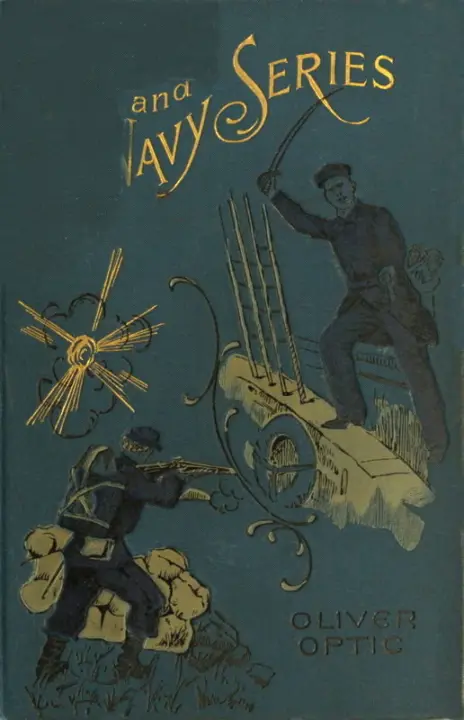
"Fighting Joe; Or, The Fortunes of a Staff Officer. A Story of the Great Rebellion" by Oliver Optic is a historical novel written in the mid-19th century. The book follows Captain Thomas Somers, a staff officer in the Union Army, during the tumultuous period of the American Civil War, highlighting his adventures and encounters in the field. The novel not only focuses on action and conflict but also emphasizes themes of loyalty, patriotism, and moral courage, embodying the spirit of the soldiers of that era. The opening of the narrative introduces Captain Thomas Somers as he navigates his way through uncertain territory while on a mission for the Army of the Potomac. Accompanied by his colored servant Alick, Somers experiences a mix of anxiety and duty as he prepares for potential skirmishes with Confederate forces. Their journey leads them to an encounter with two fellow officers, which quickly escalates into an unexpected confrontation with a group of guerillas. This initial clash highlights Somers's bravery and resourcefulness, setting the tone for his character and the challenges he will face throughout the book. The opening portion establishes a sense of urgency and foreshadows the intense military engagements that will define Somers's experiences as a staff officer.
Introduction adapted from the source catalogue; source summaries may be automatically generated.
Free to read · English · 69,878 words · No account needed
MAKE TIME FOR A GOOD BOOK
On by default. Untick to stop anonymous reading totals. Each page counts after 10 seconds in view. How this works.
Anonymous counting is on unless you have switched it off.
“Your hand, Captain Somers,” said the regular. “You are a trump.”
“Thank you; and I am happy to reciprocate the compliment,” replied the young staff officer, as he took the proffered hand of Captain Barkwood.
“As a general rule, I don’t think much of volunteer officers,” continued the regular; “but you are a stunning good fellow, and as plucky as a hen that has lost one of her chickens.”
“I am obliged to you for your good opinion, and especially for your ornithological simile,” laughed Somers, who, we need not add, was delighted with the conduct of his companion.
“My what?”
“Your ornithological simile.”
“My dear fellow, you must have swallowed a quarto dictionary. If you had only used that expression before the fight, the rebels would certainly have run away, and declined to engage a man who used words of such ominous length. No matter; you can fight.”
“I can when I am obliged to do so. You remarked, a little while ago, that you were a coward by nature.”
“So I am; but it was safer to fight than it was to run.”
“You did not behave like a man who is a coward by nature.”
“But I am a coward; and I dislike these hand-to-hand encounters.”
“You didn’t appear to dislike them very much just now,” added Somers, who was filled with admiration at the gallant bearing of the regular.
“I do; war is a science. I play at it just as I do at chess. By the way, Captain Somers, do you play chess?”
“Only a little.”
“Well, it’s a noble game; and I may have the pleasure of letting you beat me some time. War is like chess; it’s a great game. I like to see a well-planned battle, and even to take a part in it. But these little affairs, where everything depends on brute force, are my particular abomination. There is no science about them—no strategy—no chance to flank, or do any other smart thing.”
“Here comes the major; he didn’t catch his man,” said Somers, as the “fighting man” was seen galloping towards them.
“He’s a prudent man,” replied the regular, hardly betraying the contempt he felt for this particular volunteer.
“He’s a Maryland man.”
“So am I,” promptly returned Captain Barkwood, as though he feared that something might be said against the bravery of the men of his state. “I was born and brought up not ten miles from the spot where we now stand.”
“Why didn’t you follow me?” demanded the major, in a reproachful tone, as he reined in his panting steed.
Your reading position is saved on this browser. Take it to another device with a library code. Reading pages adapt to text, rather than matching a printed edition.
BEHIND THE BOOK
This eBook is for the use of anyone anywhere in the United States and most other parts of the world at no cost and with almost no restrictions whatsoever. You may copy it, give it away or re-use it under the terms of the Project Gutenberg License included with this eBook or online at www.gutenberg.org. If you are not located in the United States, you will have to check the laws of the country where you are located before using this eBook. Read the source licence.
The original source file, including credits and licence, is retained by this library. Request an original-format copy at no charge. Please include the book title and Project Gutenberg identifier #59429.
KEEP YOUR CURIOSITY GOING
Cécile Tormay

Moritz Busch
Coulson Kernahan
John L. Ransom

Maurice Baring
Frances Wright
