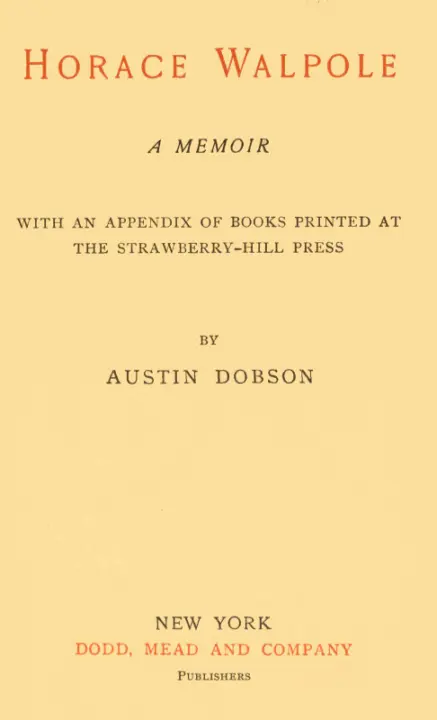
Horace Walpole: A memoir With an appendix of books printed at the Strawberry Hill Press
Austin Dobson
THE CLASSIC COLLECTION · 1889
"Fielding" by Austin Dobson is a biographical account focusing on the life and works of the English novelist and playwright Henry Fielding, written in the late 19th century. The book aims to present a thorough examination of Fielding's life, correcting past misconceptions and offering fresh insights into his personal and professional experiences. The opening of the memoir outlines Fielding's lineage and early years, detailing his birth into an ancient family and the influences that shaped his literary career. It presents a broad picture of his upbringing, education at Eton, and the early romantic escapades that hinted at his later literary pursuits. Dobson introduces various anecdotes about Fielding's family and education while alluding to his gradual emergence into the world of theater and his budding interest in playwriting, laying the groundwork for understanding Fielding's character as a dramatist and novelist.
Introduction adapted from the source catalogue; source summaries may be automatically generated.
Free to read · English · 63,377 words · No account needed
MAKE TIME FOR A GOOD BOOK
On by default. Untick to stop anonymous reading totals. Each page counts after 10 seconds in view. How this works.
Anonymous counting is on unless you have switched it off.
"Virgil then came up to me, with Mr. Addison under his Arm. Well, Sir, said he, how many Translations have these few last Years produced of my AEneid? I told him, I believed several, but I could not possibly remember; for I had never read any but Dr. Trapp's. [Footnote: Dr. Trapp's translation of the AEneid was published in 1718.]--Ay, said he, that is a curious Piece indeed! I then acquainted him with the Discovery made by Mr. Warburton of the Eleusinian Mysteries couched in his 6th book. What Mysteries? said Mr. Addison. The Eleusinian, answered Virgil, which I have disclosed in my 6th Book. How! replied Addison. You never mentioned a word of any such Mysteries to me in all our Acquaintance. I thought it was unnecessary, cried the other, to a Man of your infinite Learning: besides, you always told me, you perfectly understood my meaning. Upon this I thought the Critic looked a little out of countenance, and turned aside to a very merry Spirit, one Dick Steele, who embraced him, and told him, He had been the greatest Man upon Earth; that he readily resigned up all the Merit of his own Works to him. Upon which, Addison gave him a gracious Smile, and clapping him on the Back with much Solemnity, cried out, Well said, Dick."
After encountering these and other notabilities, including Tom Thumb and Livy, the latter of whom takes occasion to commend the ingenious performances of Lady Marlborough's assistant, Mr. Hooke, the author meets with Julian the Apostate, and from this point the narrative grows languid. Its unfinished condition may perhaps be accepted as a proof that Fielding himself had wearied of his scheme.
The third volume of the Miscellanies is wholly occupied with the remarkable work entitled the History of the Life of the late Mr. Jonathan Wild the Great. As in the case of the Journey from this World to the Next, it is not unlikely that the first germ of this may be found in the pages of the Champion. "Reputation"--says Fielding in one of the essays in that periodical--"often courts those most who regard her the least. Actions have sometimes been attended with Fame, which were undertaken in Defiance of it. Jonathan Wyld himself had for many years no small Share of it in this Kingdom." The book now under consideration is the elaboration of the idea thus casually thrown out. Under the name of a notorious thief-taker hanged at Tyburn in 1725, Fielding has traced the Progress of a Rogue to the Gallows, showing by innumerable subtle touches that the (so-called) greatness of a villain does not very materially differ from any other kind of greatness, which is equally independent of goodness. This continually suggested affinity between the ignoble and the pseudo-noble is the text of the book. Against genuine worth (its author is careful to explain) his satire is in no wise directed. He is far from considering "Newgate as no other than Human Nature with its Mask off;" but he thinks "we may be excused for suspecting, that the splendid Palaces of the Great are often no other than Newgate with the Mask on." Thus Jonathan Wild the Great is a prolonged satire upon the spurious eminence in which benevolence, honesty, charity, and the like have no part; or, as Fielding prefers to term it, that false or "Bombast greatness" which is so often mistaken for the "true Sublime in Human Nature"--Greatness and Goodness combined. So thoroughly has he explained his intention in the Prefaces to the Miscellanies, and to the book itself, that it is difficult to comprehend how Scott could fail to see his drift. Possibly, like some others, he found the subject repugnant and painful to his kindly nature. Possibly, too, he did not, for this reason, study the book very carefully, for, with the episode of Heartfree under one's eyes, it is not strictly accurate to say (as he does) that it presents "a picture of complete vice, unrelieved by any thing of human feeling, and never by any accident even deviating into virtue." If the author's introduction be borne in mind, and if the book be read steadily in the light there supplied, no one can refrain from admiring the extraordinary skill and concentration with which the plan is pursued, and the adroitness with which, at every turn, the villainy of Wild is approximated to that of those securer and more illustrious criminals with whom he is so seldom confused. And Fielding has never carried one of his chief and characteristic excellences to so great perfection: the book is a model of sustained and sleepless irony. To make any extracts from it--still less to make any extracts which should do justice to it, is almost impracticable; but the edifying discourse between Wild and Count La Ruse in Book i., and the pure comedy of that in Book iv. with the Ordinary of Newgate (who objects to wine, but drinks punch because "it is no where spoken against in Scripture"), as well as the account of the prison faction between Wild and Johnson, [Footnote: Some critics at this point appear to have identified Johnson and Wild with Lord Wilmington and Sir Robert Walpole (who resigned in 1742), while Mr. Keightley suspects that Wild throughout typifies Walpole. But the advertisement "from the Publisher" to the edition of 1754 disclaims any such "personal Application." "The Truth is (he says), as a very corrupt State of Morals is here represented, the Scene seems very properly to have been laid in Newgate: Nor do I see any Reason for introducing any allegory at all; unless we will agree that there are, without those Walls, some other Bodies of Men of worse Morals than those within; and who have, consequently, a Right to change Places with its present Inhabitants." The writer was probably Fielding.] with its admirable speech of the "grave Man" against Party, may all be cited as examples of its style and method. Nor should the character of Wild in the last chapter, and his famous rules of conduct, be neglected. It must be admitted, however, that the book is not calculated to suit the nicely-sensitive in letters; or, it may be added, those readers for whom the evolution of a purely intellectual conception is either unmeaning or uninteresting. Its place in Fielding's works is immediately after his three great novels, and this is more by reason of its subject than its workmanship, which could hardly be excelled. When it was actually composed is doubtful. If it may be connected with the already-quoted passage in the Champion, it must be placed after March 1740, which is the date of the paper; but, from a reference to Peter Pounce in Book ii., it might also be supposed to have been written after Joseph Andrews. The Bath simile in chapter xiv. Book i., makes it likely that some part of it was penned at that place, where, from an epigram in the Miscellanies "written Extempore in the Pump Room," it is clear that Fielding was staying in 1742. But, whenever it was completed, we are inclined to think that it was planned and begun before Joseph Andrews was published, as it is in the highest degree improbable that Fielding, always carefully watching the public taste, would have followed up that fortunate adventure in a new direction by a work so entirely different from it as Jonathan Wild.
Your reading position is saved on this browser. Take it to another device with a library code. Reading pages adapt to text, rather than matching a printed edition.
Austin Dobson
Austin Dobson
Austin Dobson
Austin Dobson
BEHIND THE BOOK
This eBook is for the use of anyone anywhere in the United States and most other parts of the world at no cost and with almost no restrictions whatsoever. You may copy it, give it away or re-use it under the terms of the Project Gutenberg License included with this eBook or online at www.gutenberg.org. If you are not located in the United States, you will have to check the laws of the country where you are located before using this eBook. Read the source licence.
The original source file, including credits and licence, is retained by this library. Request an original-format copy at no charge. Please include the book title and Project Gutenberg identifier #6689.
KEEP YOUR CURIOSITY GOING
John L. Ransom

Herman W. Mudgett

Harriet Monroe
Daniel Dulany Addison
Charles Lanman

Harold Rosher