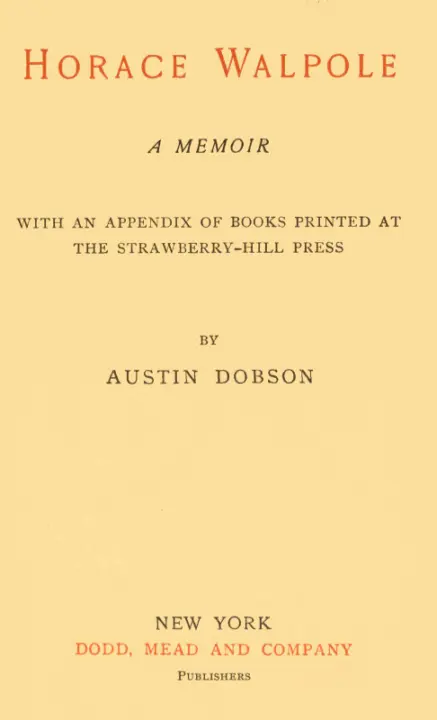
Horace Walpole: A memoir With an appendix of books printed at the Strawberry Hill Press
Austin Dobson
THE CLASSIC COLLECTION · 1889
"Fielding" by Austin Dobson is a biographical account focusing on the life and works of the English novelist and playwright Henry Fielding, written in the late 19th century. The book aims to present a thorough examination of Fielding's life, correcting past misconceptions and offering fresh insights into his personal and professional experiences. The opening of the memoir outlines Fielding's lineage and early years, detailing his birth into an ancient family and the influences that shaped his literary career. It presents a broad picture of his upbringing, education at Eton, and the early romantic escapades that hinted at his later literary pursuits. Dobson introduces various anecdotes about Fielding's family and education while alluding to his gradual emergence into the world of theater and his budding interest in playwriting, laying the groundwork for understanding Fielding's character as a dramatist and novelist.
Introduction adapted from the source catalogue; source summaries may be automatically generated.
Free to read · English · 63,377 words · No account needed
MAKE TIME FOR A GOOD BOOK
On by default. Untick to stop anonymous reading totals. Each page counts after 10 seconds in view. How this works.
Anonymous counting is on unless you have switched it off.
The Characters of Men is not equal to the Conversation. The theme is a wider one; and the end proposed,--that of supplying rules for detecting the real disposition through all the social disguises which cloak and envelop it,--can scarcely be said to be attained. But there are happy touches even in this; and when the author says--"I will venture to affirm, that I have known some of the best sort of Men in the World (to use the vulgar Phrase,) who would not have scrupled cutting a Friend's Throat; and a Fellow whom no Man should be seen to speak to, capable of the highest Acts of Friendship and Benevolence," one recognises the hand that made the sole good Samaritan in Joseph Andrews "a Lad who hath since been transported for robbing a Hen-roost." The account of the Terrestrial Chrysipus or Guinea, a burlesque on a paper read before the Royal Society on the Fresh Water Polypus, is chiefly interesting from the fact that it is supposed to be written by Petrus Gualterus (Peter Walter), who had an "extraordinary Collection" of them. He died, in fact, worth L300,000. The only other paper in the volume of any value is a short one Of the Remedy of Affliction for the Loss of our Friends, to which we shall presently return.
The farce of Eurydice, and the Wedding Day, which, with A Journey from this World to the Next, etc., make up the contents of the second volume of the Miscellanies, have been already sufficiently discussed. But the Journey deserves some further notice. It has been suggested that this curious Lucianic production may have been prompted by the vision of Mercury and Charon in the Champion, though the kind of allegory of which it consists is common enough with the elder essayists; and it is notable that another book was published in April 1743, under the title of Cardinal Fleury's Journey to the other World, which is manifestly suggested by Quevedo. Fielding's Journey, however, is a fragment which the author feigns to have found in the garret of a stationer in the Strand. Sixteen out of five-and-twenty chapters in Book i. are occupied with the transmigrations of Julian the Apostate, which are not concluded. Then follows another chapter from Book xix., which contains the history of Anna Boleyn, and the whole breaks off abruptly. Its best portion is undoubtedly the first ten chapters, which relate the writer's progress to Elysium, and afford opportunity for many strokes of satire. Such are the whimsical terror of the spiritual traveller in the stagecoach, who hears suddenly that his neighbour has died of smallpox, a disease he had been dreading all his life; and the punishment of Lord Scrape, the miser, who is doomed to dole out money to all comers, and who, after "being purified in the Body of a Hog," is ultimately to return to earth again. Nor is the delight of some of those who profit by his enforced assistance less keenly realised:--"I remarked a poetical Spirit in particular, who swore he would have a hearty Gripe at him: 'For, says he, the Rascal not only refused to subscribe to my Works; but sent back my Letter unanswered, tho' I'm a better Gentleman than himself.'" The descriptions of the City of Diseases, the Palace of Death, and the Wheel of Fortune from which men draw their chequered lots, are all unrivalled in their way. But here, as always, it is in his pictures of human nature that Fielding shines, and it is this that makes the chapters in which Minos is shown adjudicating upon the separate claims of the claimants to enter Elysium the most piquant of all. The virtuoso and butterfly hunter, who is repulsed "with great Scorn;" the dramatic author who is admitted (to his disgust), not on account of his works, but because he has once lent "the whole Profits of a Benefit Night to a Friend;" the parson who is turned back, while his poor parishioners are admitted; and the trembling wretch who has been hanged for a robbery of eighteen-pence, to which he had been driven by poverty, but whom the judge welcomes cordially because he had been a kind father, husband, and son; all these are conceived in that humane and generous spirit which is Fielding's most engaging characteristic. The chapter immediately following, which describes the literary and other inhabitants of Elysium, is even better. Here is Leonidas, who appears to be only moderately gratified with the honour recently done him by Mr. Glover the poet; here is Homer, toying with Madam Dacier, and profoundly indifferent as to his birthplace and the continuity of his poems; here, too, is Shakespeare, who, foreseeing future commentators and the "New Shakespere Society," declines to enlighten Betterton and Booth as to a disputed passage in his works, adding, "I marvel nothing so much as that Men will gird themselves at discovering obscure Beauties in an Author. Certes the greatest and most pregnant Beauties are ever the plainest and most evidently striking; and when two Meanings of a Passage can in the least ballance our Judgements which to prefer, I hold it matter of unquestionable Certainty that neither is worth a farthing." Then, again, there are Addison and Steele, who are described with so pleasant a knowledge of their personalities that, although the passage has been often quoted, there seems to be no reason why it should not be quoted once more:--
Your reading position is saved on this browser. Take it to another device with a library code. Reading pages adapt to text, rather than matching a printed edition.
Austin Dobson
Austin Dobson
Austin Dobson
Austin Dobson
BEHIND THE BOOK
This eBook is for the use of anyone anywhere in the United States and most other parts of the world at no cost and with almost no restrictions whatsoever. You may copy it, give it away or re-use it under the terms of the Project Gutenberg License included with this eBook or online at www.gutenberg.org. If you are not located in the United States, you will have to check the laws of the country where you are located before using this eBook. Read the source licence.
The original source file, including credits and licence, is retained by this library. Request an original-format copy at no charge. Please include the book title and Project Gutenberg identifier #6689.
KEEP YOUR CURIOSITY GOING
John L. Ransom

Herman W. Mudgett

Harriet Monroe
Daniel Dulany Addison
Charles Lanman

Harold Rosher