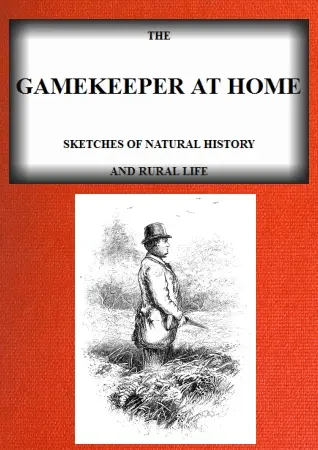
The Gamekeeper at Home: Sketches of natural history and rural life (Illustrated)
Richard Jefferies
THE CLASSIC COLLECTION · 1889
"Field and Hedgerow: Being the Last Essays of Richard Jefferies" by Richard Jefferies is a collection of essays written in the late 19th century, posthumously compiled by his widow. This work reflects Jefferies’ deep appreciation for nature and the countryside, exploring themes related to the relationship between humans and the natural world, as well as observations on rural life, seasons, and the essence of existence. The opening of the collection introduces a contemplative reflection on spring, characterized by vivid descriptions of nature's awakening through birdsong, blossoming flowers, and the budding leaves. Jefferies expresses his wonderment at how the natural world continues effortlessly without human oversight, pondering the significance of his observations and emotions as he experiences nature from within his home. The prose captures not only the beauty of the landscape but also delves into introspective thoughts about life, mortality, and humankind’s connection to the earth, setting a contemplative tone for the essays to follow.
Introduction adapted from the source catalogue; source summaries may be automatically generated.
Free to read · English · 103,814 words · No account needed
MAKE TIME FOR A GOOD BOOK
On by default. Untick to stop anonymous reading totals. Each page counts after 10 seconds in view. How this works.
Anonymous counting is on unless you have switched it off.
All the old things remain on the farm, but the village is driven out--the village that used to come as one man to the reaping. Machinery has not altered the earth, but it has altered the conditions of men's lives, and as work decreases, so men decrease. Some go the cities, some emigrate; the young men drift away, and there is none of that home life that there used to be. They are going to try to re-settle our land by altering the laws. Most certainly the laws ought to be altered, and must be altered, still it is evident to any one of dispassionate thought, while such immense quantities of gold are sent away from us, profit cannot be made in farming either small or great. The crop is the same in either case, and if there is no sale for the produce, it matters very little whether you farm four acres or four hundred.
New hats and jackets, but the same old faces. A stout old farmer sat at the side of his barn door on the hatch leaning against the post. His body was as rotund as a full sack of wheat, his great chin and his great checks were full; a man very solidly set as it were, and he eyed me, a stranger, as I passed down the lane, with mistrust and suspicion in every line of his face. Out of the hunting season a stranger might perhaps have been seen there once in six months, and this was that once. The British bull-dog growled in his countenance--very likely pleasantness itself to those he knew, grimness itself to others. The sunlight fell full into the barn, the great doors wide open; there were sacks on the other side of the door piled up inside, a heap of grain, and two men turning the winches of a winnowing machine. New hats, but old faces. Could his great-great-grandfather have been dug up and set in that barn door, he would have looked just the same, so would the sacks, and the wheat, and the sunshine. At the market town, where the auctioneer's hammer goes tap tap over bullocks and sheep, crowds of men gather together,--farmers, and bailiffs, and shepherds, drovers and labourers--and their clothes are different, but there are the same old weather-beaten faces. Faces that you may see in the ancient illuminated manuscripts, in the realistic wood engravings of early printed books, in the etchings of last century, the same lines and expression. The earth has marked them all. In a modern country sketch or picture you would not find them, they would be smoothed away--drawing-room faces, made transparent, in attitudes like easy-limbed girls delicately proportioned These are not country people. Country people are the same now in appearance as when the old artists honestly drew them; sturdy and square, bulky and slow, no attitudes, no drawing-room grace, no Christmas card glossiness; somewhat stiff of limb, with a distinct flavour of hay and straw about them, and no enamel. In the villages cottagers have no ideas of tastefully disposing their mantles about their shoulders, or of dressing for the occasion. I do not know how to describe the form of a middle-aged cottage woman on a stormy day with a large, greenish umbrella, a round bonnet, huge and enclosing all the head, back, and sides, like the vast helm of the knights, a sort of circular cloak, stout ankles well visible, and sometimes pattens; the wearer inside all this decidedly bulky, and the whole apparatus coming along through mud and rain with great deliberation. Inside the round bonnet a ruddy, apple-checked face, just such a one as used to go to mass in Sir John the priest's time, before the images were knocked out of the rood-loft at the church there. The boys and girls play in the ditches till they go to school, and they play in the hedges and ditches every hour they can get out of school, and the moment their time is up they go to work among the hedges and ditches, and though they may have had to read standard authors at school, no sooner do they get among the furrows than they talk hedge and ditch language. They do not talk Pope, or Milton, or Addison; they 'knaaws,' 'they be a-gwoin thur,' it's a 'geat,' and a 'vield,' and a 'vurrow.' These are the old faces you see, the same old powers are at work to fashion them. Heavy, blind blows of the Wind, the Rain, Frost, and Heat, have beaten up their faces in rude repousse work. They have nails in their boots, but new hats on their heads; he who paints them aright should paint the old nailed boots, but also the new hats and the Waltham watches. Why do they not read? All have been taught, and curious as the inconsistency may seem, they all value the privilege of being able to read and write, and yet they do not exercise it, except in a casual, random way. I for one, when the public schools began all through the rural districts, thought that at last the printing-press was going to reach the country people. In a measure it has done so, but in a flickering, uncertain manner; they read odd bits which come drifting to their homes in irregular ways, just as people on the coast light their fires with fragments of wreck, chance-thrown by the stormy spring-tides on the beach. So the fire of the mind in country places is fed with chips and splinters, and shapeless pieces that do not fit together, and no one sits down to read. I think I see two reasons why country people do not read, the first of which, thanks be to Allah, will endure for ever; the second may perhaps disappear in time, when those who make books come to see what is wanted.
Your reading position is saved on this browser. Take it to another device with a library code. Reading pages adapt to text, rather than matching a printed edition.
Richard Jefferies
Richard Jefferies
Richard Jefferies
Richard Jefferies
BEHIND THE BOOK
This eBook is for the use of anyone anywhere in the United States and most other parts of the world at no cost and with almost no restrictions whatsoever. You may copy it, give it away or re-use it under the terms of the Project Gutenberg License included with this eBook or online at www.gutenberg.org. If you are not located in the United States, you will have to check the laws of the country where you are located before using this eBook. Read the source licence.
The original source file, including credits and licence, is retained by this library. Request an original-format copy at no charge. Please include the book title and Project Gutenberg identifier #7030.
KEEP YOUR CURIOSITY GOING
Wilfrid Scawen Blunt
Wilfrid Scawen Blunt

E. W. (Edgar Watson) Howe

David Patterson (Spirit) Hatch

David Patterson (Spirit) Hatch

David Patterson (Spirit) Hatch