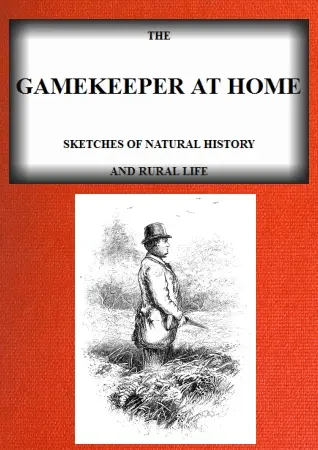
The Gamekeeper at Home: Sketches of natural history and rural life (Illustrated)
Richard Jefferies
THE CLASSIC COLLECTION · 1889
"Field and Hedgerow: Being the Last Essays of Richard Jefferies" by Richard Jefferies is a collection of essays written in the late 19th century, posthumously compiled by his widow. This work reflects Jefferies’ deep appreciation for nature and the countryside, exploring themes related to the relationship between humans and the natural world, as well as observations on rural life, seasons, and the essence of existence. The opening of the collection introduces a contemplative reflection on spring, characterized by vivid descriptions of nature's awakening through birdsong, blossoming flowers, and the budding leaves. Jefferies expresses his wonderment at how the natural world continues effortlessly without human oversight, pondering the significance of his observations and emotions as he experiences nature from within his home. The prose captures not only the beauty of the landscape but also delves into introspective thoughts about life, mortality, and humankind’s connection to the earth, setting a contemplative tone for the essays to follow.
Introduction adapted from the source catalogue; source summaries may be automatically generated.
Free to read · English · 103,814 words · No account needed
MAKE TIME FOR A GOOD BOOK
On by default. Untick to stop anonymous reading totals. Each page counts after 10 seconds in view. How this works.
Anonymous counting is on unless you have switched it off.
The gallows at the cross-roads is gone, but the workhouse stands, and custom, cruel custom, that tyrant of the mind, has inured us (to use an old word) to its existence in our midst. Apart from any physical suffering, let us only consider the slow agony of the poor old reaper when he feels his lusty arm wither, and of the grey bowed wife as they feel themselves drifting like a ship ashore to that stony waiting-room. For it is a waiting-room till the grave receives them. Economically, too, the workhouse is a heavy loss and drag.
Could we, then, see the tithe barn filled again with golden wheat for this purpose of help to humanity, it might be a great and wonderful good. With this tenth to feed the starving and clothe the naked; with the tenth to give the little children a midday meal at the school--that would be natural and true. In the course of time, as the land laws lessen their grip, and the people take possession of the earth on which they stand, it is more than probable that something of this kind will really come about. It would be only simple justice after so many centuries--it takes so many hundreds of years to get even that.
'Workhouse, indeed!' I have heard the same ancient well-to-do greybeards ejaculate, 'workhouse! they ought to be very thankful they have got such a place to go to!'
All the village has been to the wheat-field with reaping-hooks, and waggons and horses, the whole strength of man has been employed upon it; little brown hands and large brown hands, blue eyes and dark eyes have been there searching about; all the intelligence of human beings has been brought to bear, and yet the stubble is not empty. Down there come again the ever-increasing clouds of sparrows; as a cloud rises here another cloud descends beyond it, a very mist and vapour as it were of wings. It makes one wonder to think where all the nests could have been; there could hardly have been enough caves and barns for all these to have been bred in. Every one of the multitude has a keen pair of eyes and a hungry beak, and every single individual finds something to eat in the stubble. Something that was not provided for them, crumbs that have escaped from this broad table, and there they are every day for weeks together, still finding food. If you will consider the incredible number of little mouths, and the busy rate at which they ply them hour by hour, you may imagine what an immense number of grains of wheat must have escaped man's hand, for you must remember that every time they peck they take a whole grain. Down, too, come the grey-blue wood-pigeons and the wild turtle-doves. The singing linnets come in parties, the happy greenfinches, the streaked yellow-hammers, as if any one had delicately painted them in separate streaks, and not with a wash of colour, the brown buntings, chaffinches--out they come from the hazel copses, where the nuts are dropping, and the hedge berries turning red, and every one finds something to his liking. There are the seeds of the charlock and the thistle, and a hundred other little seeds, insects, and minute atom-like foods it needs a bird's eye to know. They are never still, they sweep up into the hedges and line the boughs, calling and talking, and away again to another rood of stubble without any order or plan of search, just sowing themselves about like wind-blown seeds. Up and down the day through with a zest never failing. It is beautiful to listen to them and watch them, if any one will stay under an oak by the nut-tree boughs, here the dragon-flies shoot to and fro in the shade as if the direct rays of the sun would burn their delicate wings; they hunt chiefly in the shade. The linnets will suddenly sweep up into the boughs and converse sweetly over your head. The sunshine lingers and grows sweeter as the autumn gives tokens of its coming in the buff bryony leaf, and the acorn filling its cup. They are so happy, the birds, yet there are few to listen to them. I have often looked round and wondered that no one else was about hearkening to them. Altogether, perhaps, they lead safer lives in England than anywhere else. We do not shoot them; the fowlers do mischief, still they make but little impression; there are few birds of prey, and there is not that fearful bloodthirstiness that makes a tropical forest so terrible in fact, under its outward show of glowing colour. There, with cruel hawks and owls, and serpents, and beasts of prey, a bird's life is one long terror. They are ever on the watch here, but they are not so fearfully harassed, and are not certain as it were beforehand to be torn to pieces. The land is well cultivated, and the more the culture the more the food for them. Frost and snow are their greatest enemies, but even these do not often last a great while. It is a land of woods, and above all of hedges, which are much more favourable to birds than forests, so that they are better off in England than in other countries. From the sowing to the reaping, the wheat-field gives a constant dole like the monasteries of old, only here it is no crust, but a free and bountiful largess. Then the stubble must be broken up by the plough, and again there is a fresh helping for them. Brown partridge, and black rook, and yellowhammer, all hues and degrees, come to the wheat-field.
Your reading position is saved on this browser. Take it to another device with a library code. Reading pages adapt to text, rather than matching a printed edition.
Richard Jefferies
Richard Jefferies
Richard Jefferies
Richard Jefferies
BEHIND THE BOOK
This eBook is for the use of anyone anywhere in the United States and most other parts of the world at no cost and with almost no restrictions whatsoever. You may copy it, give it away or re-use it under the terms of the Project Gutenberg License included with this eBook or online at www.gutenberg.org. If you are not located in the United States, you will have to check the laws of the country where you are located before using this eBook. Read the source licence.
The original source file, including credits and licence, is retained by this library. Request an original-format copy at no charge. Please include the book title and Project Gutenberg identifier #7030.
KEEP YOUR CURIOSITY GOING
Wilfrid Scawen Blunt
Wilfrid Scawen Blunt

E. W. (Edgar Watson) Howe

David Patterson (Spirit) Hatch

David Patterson (Spirit) Hatch

David Patterson (Spirit) Hatch