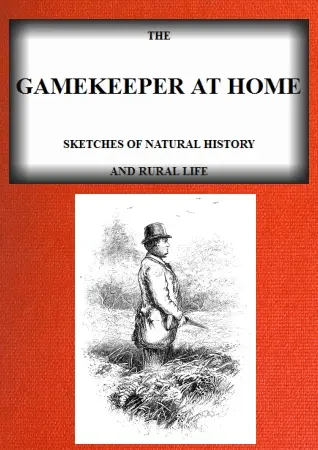
The Gamekeeper at Home: Sketches of natural history and rural life (Illustrated)
Richard Jefferies
THE CLASSIC COLLECTION · 1889
"Field and Hedgerow: Being the Last Essays of Richard Jefferies" by Richard Jefferies is a collection of essays written in the late 19th century, posthumously compiled by his widow. This work reflects Jefferies’ deep appreciation for nature and the countryside, exploring themes related to the relationship between humans and the natural world, as well as observations on rural life, seasons, and the essence of existence. The opening of the collection introduces a contemplative reflection on spring, characterized by vivid descriptions of nature's awakening through birdsong, blossoming flowers, and the budding leaves. Jefferies expresses his wonderment at how the natural world continues effortlessly without human oversight, pondering the significance of his observations and emotions as he experiences nature from within his home. The prose captures not only the beauty of the landscape but also delves into introspective thoughts about life, mortality, and humankind’s connection to the earth, setting a contemplative tone for the essays to follow.
Introduction adapted from the source catalogue; source summaries may be automatically generated.
Free to read · English · 103,814 words · No account needed
MAKE TIME FOR A GOOD BOOK
On by default. Untick to stop anonymous reading totals. Each page counts after 10 seconds in view. How this works.
Anonymous counting is on unless you have switched it off.
There was another wheat-field by the side of which I used to walk sometimes in the evenings, as the grains in the cars began to grow firm. The path ran for a mile beside it--a mile of wheat in one piece--all those million million stalks the same height, all with about the same number of grains in each car, all ripening together. The hue of the surface travelled along as you approached; the tint of yellow shifted farther like the reflection of sunlight on water, but the surface was really much the same colour everywhere. It seemed a triumph of culture over such a space, such regularity, such perfection of myriads of plants springing in their true lines at the same time, each particular ear perfect, and a mile of it. Perfect work with the plough, the drill, the harrow in every detail, and yet such breadth. Let your hand touch the ears lightly as you walk--drawn through them as if over the side of a boat in water--feeling the golden heads. The sparrows fly out every now and then ahead; some of the birds like their corn as it hardens, and some while it is soft and full of milky sap. There are hares within, and many a brood of partridge chicks that cannot yet use their wings. Thick as the seed itself the feathered creatures have been among the wheat since it was sown. Finches more numerous than the berries on the hedges; sparrows like the finches multiplied by finches, linnets, rooks, like leaves on the trees, wood-pigeons whose crops are like bushel baskets for capacity; and now as it ripens the multitude will be multiplied by legions, and as it comes to the harvest there is a fresh crop of sparrows from the nests in the barns, you may see a brown cloud of them a hundred yards long. Besides which there were the rabbits that ate the young green blades, and the mice that will be busy in the sheaves, and the insects from spring-time to granary, a nameless host uncounted. A whole world, as it were, let loose upon the wheat, to eat, consume, and wither it, and yet it conquers the whole world. The great field you see was filled with gold corn four feet deep as a pitcher is filled with water to the brim. Of yore the rich man is said, in the Roman classic, to have measured his money, so here you might have measured it by the rood. The sunbeams sank deeper and deeper into the wheatears, layer upon layer of light, and the colour deepened by these daily strokes. There was no bulletin to tell the folk of its progress, no Nileometer to mark the rising flood of the wheat to its hour of overflow. Yet there went through the village a sense of expectation, and men said to each other, 'We shall be there soon.' No one knew the day--the last day of doom of the golden race; every one knew it was nigh. One evening there was a small square piece cut at one side, a little notch, and two shocks stood there in the twilight. Next day the village sent forth its army with their crooked weapons to cut and slay. It used to be an era, let me tell you, when a great farmer gave the signal to his reapers; not a man, woman, or child that did not talk of that. Well-to-do people stopped their vehicles and walked out into the new stubble. Ladies came, farmers, men of low degree, everybody--all to exchange a word or two with the workers. These were so terribly in earnest at the start they could scarcely acknowledge the presence even of the squire. They felt themselves so important, and were so full, and so intense and one-minded in their labour, that the great of the earth might come and go as sparrows for aught they cared. More men and more men were put on day by day, and women to bind the sheaves, till the vast field held the village, yet they seemed but a handful buried in the tunnels of the golden mine: they were lost in it like the hares, for as the wheat fell, the shocks rose behind them, low tents of corn. Your skin or mine could not have stood the scratching of the straw, which is stiff and sharp, and the burning of the sun, which blisters like red-hot iron. No one could stand the harvest-field as a reaper except he had been born and cradled in a cottage, and passed his childhood bareheaded in July heats and January snows. I was always fond of being out of doors, yet I used to wonder how these men and women could stand it, for the summer day is long, and they were there hours before I was up. The edge of the reap-hook had to be driven by force through the stout stalks like a sword, blow after blow, minute after minute, hour after hour; the back stooping, and the broad sun throwing his fiery rays from a full disc on the head and neck. I think some of them used to put handkerchiefs doubled up in their hats as pads, as in the East they wind the long roll of the turban about the head, and perhaps they would have done better if they had adopted the custom of the South and wound a long scarf about the middle of the body, for they were very liable to be struck down with such internal complaints as come from great heat. Their necks grew black, much like black oak in old houses. Their open chests were always bare, and flat, and stark, and never rising with rounded bust-like muscle as the Greek statues of athletes.
Your reading position is saved on this browser. Take it to another device with a library code. Reading pages adapt to text, rather than matching a printed edition.
Richard Jefferies
Richard Jefferies
Richard Jefferies
Richard Jefferies
BEHIND THE BOOK
This eBook is for the use of anyone anywhere in the United States and most other parts of the world at no cost and with almost no restrictions whatsoever. You may copy it, give it away or re-use it under the terms of the Project Gutenberg License included with this eBook or online at www.gutenberg.org. If you are not located in the United States, you will have to check the laws of the country where you are located before using this eBook. Read the source licence.
The original source file, including credits and licence, is retained by this library. Request an original-format copy at no charge. Please include the book title and Project Gutenberg identifier #7030.
KEEP YOUR CURIOSITY GOING
Wilfrid Scawen Blunt
Wilfrid Scawen Blunt

E. W. (Edgar Watson) Howe

David Patterson (Spirit) Hatch

David Patterson (Spirit) Hatch

David Patterson (Spirit) Hatch