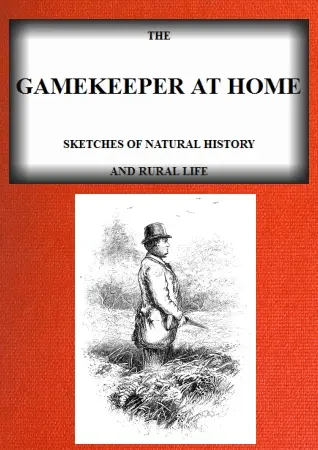
The Gamekeeper at Home: Sketches of natural history and rural life (Illustrated)
Richard Jefferies
THE CLASSIC COLLECTION · 1889
"Field and Hedgerow: Being the Last Essays of Richard Jefferies" by Richard Jefferies is a collection of essays written in the late 19th century, posthumously compiled by his widow. This work reflects Jefferies’ deep appreciation for nature and the countryside, exploring themes related to the relationship between humans and the natural world, as well as observations on rural life, seasons, and the essence of existence. The opening of the collection introduces a contemplative reflection on spring, characterized by vivid descriptions of nature's awakening through birdsong, blossoming flowers, and the budding leaves. Jefferies expresses his wonderment at how the natural world continues effortlessly without human oversight, pondering the significance of his observations and emotions as he experiences nature from within his home. The prose captures not only the beauty of the landscape but also delves into introspective thoughts about life, mortality, and humankind’s connection to the earth, setting a contemplative tone for the essays to follow.
Introduction adapted from the source catalogue; source summaries may be automatically generated.
Free to read · English · 103,814 words · No account needed
MAKE TIME FOR A GOOD BOOK
On by default. Untick to stop anonymous reading totals. Each page counts after 10 seconds in view. How this works.
Anonymous counting is on unless you have switched it off.
The ancient Roman censor who tried by laws and persuasions to induce the inhabitants of Rome to marry, yet could not succeed in inducing them to submit to what they considered a sacrifice for the benefit of the state, would have been delighted with the marrying tendencies of the chapel people. A venerable old gentleman--a great pillar of the body--after the decease of his first wife married her sister, and again, upon her removal, married his cook. Another great prop--elderly indeed, but still upright and iron-grey, a most powerfully made man, who always spoke as if his words were indeed law--rule-of-thumb law--has married three sisters in succession, and has had offspring by all. Their exact degrees of consanguinity I cannot tell you, or whether they call each other brothers and sisters, or cousins. This is certain, however, that whether such marriages be legal or not, they are as such regarded and as such accepted in every sense by the society to which these gentlemen belong. Another gentleman now has his fourth wife, and he, too, is a most strenuous believer, and not his bitterest enemy can rake up the smallest accusation against his character. He, too, is a strong and upright man, fully capable of another wife if time should chance to bring it about. Now, the odd part of it is that, having married four times, and each time in the same village, where all the families are more or less connected, he is more or less related to every single individual in the parish. First, there are his own blood relations and his wives' blood relations, and then there are their relations' relations, and next his sons and daughters have married and introduced a fresh roll, and I really do not think either he or anybody else knows exactly where the list ends. This is nothing uncommon. Though clans and tribes no longer settle under their respective chiefs in villages, the families of the same name and blood still present a very close representation of the clan system. They have all the tribal relationship without any of its feeling. Instead of forming a strong body and helping each other, these people seemed to detest one another, and to lose no opportunity of snatching some little advantage or telling some scandalous tale. In fact, this in-and-in breeding seems one of the curses of village life, and a cause of stagnation and narrowness of mind. This marrying and giving in marriage is not singular to well-to-do leaders of chapel society, but goes on with equal fervour among the lower members. The cottage girls and cottage boys marry the instant they get a chance, and it is not at all uncommon to find comparatively young labourers who have had two wives. There is nothing in this to reproach: it is a peculiarity of the cast of mind which I am endeavouring to describe--a cast of mind perhaps not much marked by sentimentality. Something in this practice reminds one of the Mormons. Certainly the wives are not taken together, but they are sealed as fast as circumstances permit. Something in it has a Mormonite aspect to an observer, and perhaps the existence of this cast of mind may assist in explaining the inexplicable growth of that strange religion. Doubtless they would repudiate the suggestion with loud outcries and indignation, for people are always most vigorous in denouncing themselves unconsciously. These numerous wives (who are quite willing), the marrying of sisters, the primitive gatherings at the chapel, so like the religious camps of the Far West, the general relationship, have a distinct flavour of Salt Lake. Add to this the immense working power of these pluralist giants, for you will generally find that the well-to-do chapeller with his third wife, or more, is a man who has raised himself from very much nothing to very much something. By sheer force of labour and push he has lifted himself head and shoulders above the village--a career, too, conspicuous by strict integrity. Did he live in a London suburb he would be pointed out to the rising generation by anxious fathers as the very model for them to follow. The village ought to be proud of them, but the village secretly and aside hates them, being practical commentaries on the general sloth and stupidity. This energy of work, too, is like the saints of Utah, who have made an oasis and a garden where was a desert. After labouring from morning till night they like the sound of a feminine voice and the warmth of a feminine welcome in the back parlour of rest.
Your reading position is saved on this browser. Take it to another device with a library code. Reading pages adapt to text, rather than matching a printed edition.
Richard Jefferies
Richard Jefferies
Richard Jefferies
Richard Jefferies
BEHIND THE BOOK
This eBook is for the use of anyone anywhere in the United States and most other parts of the world at no cost and with almost no restrictions whatsoever. You may copy it, give it away or re-use it under the terms of the Project Gutenberg License included with this eBook or online at www.gutenberg.org. If you are not located in the United States, you will have to check the laws of the country where you are located before using this eBook. Read the source licence.
The original source file, including credits and licence, is retained by this library. Request an original-format copy at no charge. Please include the book title and Project Gutenberg identifier #7030.
KEEP YOUR CURIOSITY GOING
Wilfrid Scawen Blunt
Wilfrid Scawen Blunt

E. W. (Edgar Watson) Howe

David Patterson (Spirit) Hatch

David Patterson (Spirit) Hatch

David Patterson (Spirit) Hatch