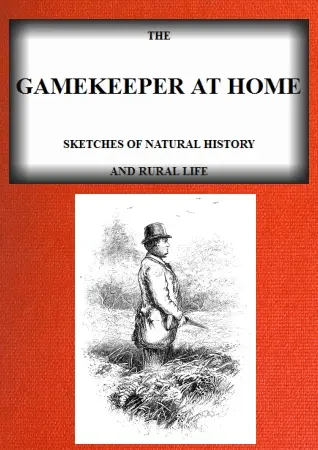
The Gamekeeper at Home: Sketches of natural history and rural life (Illustrated)
Richard Jefferies
THE CLASSIC COLLECTION · 1889
"Field and Hedgerow: Being the Last Essays of Richard Jefferies" by Richard Jefferies is a collection of essays written in the late 19th century, posthumously compiled by his widow. This work reflects Jefferies’ deep appreciation for nature and the countryside, exploring themes related to the relationship between humans and the natural world, as well as observations on rural life, seasons, and the essence of existence. The opening of the collection introduces a contemplative reflection on spring, characterized by vivid descriptions of nature's awakening through birdsong, blossoming flowers, and the budding leaves. Jefferies expresses his wonderment at how the natural world continues effortlessly without human oversight, pondering the significance of his observations and emotions as he experiences nature from within his home. The prose captures not only the beauty of the landscape but also delves into introspective thoughts about life, mortality, and humankind’s connection to the earth, setting a contemplative tone for the essays to follow.
Introduction adapted from the source catalogue; source summaries may be automatically generated.
Free to read · English · 103,814 words · No account needed
MAKE TIME FOR A GOOD BOOK
On by default. Untick to stop anonymous reading totals. Each page counts after 10 seconds in view. How this works.
Anonymous counting is on unless you have switched it off.
The hundreds of times I saw the tall chimney of that cottage rise out of the hill-side as I came home at all hours of the day and night! the first chimney after a long journey, always comfortable to see, especially so in earlier days, when we had a kind of halting belief in John Brown's ghosts, several of which were dotted along that road according to him. The ghosts die as we grow older, they die and their places are taken by real ghosts. I wish I had sent John Brown a pound or two when I was in good health; but one is selfish then, and puts off things till it is too late--a lame excuse verily. I can scarcely believe now that he is really dead, gone as you might casually pluck a hawthorn leaf from the hedge.
The next cottage was a very marked one, for houses grow to their owners. The low thatched roof had rounded itself and stooped down to fit itself to Job's shoulders; the walls had got short and thick to suit him, and they had a yellowish colour, like his complexion, as if chewing tobacco had stained his cheeks right through. Tobacco juice had likewise penetrated and tinted the wall. It was cut off as it seemed by a party-wall into one room, instead of which there were more rooms beyond which no one would have suspected. Job had a way of shaking hands with you with his right hand, while his left hand was casually doing something else in a detached sort of way. 'Yes, sir,' and 'No, sir,' and nodding to everything you said all so complaisant, but at the end of the bargain you generally found yourself a few shillings in some roundabout manner on the wrong side. Job had a lot of shut-up rooms in his house and in his character, which never seemed to be opened to daylight. The eaves hung over and beetled like his brows, and he had a forelock, a regular antique forelock, which he used to touch with the greatest humility. There was a long bough of an elm hanging over one gable just like the forelock. His face was a blank, like the broad end wall of the cottage, which had no window--at least you might think so until you looked up and discovered one little arrow slit, one narrow pane, and woke with a start to the idea that Job was always up there watching and listening. That was how he looked out of his one eye so intensely cunning, the other being a wall eye--that is, the world supposed so, as he kept it half shut, always between the lights; but whether it was really blind or not I cannot say. Job caught rats and rabbits and moles, and bought fagots or potatoes, or fruit or rabbit-skins, or rusty iron: wonderful how he seemed to have command of money. It was done probably by buying and selling almost simultaneously, so that the cash passed really from one customer to another, and was never his at all. Also he worked as a labourer, chiefly piecework; also Mrs. Job had a shop window about two feet square: snuff and tobacco, bread and cheese, immense big round jumbles and sugar, kept on the floor above, and reached down by hand, when wanted, through the opening for the ladder stairs. The front door--Job's right hand--was always open in summer, and the flagstones of the floor chalked round their edges; a clean table, clean chairs, decent crockery, an old clock about an hour slow, a large hearth with a minute fire to boil the kettle without heating the room. Tea was usually at half-past three, and it is a fact that many well-to-do persons, as they came along the road hot and dusty, used to drop in and rest and take a cup--very little milk and much gossip. Two paths met just there, and people used to step in out of a storm of rain, a sort of thatched house club. Job was somehow on fair terms with nearly everybody, and that is a wonderful thing in a village, where everybody knows everybody's business, and petty interests continually cross. The strangest fellow and the strangest way of life, and yet I do not believe a black mark was ever put against him; the shiftiness was all for nothing. It arose, no doubt, out of the constant and eager straining to gain a little advantage and make an extra penny. Had Job been a Jew he would have been rich. He was the exact counterpart of the London Jew dealer, set down in the midst of the country. Job should have been rich. Such immense dark brown jumbles, such cheek-distenders--never any French sweetmeats or chocolate or bonbons to equal these. I really think I could eat one now. The pennies and fourpenny bits--there were fourpenny bits in those days--that went behind that two-foot window, goodness! there was no end. Job used to chink them in a pint pot sometimes before the company, to give them an idea of his great hoards. He always tried to impress people with his wealth, and would talk of a fifty-pound contract as if it was nothing to him. Jumbles are eternal, if nothing else is. I thought then there was not such another shop as Job's in the universe. I have found since that there is a Job shop in every village, and in every street in every town--that is to say, a window for jumbles and rubbish; and if you don't know it, you may be quite sure your children do, and spend many a sly penny there. Be as rich as you may, and give them gilded sweetmeats at home, still they will slip round to the Job shop.
Your reading position is saved on this browser. Take it to another device with a library code. Reading pages adapt to text, rather than matching a printed edition.
Richard Jefferies
Richard Jefferies
Richard Jefferies
Richard Jefferies
BEHIND THE BOOK
This eBook is for the use of anyone anywhere in the United States and most other parts of the world at no cost and with almost no restrictions whatsoever. You may copy it, give it away or re-use it under the terms of the Project Gutenberg License included with this eBook or online at www.gutenberg.org. If you are not located in the United States, you will have to check the laws of the country where you are located before using this eBook. Read the source licence.
The original source file, including credits and licence, is retained by this library. Request an original-format copy at no charge. Please include the book title and Project Gutenberg identifier #7030.
KEEP YOUR CURIOSITY GOING
Wilfrid Scawen Blunt
Wilfrid Scawen Blunt

E. W. (Edgar Watson) Howe

David Patterson (Spirit) Hatch

David Patterson (Spirit) Hatch

David Patterson (Spirit) Hatch