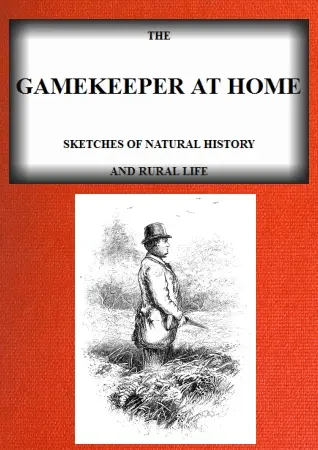
The Gamekeeper at Home: Sketches of natural history and rural life (Illustrated)
Richard Jefferies
THE CLASSIC COLLECTION · 1889
"Field and Hedgerow: Being the Last Essays of Richard Jefferies" by Richard Jefferies is a collection of essays written in the late 19th century, posthumously compiled by his widow. This work reflects Jefferies’ deep appreciation for nature and the countryside, exploring themes related to the relationship between humans and the natural world, as well as observations on rural life, seasons, and the essence of existence. The opening of the collection introduces a contemplative reflection on spring, characterized by vivid descriptions of nature's awakening through birdsong, blossoming flowers, and the budding leaves. Jefferies expresses his wonderment at how the natural world continues effortlessly without human oversight, pondering the significance of his observations and emotions as he experiences nature from within his home. The prose captures not only the beauty of the landscape but also delves into introspective thoughts about life, mortality, and humankind’s connection to the earth, setting a contemplative tone for the essays to follow.
Introduction adapted from the source catalogue; source summaries may be automatically generated.
Free to read · English · 103,814 words · No account needed
MAKE TIME FOR A GOOD BOOK
On by default. Untick to stop anonymous reading totals. Each page counts after 10 seconds in view. How this works.
Anonymous counting is on unless you have switched it off.
I remember taking sly glances when I was a very little boy at an old Culpepper's Herbal, heavily bound in leather and curiously illustrated. It was so deliciously wicked to read about the poisons; and I thought perhaps it was a book like that, only in papyrus rolls, that was used by the sorceress who got ready the poisoned mushrooms in old Rome. Youth's ideas are so imaginative, and bring together things that are so widely separated. Conscience told me I had no business to read about poisons; but there was a fearful fascination in hemlock, and I recollect tasting a little bit--it was very nasty. At this day, nevertheless, if any one wishes to begin a pleasant, interesting, unscientific acquaintance with English plants, he would do very well indeed to get a good copy of Culpepper. Grey hairs had insisted in showing themselves in my beard when, all those weary years afterwards, I thought I would like to buy the still older Englishman, Gerard, who had no Linnaeus to guide him, who walked about our English lanes centuries ago. What wonderful scenes he must have viewed when they were all a tangle of wild flowers, and plants that are now scarce were common, and the old ploughs, and the curious customs, and the wild red-deer--it would make a good picture, it really would, Gerard studying English orchids! Such a volume!--hundreds of pages, yellow of course, close type, and marvellously well printed. The minute care they must have taken in those early days of printing to get up such a book--a wonderful volume both in bodily shape and contents. Just then the only copy I could hear of was much damaged. The cunning old bookseller said he could make it up; but I have no fancy for patched books, they are not genuine; I would rather have them deficient; and the price was rather long, and so I went Gerardless. Of folk-lore and medicinal use and history and associations here you have hints. The bottom of the sack is not yet; there are the monographs, years of study expended upon one species of plant growing in one locality, perhaps; some made up into thick books and some into broad quarto pamphlets, with most beautiful plates, that, if you were to see them, would tempt you to cut them out and steal them, all sunk and lost like dead ships under the sand: piles of monographs. There are warehouses in London that are choked to the beams of the roof with them, and every fresh exploration furnishes another shelf-load. The source of the Nile was unknown a very few years ago, and now, I have no doubt, there are dozens of monographs on the flowers that flourish there. Indeed, there is not a thing that grows that may not furnish a monograph. The author spends perhaps twenty years in collecting his material, during which time he must of course come across a great variety of amusing information, and then he spends another ten years writing out a fair copy of his labours. Then he thinks it does not quite do in that form, so he snips a paragraph out of the beginning and puts it at the end; next he shifts some more matter from the middle to the preface; then he thinks it over. It seems to him that it is too big, it wants condensation. The scientific world will say he has made too much of it; it ought to read very slight, and present the facts while concealing the labour. So he sets about removing the superfluous--leaves out all the personal observations, and all the little adventures he has met with in his investigations; and so, having got it down to the dry bones and stones thereof and omitted all the mortar that stuck them together, he sends for the engraver, and the next three years are occupied in working up the illustrations. About this time some new discovery is made by a foreign observer, which necessitates a complete revision of the subject; and so having shifted the contents of the book about hither and thither till he does not know which is the end and which is the beginning, he pitches the much-mutilated copy into a drawer and turns the key. Farewell, no more of this; his declining days shall be spent in peace. A few months afterwards a work is announced in Leipsic which 'really trenches on my favourite subject, and really after spending a lifetime I can't stand it.' By this time his handwriting has become so shaky he can hardly read it himself, so he sends in despair for a lady who works a type-writer, and with infinite patience she makes a clean manuscript of the muddled mass. To the press at last, and the proofs come rapidly. Such a relief! How joyfully easy a thing is when you set about it! but by-and-by this won't do. Sub-section A ought to be in a foot-note, family B is doubtful; and so the corrections grow and run over the margin in a thin treble hand, till they approach the bulk of the original book--a good profit for the printer; and so after about forty years the monograph is published--the work of a life is accomplished. Fifty copies are sent round to as many public libraries and learned societies, and the rest of the impression lies on the shelves till dust and time and spiders' webs have buried it. Splendid work in it too. Looked back upon from to-day with the key of modern thought, these monographs often contain a whole chest of treasure. And still there are the periodicals, a century of magazines and journals and reviews and notices that have been coming out these hundred years and dropping to the ground like dead leaves unnoticed. And then there are the art works--books about shape and colour and ornament, and a naturalist lately has been trying to see how the leaves of one tree look fitted on the boughs of another. Boundless is the wealth of Flora's lap; the ingenuity of man has been weaving wreaths out of it for ages, and still the bottom of the sack is not yet. Nor have we got much news of the dandelion. For I sit on the thrown timber under the trees and meditate, and I want something more: I want the soul of the flowers.
Your reading position is saved on this browser. Take it to another device with a library code. Reading pages adapt to text, rather than matching a printed edition.
Richard Jefferies
Richard Jefferies
Richard Jefferies
Richard Jefferies
BEHIND THE BOOK
This eBook is for the use of anyone anywhere in the United States and most other parts of the world at no cost and with almost no restrictions whatsoever. You may copy it, give it away or re-use it under the terms of the Project Gutenberg License included with this eBook or online at www.gutenberg.org. If you are not located in the United States, you will have to check the laws of the country where you are located before using this eBook. Read the source licence.
The original source file, including credits and licence, is retained by this library. Request an original-format copy at no charge. Please include the book title and Project Gutenberg identifier #7030.
KEEP YOUR CURIOSITY GOING
Wilfrid Scawen Blunt
Wilfrid Scawen Blunt

E. W. (Edgar Watson) Howe

David Patterson (Spirit) Hatch

David Patterson (Spirit) Hatch

David Patterson (Spirit) Hatch