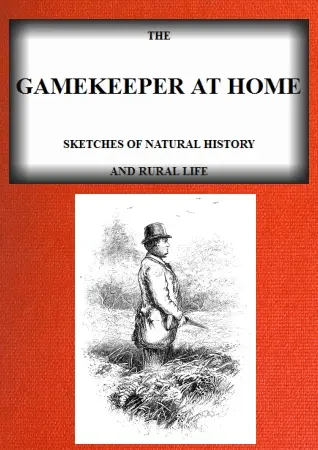
The Gamekeeper at Home: Sketches of natural history and rural life (Illustrated)
Richard Jefferies
THE CLASSIC COLLECTION · 1889
"Field and Hedgerow: Being the Last Essays of Richard Jefferies" by Richard Jefferies is a collection of essays written in the late 19th century, posthumously compiled by his widow. This work reflects Jefferies’ deep appreciation for nature and the countryside, exploring themes related to the relationship between humans and the natural world, as well as observations on rural life, seasons, and the essence of existence. The opening of the collection introduces a contemplative reflection on spring, characterized by vivid descriptions of nature's awakening through birdsong, blossoming flowers, and the budding leaves. Jefferies expresses his wonderment at how the natural world continues effortlessly without human oversight, pondering the significance of his observations and emotions as he experiences nature from within his home. The prose captures not only the beauty of the landscape but also delves into introspective thoughts about life, mortality, and humankind’s connection to the earth, setting a contemplative tone for the essays to follow.
Introduction adapted from the source catalogue; source summaries may be automatically generated.
Free to read · English · 103,814 words · No account needed
MAKE TIME FOR A GOOD BOOK
On by default. Untick to stop anonymous reading totals. Each page counts after 10 seconds in view. How this works.
Anonymous counting is on unless you have switched it off.
Country boys set some value on the eggs of the nettle-creeper or whitethroat because the nest is difficult to find, and the eggs curiously marked. They want the eggs as soon as laid, when they blow well; and it is just at this stage that the nest is most difficult to discover, as the bird gives little evidence of its presence. The nest is placed among the thick grasses and plants that grow at the verge or down the sides of dry ditches, and is frequently overshadowed by nettles. But there does not appear to be any conscious effort at concealment. The bird spends the day searching for food in such places--hence its name nettle-creeper--creeping along the hedges, under brambles and thorns, and builds its nest in the locality to which it is accustomed. It may appear to be cunning to a superficial human observer, but it is certain that the bird does not think itself cunning. Men who live by fishing build their houses near the sea; those who cultivate wheat, in open plains; artisans, by factories. The whitethroat frequents the hedge and ditch, and there weaves its slender nest. So much has been attributed to birds of which they are really quite unconscious. It has even been put forward that the colours of their eggs are intended to deceive; and those of the dotterel, laid on the open beach, are often mentioned as an instance. The resemblance of the dotterel's egg to a pebble is no greater than the resemblance between many eggs laid in nests and pebbles. If the whitethroat eggs were taken from the nest and placed among particoloured pebbles such as are common on some shores, it would need care to distinguish them. If the dotterel's eggs were put down among grass, or even among the clods of ploughed land, they would be equally difficult to find. You might as well suppose that the whitethroat is aware that nettles will sting the human hand approaching its nest as that eggs are especially adjusted in colour to deceive human eyes. As for deceiving the eyes of those birds that are fond of eating eggs, the thing is impossible; the size of the egg is alone sufficient: how conceal an object of that size from an eye that can distinguish insects? The egg takes its chance, coloured or not. Sportsmen would be very glad if pheasants would kindly learn by experience, and lay eggs of a hue invisible to the poaching rook or crow. Nor is this nest, that seems so slender and so delicately made, really so slender to the bird itself. To a man or woman, so many times larger than the nest, its construction appears intricate. Suppose a lady stands five feet four inches high, and the nest placed in her hand measures two inches across: the difference is immense. The bird who built it is smaller than the nest. The thing is reversed, and it does not look tiny to the bird. The horsehair or fibre, which to us is an inch or two long, to the bird is a bamboo or cane three or four feet in length. No one would consider it difficult to weave cane or willow wands as tall as himself. The girls at Luton perform much more difficult feats in weaving straw-plait for bonnets than any bird accomplishes. A rook's nest looked at in the same way is about as large to the bird as a small breakfast-parlour, and is composed of poles. To understand birds you must try and see things as they see them, not as you see them. They are quite oblivious of your sentiments or ideas, and their actions have no relation to yours. A whole system of sentiment and conduct has been invented for birds and animals based entirely upon the singular method of attributing to them plans which might occur to a human being. The long-tailed tit often builds its nest in the midst of blackthorn thickets (which afford it the lichen it uses), or in deep hawthorn bushes. A man comes along, sees the nest, and after considerable exertion--having to thrust himself into the hedge--and after some pain, being pricked by the thorns, succeeds, with bleeding hands, in obtaining possession of it. 'Ah,' he moralises, 'what wonderful instinct on the part of this little creature to surround itself with a zareba like the troops after Osman Digma! Just look at my hands.' Proof positive to him; but not to any one who considers that through the winter, up till nesting-time, these little creatures have been creeping about such thorns and thickets, and that they had no expectation whatever of a hand being thrust into the bushes. The spot which is so difficult of access to a man is to them easy of entrance. They look at the matter from the very opposite point of view. The more thoroughly the artificial system of natural history ethics is dismissed from the mind the more interesting wild creatures will be found, because while it is adhered to a veil is held before the eyes, and nothing useful can ever be discovered. Put it aside, and there is always something new and as interesting as a fresh nest to a boy.
Your reading position is saved on this browser. Take it to another device with a library code. Reading pages adapt to text, rather than matching a printed edition.
Richard Jefferies
Richard Jefferies
Richard Jefferies
Richard Jefferies
BEHIND THE BOOK
This eBook is for the use of anyone anywhere in the United States and most other parts of the world at no cost and with almost no restrictions whatsoever. You may copy it, give it away or re-use it under the terms of the Project Gutenberg License included with this eBook or online at www.gutenberg.org. If you are not located in the United States, you will have to check the laws of the country where you are located before using this eBook. Read the source licence.
The original source file, including credits and licence, is retained by this library. Request an original-format copy at no charge. Please include the book title and Project Gutenberg identifier #7030.
KEEP YOUR CURIOSITY GOING
Wilfrid Scawen Blunt
Wilfrid Scawen Blunt

E. W. (Edgar Watson) Howe

David Patterson (Spirit) Hatch

David Patterson (Spirit) Hatch

David Patterson (Spirit) Hatch