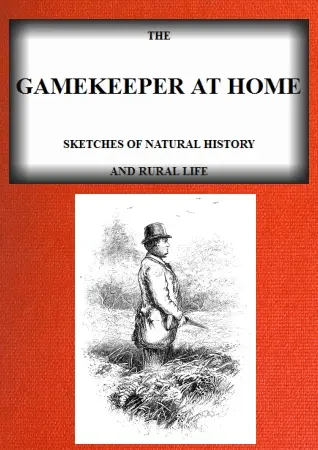
The Gamekeeper at Home: Sketches of natural history and rural life (Illustrated)
Richard Jefferies
THE CLASSIC COLLECTION · 1889
"Field and Hedgerow: Being the Last Essays of Richard Jefferies" by Richard Jefferies is a collection of essays written in the late 19th century, posthumously compiled by his widow. This work reflects Jefferies’ deep appreciation for nature and the countryside, exploring themes related to the relationship between humans and the natural world, as well as observations on rural life, seasons, and the essence of existence. The opening of the collection introduces a contemplative reflection on spring, characterized by vivid descriptions of nature's awakening through birdsong, blossoming flowers, and the budding leaves. Jefferies expresses his wonderment at how the natural world continues effortlessly without human oversight, pondering the significance of his observations and emotions as he experiences nature from within his home. The prose captures not only the beauty of the landscape but also delves into introspective thoughts about life, mortality, and humankind’s connection to the earth, setting a contemplative tone for the essays to follow.
Introduction adapted from the source catalogue; source summaries may be automatically generated.
Free to read · English · 103,814 words · No account needed
MAKE TIME FOR A GOOD BOOK
On by default. Untick to stop anonymous reading totals. Each page counts after 10 seconds in view. How this works.
Anonymous counting is on unless you have switched it off.
The most ancient attempt to delineate the objects of sport in existence is, I think, the celebrated engraving of a mammoth on a portion of a mammoth's tusk. I call it an engraving because the figure is marked out with incised lines such as the engraver makes with his tool, and it is perfect enough to print from. If it were inked and properly manipulated it would leave an impression--an artist's proof the most curious and extraordinary in the world, for the block was cut with flint instruments by the Cave-men an incredible number of years ago, perhaps before England was separated from the Continent by the sea, while the two were still connected, and it was dry land where now the Calais-Douvres steams so steadily over the waves. But it would be an artist's proof with the lights and shades reversed, the lines that sketch the form of the mammoth would be white and the body dark, yet for all that lifelike, since the undulating indentations that represent the woolly hide of the immense creature would relieve the ground. This picture of a prehistoric animal, drawn by a prehistoric artist, shows that Art arose from the chase. Traced to the den of primeval man, who had no Academy to instruct him, no Ruskin to guide, and no gallery to exhibit in, it appears that Art sprang from nature, and not from science. His life was occupied with the hunt, and he represented that which filled his thoughts. Those who understand wild sports will not for a moment doubt that the mammoth was taken in pits or otherwise destroyed despite its huge strength; no matter if it had been twice as large, the cunning of man would have been equal to the difficulty. The mind is the arrow that slays the monster. The greater the danger the greater the interest, and consequently the more the imagination would dwell upon the circumstances of the chase. Afterwards resting in the cave round about the fire and thinking of the mighty work of sport which had been accomplished, the finger of the savage would involuntarily describe the outline of the creature so laboriously captured. His finger might describe it upon the scattered ashes whitening the ground beside him. Or it might describe the outline simply in the air. Speech in its inception was as much expressed by the finger as the tongue; perhaps the fingers talked before the mouth, and in a sense writing preceded language. Uttering the unpolished sound which in their primitive society indicated the mammoth, the savage drew rapidly a figure with his finger, and his companions read his meaning written in the air. To this day it is common for the Italian peasantry to talk with their fingers; a few syllables suffice, illustrated and emphasised by those dexterous hands. A more subtle meaning is thus conveyed than could be put in words. Some of the most ancient languages seem bald and incomplete, too rigid; they need intonation, as it were, to express passion or changes of emotion, and when written the letters are too far apart to indicate what is meant. Not too far apart upon the page, but far apart in their sense, which has to be supplied as you supply the vowels. In actual use such languages must have required much gesture and finger-sketching in the air. The letters of the Egyptians largely consist of animals and birds, which represent both sounds and ideas. Dreaming over the embers of his fire, the Cave-man saw pass before his mental vision all the circumstances of the chase, ending with the crash when the mammoth crushed into the pit, at which he would start and partially awake. Intentness of mind upon a pursuit causes an equivalent intentness of dream, and thus wild races believe their dreams to be real and substantial things, and not mere shadows of the night. To those who do not read or write much, even in our days, dreams are much more real than to those who are continuously exercising the imagination. If you use your imagination all day you will not fear it at night. Since I have been occupied with literature my dreams have lost all vividness and are less real than the shadows of trees, they do not deceive me even in my sleep. At every hour of the day I am accustomed to call up figures at will before my eyes, which stand out well defined and coloured to the very hue of their faces. If I see these or have disturbed visions during the night they do not affect me in the least. The less literary a people the more they believe in dreams; the disappearance of superstition is not due to the cultivation of reason or the spread of knowledge, but purely to the mechanical effect of reading, which so perpetually puts figures and aerial shapes before the mental gaze that in time those that occur naturally are thought no more of than those conjured into existence by a book. It is in far-away country places, where people read very little, that they see phantoms and consult the oracles of fate. Their dreams are real.
Your reading position is saved on this browser. Take it to another device with a library code. Reading pages adapt to text, rather than matching a printed edition.
Richard Jefferies
Richard Jefferies
Richard Jefferies
Richard Jefferies
BEHIND THE BOOK
This eBook is for the use of anyone anywhere in the United States and most other parts of the world at no cost and with almost no restrictions whatsoever. You may copy it, give it away or re-use it under the terms of the Project Gutenberg License included with this eBook or online at www.gutenberg.org. If you are not located in the United States, you will have to check the laws of the country where you are located before using this eBook. Read the source licence.
The original source file, including credits and licence, is retained by this library. Request an original-format copy at no charge. Please include the book title and Project Gutenberg identifier #7030.
KEEP YOUR CURIOSITY GOING
Wilfrid Scawen Blunt
Wilfrid Scawen Blunt

E. W. (Edgar Watson) Howe

David Patterson (Spirit) Hatch

David Patterson (Spirit) Hatch

David Patterson (Spirit) Hatch