
The story of Betty
Carolyn Wells
THE CLASSIC COLLECTION · 1917
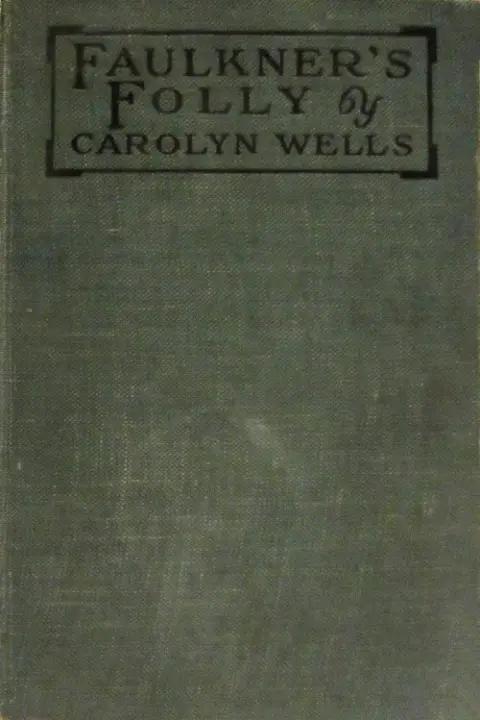
"Faulkner's Folly" by Carolyn Wells is a mystery novel written in the early 20th century. The story unfolds in a grand home known as Faulkner's Folly, where the life of renowned artist Eric Stannard takes a tragic turn when he is found murdered. The primary characters include Beatrice Faulkner, who is a guest in the house, and the women closely associated with the victim, namely his wife Joyce and a model named Natalie Vernon, who are both quickly embroiled in the subsequent investigation. The opening of the novel introduces the dramatic scene in the studio of Faulkner's Folly, where Stannard is discovered dead with an etching needle protruding from his chest. The narrative sets an eerie atmosphere as the characters, particularly Beatrice and the footman Blake, respond to the horrifying situation. As they enter the studio, we learn that Stannard's last words implicate one of the women present, casting suspicion over both Joyce and Natalie. The initial confusion leads to a storm of emotions and conflicting testimonies as a police investigation begins, focusing on the relationships and motives surrounding the characters involved. The rich detail in the opening hints at a complex web of intrigue that will unravel as the mystery deepens.
Introduction adapted from the source catalogue; source summaries may be automatically generated.
Free to read · English · 58,762 words · No account needed
MAKE TIME FOR A GOOD BOOK
On by default. Untick to stop anonymous reading totals. Each page counts after 10 seconds in view. How this works.
Anonymous counting is on unless you have switched it off.
"For shame, Mr. Roberts!" cried Joyce, angrily. "I am sorry I asked you here to-night, and I will now ask that you go away. I am more than interested in Orienta's work, I am enthralled, and I refuse to have it interrupted or interfered with by your unjust suspicions and rude behaviour! Please go away, and let us continue our experiments in peace."
"Oh, Mrs. Stannard, please let me stay," begged the penitent Bobsy; "I'll be good, I promise you. You see, I'm so interested in the thing, I wrote that to test it, and Madame Orienta came through with flying colours. If you will let me remain, I promise not to offend again, in any particular."
Bobsy had a way with him, and Orienta herself smiled a little as she said, "Let him stay. I'm glad to convince him."
So Bobsy staid.
Then Barry proposed that they try the same test over again, but without signing their papers. "Thus," he said, "we will feel more free to ask what we choose."
Orienta agreed, and again each wrote a question, and sealed it in an
envelope.
"Seal them with wax, if you wish," said the Priestess, smiling at Bobsy. "I see there is a sealing set right there on the desk."
So Bobsy and Natalie sealed their envelopes, and stamped them with their
rings.
"I won't do that," said Joyce, "it's too silly. We all know there's no
trick in it."
"Shall I read these in the dark or in the light?" asked Orienta, as Bobsy held the five missives toward her.
"Why not as you did before?" said Beatrice, "part of them in darkness and part in light. I think those read in the dark even more wonderful than in the light."
"So do I," agreed Joyce. "But we'll try both ways. Which first?"
"You may choose," said the Priestess.
"Dark, then," replied Joyce.
So again the room was made totally dark, and immediately came Orienta's
soft, velvety tones.
"'Will what I fear ever happen?'" she read slowly. Then she sighed, "I cannot say, my child." Every one present knew she spoke to Natalie, although the question had not been signed. "I hope not,--I think not,--but the vision is clouded. It is better that you forget all. Forget the past, live for a bright and happy future. The vision fades."
They had come to know that that last phrase meant the end of a subject, and the next one would ensue.
With scarcely a pause and without hesitation, Orienta went on:
"'What can I do to help?'" No hint was needed, for all felt sure this was Beatrice Faulkner's question.
Your reading position is saved on this browser. Take it to another device with a library code. Reading pages adapt to text, rather than matching a printed edition.
Carolyn Wells

Carolyn Wells & Harry Persons Taber

Carolyn Wells

Carolyn Wells
BEHIND THE BOOK
This eBook is for the use of anyone anywhere in the United States and most other parts of the world at no cost and with almost no restrictions whatsoever. You may copy it, give it away or re-use it under the terms of the Project Gutenberg License included with this eBook or online at www.gutenberg.org. If you are not located in the United States, you will have to check the laws of the country where you are located before using this eBook. Read the source licence.
The original source file, including credits and licence, is retained by this library. Request an original-format copy at no charge. Please include the book title and Project Gutenberg identifier #59126.
KEEP YOUR CURIOSITY GOING
Coulson Kernahan

Maurice Baring
Frances Wright
Cécile Tormay

Frederic Jesup Stimson

W. H. P. (William Henry Pope) Jarvis