
The story of Betty
Carolyn Wells
THE CLASSIC COLLECTION · 1917
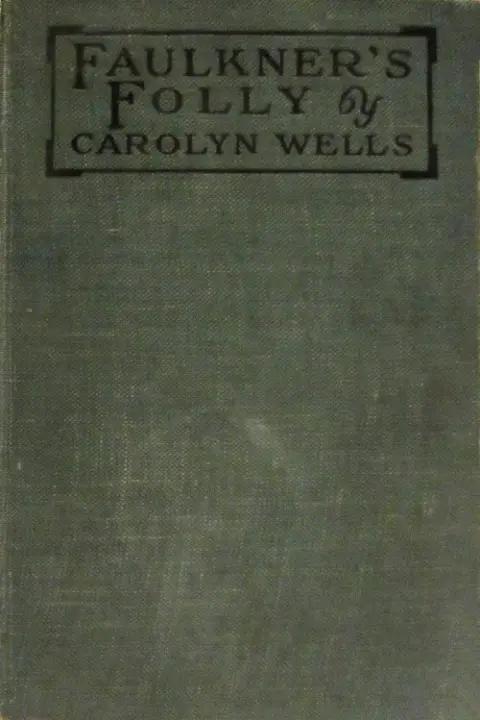
"Faulkner's Folly" by Carolyn Wells is a mystery novel written in the early 20th century. The story unfolds in a grand home known as Faulkner's Folly, where the life of renowned artist Eric Stannard takes a tragic turn when he is found murdered. The primary characters include Beatrice Faulkner, who is a guest in the house, and the women closely associated with the victim, namely his wife Joyce and a model named Natalie Vernon, who are both quickly embroiled in the subsequent investigation. The opening of the novel introduces the dramatic scene in the studio of Faulkner's Folly, where Stannard is discovered dead with an etching needle protruding from his chest. The narrative sets an eerie atmosphere as the characters, particularly Beatrice and the footman Blake, respond to the horrifying situation. As they enter the studio, we learn that Stannard's last words implicate one of the women present, casting suspicion over both Joyce and Natalie. The initial confusion leads to a storm of emotions and conflicting testimonies as a police investigation begins, focusing on the relationships and motives surrounding the characters involved. The rich detail in the opening hints at a complex web of intrigue that will unravel as the mystery deepens.
Introduction adapted from the source catalogue; source summaries may be automatically generated.
Free to read · English · 58,762 words · No account needed
MAKE TIME FOR A GOOD BOOK
On by default. Untick to stop anonymous reading totals. Each page counts after 10 seconds in view. How this works.
Anonymous counting is on unless you have switched it off.
Nor was this perfunctory, for the charm of the guest was manifest from the first. At her entrance, at the first sound of her low, silvery voice, each hearer was thrilled as by an unexpected bit of music.
"Mrs. Stannard?" she said, as Joyce rose and held out her hand. The long cloak of deep pansy-coloured satin fell back showing its lining of pale violet, and the dark Oriental face lighted with responsive cordiality, while she returned the greetings.
Selecting a stately, tall-backed chair, Orienta sank into it, and crossed her dainty feet on a cushion which Barry offered. Her purple hat was like a turban, but its soft folds were neither conspicuous nor eccentric. She chose to keep her hat on, and also retained her long cloak, which, thrown back, disclosed her robe of voluminous folds of dull white silk. Made in Oriental design, it was yet modishly effective and suited well the type of its wearer.
Though not beautiful, the woman was wonderfully charming. In looking at her each auditor forgot self and others in contemplation of this strange personality. Each of the four observing her had eyes only for her, and didn't even glance aside to question the others' approval.
Without seeming to notice this mute tribute, Orienta began to speak. "We will waste no time in commonplaces," she said, her voice as perfectly modulated as that of a great actress, "they cannot interest us at this time. It is for you to tell me whether or not you wish to command my services in this matter of mystery. If so, well,--if not, I go away, and that is all."
The name she had chosen to adopt was a perfect description of her whole personality. Her oval face was of olive complexion; her eyes, not black, but the darkest seal brown; her hair, as it strayed carelessly from the edges of the confining turban, was brown, in moist tendrils at the temples, as if she were under some mental excitement.
It was evident,--to the women, at least,--that the scarlet of her full lips, and the flush on her cheek bones, was artificial, but it gave the impression of being frankly so, and not with intent to deceive. It was perfectly applied, at any rate, and the flash of her ivory white teeth made her smile fascinating.
"That's the word," Barry Stannard thought, as it occurred to him, "she's fascinating, that's what she is. Not entirely wholesome, not altogether to be trusted, but very, very fascinating."
With a subtle understanding, Orienta perceived that Barry had set his stamp of approval on her, and turned her attention to the women.
Your reading position is saved on this browser. Take it to another device with a library code. Reading pages adapt to text, rather than matching a printed edition.
Carolyn Wells

Carolyn Wells & Harry Persons Taber

Carolyn Wells

Carolyn Wells
BEHIND THE BOOK
This eBook is for the use of anyone anywhere in the United States and most other parts of the world at no cost and with almost no restrictions whatsoever. You may copy it, give it away or re-use it under the terms of the Project Gutenberg License included with this eBook or online at www.gutenberg.org. If you are not located in the United States, you will have to check the laws of the country where you are located before using this eBook. Read the source licence.
The original source file, including credits and licence, is retained by this library. Request an original-format copy at no charge. Please include the book title and Project Gutenberg identifier #59126.
KEEP YOUR CURIOSITY GOING
Coulson Kernahan

Maurice Baring
Frances Wright
Cécile Tormay

Frederic Jesup Stimson

W. H. P. (William Henry Pope) Jarvis