
The story of Betty
Carolyn Wells
THE CLASSIC COLLECTION · 1917
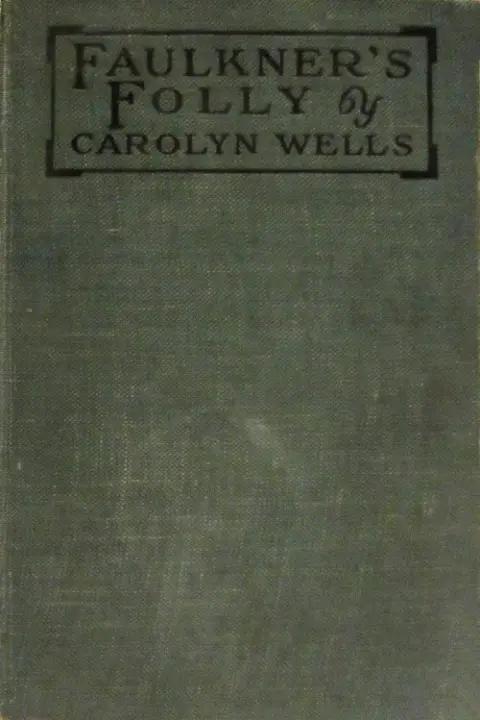
"Faulkner's Folly" by Carolyn Wells is a mystery novel written in the early 20th century. The story unfolds in a grand home known as Faulkner's Folly, where the life of renowned artist Eric Stannard takes a tragic turn when he is found murdered. The primary characters include Beatrice Faulkner, who is a guest in the house, and the women closely associated with the victim, namely his wife Joyce and a model named Natalie Vernon, who are both quickly embroiled in the subsequent investigation. The opening of the novel introduces the dramatic scene in the studio of Faulkner's Folly, where Stannard is discovered dead with an etching needle protruding from his chest. The narrative sets an eerie atmosphere as the characters, particularly Beatrice and the footman Blake, respond to the horrifying situation. As they enter the studio, we learn that Stannard's last words implicate one of the women present, casting suspicion over both Joyce and Natalie. The initial confusion leads to a storm of emotions and conflicting testimonies as a police investigation begins, focusing on the relationships and motives surrounding the characters involved. The rich detail in the opening hints at a complex web of intrigue that will unravel as the mystery deepens.
Introduction adapted from the source catalogue; source summaries may be automatically generated.
Free to read · English · 58,762 words · No account needed
MAKE TIME FOR A GOOD BOOK
On by default. Untick to stop anonymous reading totals. Each page counts after 10 seconds in view. How this works.
Anonymous counting is on unless you have switched it off.
At his exclamation, Joyce ran down from the hall above, where she had been listening to Beatrice's story. She sank down beside the wounded woman and took the drooping figure in her arms.
"Forgive----" moaned Beatrice. "Joyce,--forgive,--I--I loved him so."
"Yes,--yes," soothed Joyce, scarce knowing what she said. "What can we do, Mr. Ford? Oh, what can we do?"
"Nothing, I fear. Call help. Shall I ring?" Ford hastened to the nearest bell he could notice and rang it. Immediately people began to gather, servants, family,--and all sorts of contradictory orders were given. But with his finger on the pulse of the dying woman the detective tried to learn yet more facts. "The will," he asked, bending above her. "Who changed it?"
"Eric himself," Beatrice answered, "that's why--oh, Eric!" Her faced beamed with a strange radiance, and then sinking back in Joyce's arms, Beatrice Faulkner breathed her last.
The next day Alan Ford declared he must hasten away as his engagements
were pressing.
"But tell us more of your work," implored Bobsy Roberts, "give us a few
moments more."
"And tell us about that clairvoyant woman," said Barry. "If she was a fake, how did she read those papers in the dark?"
"I realised, before I came up here at all," said Ford, "that there had to be some secret means of entrance to the studio. I see now, it was never meant to be secret. The architect made the Reception Room ceiling lower than the studio ceiling, because it was a smaller room and he observed due proportions. This left a space there, but it was not concealed or hidden. The catches on both doors are merely small ones and inconspicuous but not concealed. Mr. Faulkner left all the house plans in that loft and Eric Stannard knew of it. He chose to conceal his jewels there as being a convenient place. Only he and Mrs. Faulkner knew of the space, but that was merely a chance happening. He, in no sense, kept it a secret. When I read the accounts in New York papers I felt the case must hinge on another entrance of some sort. When I reached here I saw at once that there was a discrepancy in the heights of those two ceilings, and I worked from that. I was sure the spirit manifestations were made possible by human means working through that concealed space, and I found I was right. I assumed it was probably Mrs. Faulkner who played the spirit as she refused to show the plans of the house, and my theories, based on those plans, left her free to do all she did do, without being discovered. I found she could have placed the jewels on the table that night and returned to her room through the little loft, and be seated at her desk, writing, when Mrs. Stannard reached her room. She said she heard Mrs. Stannard coming up stairs, but as the door was shut and the stairs thickly carpeted, this was unlikely. So I assume she was expecting her. All facts pointed to the guilt of Mrs. Faulkner, but they were by no means obvious. So, when I said if spirits came to the studio last night I should drop the case to-day, I meant because it would be solved. But Mrs. Faulkner thought I would give it up as unsolvable, so she played 'spirit' again. I had in my hand a tiny mirror of the sort that shows what is passing at one's back. I heard, as I sat there, the soft opening of the panel in the studio balcony, and I knew she was coming down the little stair. I heard her click off the light, and just as she did so, I caught a glimpse of her in my mirror. So I went out at the hall door, snapping on the light as I passed, and went up on the grand staircase, knowing I would head her off, and have her practically penned in there. Mrs. Stannard found me waiting there, and I arranged for her to witness the confession that I knew must come. I did not foresee that Mrs. Faulkner would take her own life, but perhaps it is as well. There was no happiness or peace for her in this world, it was better she should expiate her own sin. Poor soul, she was a victim of a love that proved too great for her human nature to strive against. As to the will, I felt sure Mr. Stannard had made that change himself. It looked like his writing, and I felt sure neither Miss Vernon nor Mr. Barry Stannard would have done it."
Your reading position is saved on this browser. Take it to another device with a library code. Reading pages adapt to text, rather than matching a printed edition.
Carolyn Wells

Carolyn Wells & Harry Persons Taber

Carolyn Wells

Carolyn Wells
BEHIND THE BOOK
This eBook is for the use of anyone anywhere in the United States and most other parts of the world at no cost and with almost no restrictions whatsoever. You may copy it, give it away or re-use it under the terms of the Project Gutenberg License included with this eBook or online at www.gutenberg.org. If you are not located in the United States, you will have to check the laws of the country where you are located before using this eBook. Read the source licence.
The original source file, including credits and licence, is retained by this library. Request an original-format copy at no charge. Please include the book title and Project Gutenberg identifier #59126.
KEEP YOUR CURIOSITY GOING
Coulson Kernahan

Maurice Baring
Frances Wright
Cécile Tormay

Frederic Jesup Stimson

W. H. P. (William Henry Pope) Jarvis