
The story of Betty
Carolyn Wells
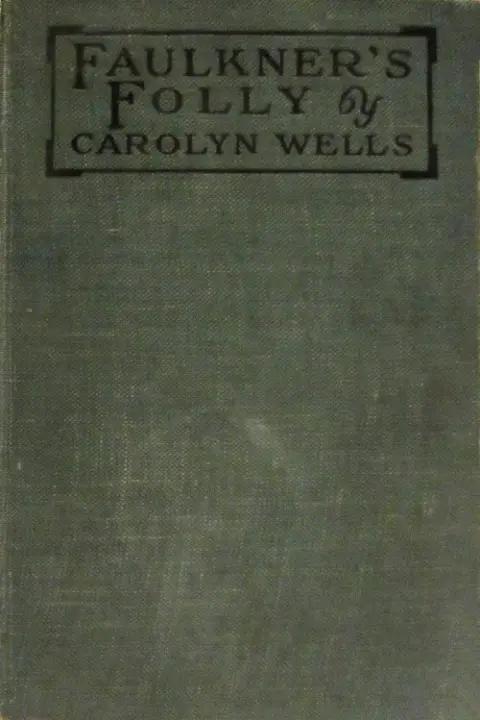
THE CLASSIC COLLECTION · 1917
"Faulkner's Folly" by Carolyn Wells is a mystery novel written in the early 20th century. The story unfolds in a grand home known as Faulkner's Folly, where the life of renowned artist Eric Stannard takes a tragic turn when he is found murdered. The primary characters include Beatrice Faulkner, who is a guest in the house, and the women closely associated with the victim, namely his wife Joyce and a model named Natalie Vernon, who are both quickly embroiled in the subsequent investigation. The opening of the novel introduces the dramatic scene in the studio of Faulkner's Folly, where Stannard is discovered dead with an etching needle protruding from his chest. The narrative sets an eerie atmosphere as the characters, particularly Beatrice and the footman Blake, respond to the horrifying situation. As they enter the studio, we learn that Stannard's last words implicate one of the women present, casting suspicion over both Joyce and Natalie. The initial confusion leads to a storm of emotions and conflicting testimonies as a police investigation begins, focusing on the relationships and motives surrounding the characters involved. The rich detail in the opening hints at a complex web of intrigue that will unravel as the mystery deepens.
Introduction adapted from the source catalogue; source summaries may be automatically generated.
Free to read · English · 58,762 words · No account needed
MAKE TIME FOR A GOOD BOOK
On by default. Untick to stop anonymous reading totals. Each page counts after 10 seconds in view. How this works.
Anonymous counting is on unless you have switched it off.
"I was his first love. We were schoolmates. I always loved him--more than loved him. I worshipped, adored him. He loved me,--but he was always fickle. He loved every woman he saw. Then,--he married--his first wife, I mean, and I thought I should die. But never mind the past. I married, and I tried to forget Eric. My husband built this beautiful home, but he had financial troubles and couldn't keep it. Eric Stannard bought it, and meanwhile his wife had died, and he married my friend Joyce. I tried to be reconciled, but the demon of jealousy tore my very heart out. I gave over this house to them and went away. A portrait of myself was to be part of the purchase price, and--even though I knew it would be acute torment to see Eric happy here with Joyce, I came to stay a month and have the picture painted. As I feared, the necessarily intimate association between the artist and myself quickened my never-dying love for him, until I was almost frantic. I could have stood it, though, had it been only his wife. But when he fell desperately in love with the model, I resented it for Joyce and myself both. But I had no thought of killing him,--don't think that!"
"It was done on a sudden impulse, then." Ford was watching her closely. He knew that her enforced calm might give way at any instant and he strove to speak quietly and lead her gently on to a confession. Moreover, he trusted that Joyce was listening, as he had asked her to do. Thus the confession would be witnessed.
"It was this way," and Beatrice looked piteously into his kind eyes. "Mr. Wadsworth asked me that night to marry him. We were in the Drawing Room, as you know. I wouldn't say yes, for I still had a faint hope of winning Eric. It was absurd for me to think it, but I was desperate. After Mr. Wadsworth left me, I sat a moment in the Drawing Room, and then I resolved to go to Eric, by the secret passage, of which only he and I knew, and beg him to put Joyce away and take me. I say this without shame, for I was--and am, still, so madly in love with him, that I had no shame regarding it, and would have suffered any ignominy or humiliation to win him. I went through that small space; it is not really secret, but no one has ever noticed it, and I went through to the studio, and stepping in the room, on the little balcony, I saw Eric below me, gazing at the etching of Natalie with an adoring look. He bent down and kissed the picture, and then I descended the stairs and spoke to him. I told him that Natalie loved Barry and hated him. I urged him to divorce Joyce and let her marry Eugene Courtenay and I begged him to marry me. He laughed at me! I shall never forget that laugh! But that wasn't why I killed him. It was because he turned again to that picture of Natalie and into his face came a look that I had never seen there. A look of love such as I had never been able to call forth on his face, a worshipping passion that transcended all love I had ever dreamed of. And that he felt for a little girl who hated him. Jealousy maddened me, and snatching up an etching tool I marred the wax beyond recognition. He turned on me, his face livid with rage. The contrast,--the look of love he had for the girl, the look of venomous hate he gave me, bereft me of my senses. No, I do not mean I did not know what I was doing,--I did know. I fully meant at that moment to kill him, and then to kill myself, that we might at least die together. I should not have thought of killing him if I hadn't chanced to have that tool in my hand. Nor should I have wanted to kill him but for his scorn of me and his love for her. The two together drove me wild, and I stabbed him in a moment of fierce passion that was love, not hate. Then, as I was about to draw forth the needle and stab myself, I saw that he was not dead. He looked at me, and I couldn't say it was with hatred. I think--I honestly think--that he gloried in my deed,--you cannot understand,--it is a strange idea, but I think he realised at last the depth of my love and appreciated it. Anyway, I read that in his face, and I couldn't bring myself to leave a world that still held him. I didn't dare remove the needle, lest it bring about his death,--I didn't dare remain and be found there with him. My mind fairly flew. I thought so fast and so clearly, I concluded to escape by the panel and return quickly through the hall and thus coming upon him, apparently innocently, save his life."
Your reading position is saved on this browser. Take it to another device with a library code. Reading pages adapt to text, rather than matching a printed edition.
Carolyn Wells

Carolyn Wells & Harry Persons Taber

Carolyn Wells

Carolyn Wells
BEHIND THE BOOK
This eBook is for the use of anyone anywhere in the United States and most other parts of the world at no cost and with almost no restrictions whatsoever. You may copy it, give it away or re-use it under the terms of the Project Gutenberg License included with this eBook or online at www.gutenberg.org. If you are not located in the United States, you will have to check the laws of the country where you are located before using this eBook. Read the source licence.
The original source file, including credits and licence, is retained by this library. Request an original-format copy at no charge. Please include the book title and Project Gutenberg identifier #59126.
KEEP YOUR CURIOSITY GOING
Coulson Kernahan

Maurice Baring
Frances Wright
Cécile Tormay

Frederic Jesup Stimson

W. H. P. (William Henry Pope) Jarvis