
The story of Betty
Carolyn Wells
THE CLASSIC COLLECTION · 1917
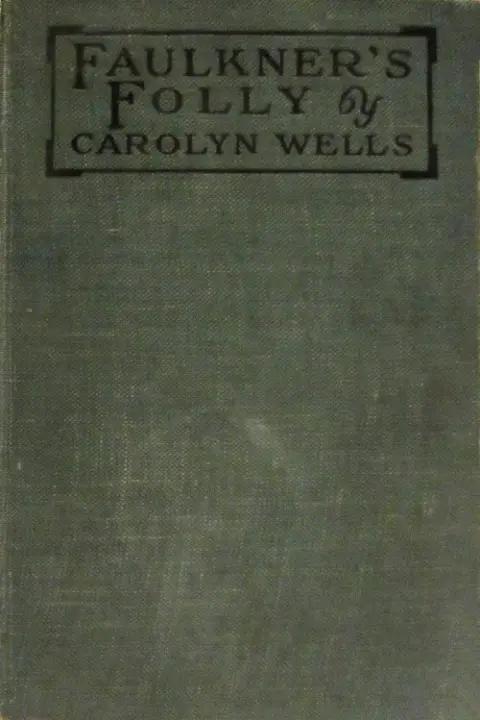
"Faulkner's Folly" by Carolyn Wells is a mystery novel written in the early 20th century. The story unfolds in a grand home known as Faulkner's Folly, where the life of renowned artist Eric Stannard takes a tragic turn when he is found murdered. The primary characters include Beatrice Faulkner, who is a guest in the house, and the women closely associated with the victim, namely his wife Joyce and a model named Natalie Vernon, who are both quickly embroiled in the subsequent investigation. The opening of the novel introduces the dramatic scene in the studio of Faulkner's Folly, where Stannard is discovered dead with an etching needle protruding from his chest. The narrative sets an eerie atmosphere as the characters, particularly Beatrice and the footman Blake, respond to the horrifying situation. As they enter the studio, we learn that Stannard's last words implicate one of the women present, casting suspicion over both Joyce and Natalie. The initial confusion leads to a storm of emotions and conflicting testimonies as a police investigation begins, focusing on the relationships and motives surrounding the characters involved. The rich detail in the opening hints at a complex web of intrigue that will unravel as the mystery deepens.
Introduction adapted from the source catalogue; source summaries may be automatically generated.
Free to read · English · 58,762 words · No account needed
MAKE TIME FOR A GOOD BOOK
On by default. Untick to stop anonymous reading totals. Each page counts after 10 seconds in view. How this works.
Anonymous counting is on unless you have switched it off.
"Not that, exactly. Mrs. Stannard stood behind, but off toward his left, and Miss Vernon was behind, but toward the right."
"Show me exactly, Blake, where these two ladies stood," and Coroner Lamson rose to see his demands fulfilled.
"Oh, sir," begged Blake, his frightened eyes wavering toward the members of the household which employed him, "oh, sir--Mrs. Faulkner, sir,--she came in with me,--she can tell better than I----"
"Mrs. Faulkner will be questioned in due time. You came in first; we will hear your version and then hers. Be accurate now."
With great hesitancy, Blake stepped to the spots he had designated.
"Mrs. Stannard stood here," he said, indicating a position perhaps a yard back and to the left of Stannard's chair, which was still in its place.
"What was she doing?"
"Nothing, sir. One hand was on this table, and the other sort of clasped
against her breast."
"And Miss Vernon?"
"She was over here," and Blake, still behind the chair, crossed to its other side, and stood near the outer door.
"How was she standing?"
"Against this small table, and the table was swaying back and forth, like it would upset in a minute."
"And her hands?"
"They were both behind her, sir, clutching at the table."
"You have a wonderful memory, Blake," and the Coroner looked hard at his
witness.
"Not always, sir. But the thing is like a picture to my mind."
"Like a moving picture?"
"No, sir, nobody moved. It was like a tableau, sir----"
"And then," prompted Inspector Bardon.
At this point, Barry Stannard was again seen to look at Blake with a glance of deep concentration.
"Important, if true," Detective Roberts said to himself. "Young Stannard is afraid of the footman's further disclosures!"
Whether that was so or not, Blake suddenly lost his power of clear and
concise narration.
"Why, then----" he stammered, "then, all was confusion. I started toward Mr. Stannard, it--it seemed my duty. And Mrs. Faulkner, she came toward him----"
"And the two ladies behind him?"
"They came toward him, too, and Mrs. Stannard took hold of his hand----"
"Well?"
"Well, sir, I couldn't help it, sir--I blurted out, 'Who did this?' And Mr. Stannard--he said----"
"Said! Spoke?"
Attention was concentrated on the footman, and it is doubtful if any one save Roberts noticed Barry Stannard's face. It was drawn in an agonised protest at the forthcoming revelation. But Blake, accustomed to obeying orders implicitly, continued to tell his story.
"Yes, sir, he spoke--sort of whispered, in a gasping way----"
"And what did he say?"
"He said, 'Natalie, not Joyce.'"
"You are sure?"
Your reading position is saved on this browser. Take it to another device with a library code. Reading pages adapt to text, rather than matching a printed edition.
Carolyn Wells

Carolyn Wells & Harry Persons Taber

Carolyn Wells

Carolyn Wells
BEHIND THE BOOK
This eBook is for the use of anyone anywhere in the United States and most other parts of the world at no cost and with almost no restrictions whatsoever. You may copy it, give it away or re-use it under the terms of the Project Gutenberg License included with this eBook or online at www.gutenberg.org. If you are not located in the United States, you will have to check the laws of the country where you are located before using this eBook. Read the source licence.
The original source file, including credits and licence, is retained by this library. Request an original-format copy at no charge. Please include the book title and Project Gutenberg identifier #59126.
KEEP YOUR CURIOSITY GOING
Coulson Kernahan

Maurice Baring
Frances Wright
Cécile Tormay

Frederic Jesup Stimson

W. H. P. (William Henry Pope) Jarvis