
Last letters from the living dead man
David Patterson (Spirit) Hatch
THE CLASSIC COLLECTION · 1856
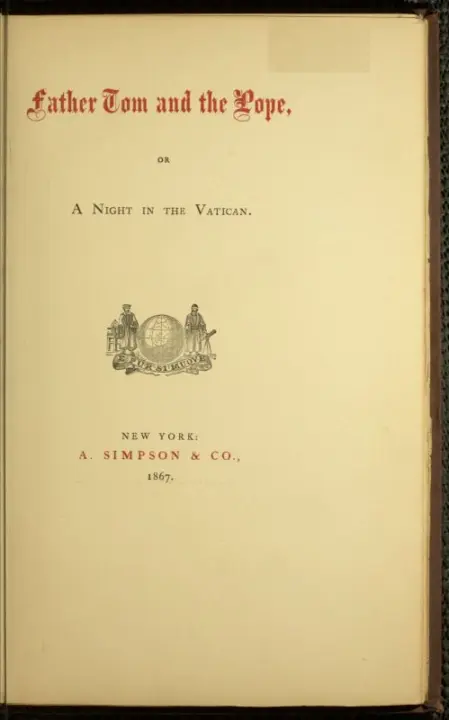
"Father Tom and the Pope: Or, a night in the Vatican" by Samuel Ferguson is a satirical work that blends elements of fiction and theological debate, likely written during the mid-19th century. This novel depicts the humorous escapades of Father Tom, a Catholic priest from Ireland, as he engages in a series of dialogues and conflicts with the Pope, showcasing both wit and satire surrounding religious controversies of the time. The narrative is set against a backdrop of lively Irish culture and its relationship with the Catholic Church, emphasizing the social attitudes of the era. The storyline follows Father Tom Maguire, a charismatic and humorous character known for his outspoken nature, as he unexpectedly visits the Vatican. The priest engages the Pope in debates about theology, ethics, and several humorous discussions involving drinking and witty repartees. Through his interactions, Father Tom cleverly maneuvers through various theological scenarios, often turning the Pope’s words back on him, which leads to comical misunderstandings. As the evening unfolds, the discourse reveals deeper insights into faith and the clerical hierarchy while remaining light-hearted and entertaining. The text ultimately conveys a rich interplay of comedy and critique regarding the religious tensions between Catholicism and Protestantism in a way that reflects the cultural dynamics of the time.
Introduction adapted from the source catalogue; source summaries may be automatically generated.
Free to read · English · 11,252 words · No account needed
MAKE TIME FOR A GOOD BOOK
On by default. Untick to stop anonymous reading totals. Each page counts after 10 seconds in view. How this works.
Anonymous counting is on unless you have switched it off.
Neither ov them spoke for near a minit, considhering wid themselves how they wor to begin sich a great thrial ov shkill. At last says the Pope--the blessed man! only think how 'cute it was ov him!--"Domine Maguire," says he, "valde desidhero, certiorem fieri de significatione istius verbi eversor quo jam jam usus es"--(well, surely I am the boy for the Latin!)
"Eversor, id est cyathus," says his Riv'rence, "nam apud nos tumbleri, seu eversores, dicti sunt ab evertendo ceremonian inter amicos; non, ut Temperantiæ Societatis frigidis fautoribus placet, ab evertendis ipsis potatoribus." (It's not every masther unher the Boord, I tell you, could carry such a car-load ov the dead langidges.) "In agro vero Louthiano et Midensi," says he, "nomine gaudent quodam secundum linguam Anglicanam significante bombardam seu tormentum; quia ex eis tanquam ex telis jaculatoriis liquorem faucibus immitere solent. Etiam inter hæreticos illos melanostomos" (that was a touch of Greek), "Presbyterianos Septentrionales, qui sunt terribiles potatores, Cyathi dicti sunt faceres, et dimidium Cyathi hæf-a-glessus. Dimidium Cyathi vero apud Metropolitanos Hibernicos dicitur dandy."--
"En verbum Anglicanum!" says the Pope, clapping his hands--"leporem te fecisti;" as much as to say that he had made a hare ov himself.
"Dandæus, dandæus, verbum erat," says his Riv'rence--oh, the dear man, but it's himself that was handy ever and always at getting out ov a hobble--"dandæus verbum erat," says he, "quod dicturus eram, cum me intherpillavisti."
"Ast ego dico," says the Pope, very sharp, "quod verbum erat dandy."
"Per tibicinem qui coram Mose modulatus est," says his Riv'rence, "id flagellat mundum! Dandæus dixi, et tu dicis dandy; ergo tu es lepus, non ego--Ah, ha! Saccavi vesthram Sanctitatem!"
"Mendacium est!" says the Pope, quite forgetting himself, he was so mad at being sacked before the sarvints.
Well, if it hadn't been that his Holiness was in it, Father Tom 'ud have given him the contints of his tumbler betuxt the two eyes for calling him a liar; and, in troth, it's very well it was in Latin the offince was conveyed, for, if it had been in the vernacular, there's no saying what 'ud ha' been the consequence. His Riv'rence was mighty angry anyhow.--"Tu senex lathro," says he, "quomodo audes me mendacem prædicare?"
"Et tu, sacrilege nebulo," says the Pope, "quomodo audacitatem habeas, me Dei in terris vicarium, lathronem conviciari?"
"Interroga circumcirca," says his Riv'rence.
"Abi ex ædibus meis," says the Pope.
"Abi tu in malem crucem," says his Riv'rence.
"Excomunicabo te," says the Pope.
"Diabolus curat," says his Riv'rence.
"Anathema sis," says the Pope.
Your reading position is saved on this browser. Take it to another device with a library code. Reading pages adapt to text, rather than matching a printed edition.
BEHIND THE BOOK
This eBook is for the use of anyone anywhere in the United States and most other parts of the world at no cost and with almost no restrictions whatsoever. You may copy it, give it away or re-use it under the terms of the Project Gutenberg License included with this eBook or online at www.gutenberg.org. If you are not located in the United States, you will have to check the laws of the country where you are located before using this eBook. Read the source licence.
The original source file, including credits and licence, is retained by this library. Request an original-format copy at no charge. Please include the book title and Project Gutenberg identifier #71203.
KEEP YOUR CURIOSITY GOING
David Patterson (Spirit) Hatch

David Patterson (Spirit) Hatch

David Patterson (Spirit) Hatch
Coulson Kernahan

Maurice Baring
Frances Wright