
Last letters from the living dead man
David Patterson (Spirit) Hatch
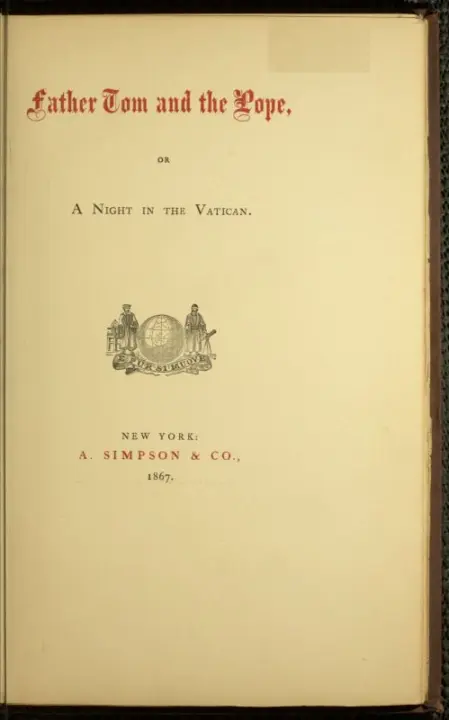
THE CLASSIC COLLECTION · 1856
"Father Tom and the Pope: Or, a night in the Vatican" by Samuel Ferguson is a satirical work that blends elements of fiction and theological debate, likely written during the mid-19th century. This novel depicts the humorous escapades of Father Tom, a Catholic priest from Ireland, as he engages in a series of dialogues and conflicts with the Pope, showcasing both wit and satire surrounding religious controversies of the time. The narrative is set against a backdrop of lively Irish culture and its relationship with the Catholic Church, emphasizing the social attitudes of the era. The storyline follows Father Tom Maguire, a charismatic and humorous character known for his outspoken nature, as he unexpectedly visits the Vatican. The priest engages the Pope in debates about theology, ethics, and several humorous discussions involving drinking and witty repartees. Through his interactions, Father Tom cleverly maneuvers through various theological scenarios, often turning the Pope’s words back on him, which leads to comical misunderstandings. As the evening unfolds, the discourse reveals deeper insights into faith and the clerical hierarchy while remaining light-hearted and entertaining. The text ultimately conveys a rich interplay of comedy and critique regarding the religious tensions between Catholicism and Protestantism in a way that reflects the cultural dynamics of the time.
Introduction adapted from the source catalogue; source summaries may be automatically generated.
Free to read · English · 11,252 words · No account needed
MAKE TIME FOR A GOOD BOOK
On by default. Untick to stop anonymous reading totals. Each page counts after 10 seconds in view. How this works.
Anonymous counting is on unless you have switched it off.
"Cum omni jucunditate in vita," says his Riv'rence. "Cum summâ concupiscintiâ et animositate," says he; as much as to say: "Wid all the veins ov my heart, I'll do that same;" and so, wid that, they mixed their fourth gun a piece.
"Aqua vitæ vesthra sane est liquor admirabilis," says the Pope.
"Verum est pro te--it's thrue for you," says his Riv'rence, forgetting the idyim ov the Latin phrawseology, in a manner.
"Prava est tua Latinitas, domine," says the Pope, finding fault like
wid his etymology.
"Parva culpa mihi," "small blame to me, that is," says his Riv'rence; "nam multum laboro in partibus interioribus," says he--the dear man! that never was at a loss for an excuse!
"Quid tibi incommodi?" says the Pope, axing him what ailed him.
"Habesne id quod Anglice vocamus, a looking-glass," says his Riv'rence.
"Immo, habeo speculum splendidissimum subther operculum pyxidis hujus starnutatoriæ," says the Pope, pulling out a beautiful goold snuff-box, wid a looking-glass in under the lid; "Subther operculum pyxidis hujus starnutatorii--no--starnutatoriæ--quam dono accepi ab Archi-duce Austhriaco siptuagisima prætheritâ," says he; as much as to say that he got the box in a prisint from the Queen of Spain last Lint, if I rightly remimber.
Well, Father Tom laughed like to burst. At last says he, "Pather Sancte," says he, "sub errore jaces. 'Looking-glass' apud nos habet significationem quamdam peculiarem ex tempore diei dependentem"--there was a sthring ov accusatives for yez!--"nam mane speculum sonat," says he, "post prandium vero mat--mat--mat"--sorra be in me but I disremimber the classic appellivation ov the same article. Howandiver, his Riv'rence went on explaining himself in such a way as no scholar could mistake. "Vesica mea," says he, "ab illo ultimo eversore distenditur, donec similis est rumpere. Verbis apertis," says he, "Vesthræ Sanctitatis præsentia salvata, aquam facere valde desidhero."
"Ho, ho, ho!" says the Pope, grabbing up his box; "si inquinavisses meam pyxidem, excimnicari debuisses. Hillo, Anthony," says he to his head butler, "fetch Misther Maguire a----"
"You spoke first!" says his Riv'rence, jumping off his sate: "You spoke first in the vernacular. I take Misther Anthony to witness," says he.
"What else would you have me to do?" says the Pope, quite dogged like to see himself bate thataway at his own waypons. "Sure," says he, "Anthony wouldn't undherstand a B from a bull's foot, if I spoke to him any other way."
"Well, then," says his Riv'rence, in considheration ov the needcessity, says he, "I'll let you off for this time; but mind, now, afther I say præstho, the first of us that spakes a word of English is the hare--præstho!"
Your reading position is saved on this browser. Take it to another device with a library code. Reading pages adapt to text, rather than matching a printed edition.
BEHIND THE BOOK
This eBook is for the use of anyone anywhere in the United States and most other parts of the world at no cost and with almost no restrictions whatsoever. You may copy it, give it away or re-use it under the terms of the Project Gutenberg License included with this eBook or online at www.gutenberg.org. If you are not located in the United States, you will have to check the laws of the country where you are located before using this eBook. Read the source licence.
The original source file, including credits and licence, is retained by this library. Request an original-format copy at no charge. Please include the book title and Project Gutenberg identifier #71203.
KEEP YOUR CURIOSITY GOING
David Patterson (Spirit) Hatch

David Patterson (Spirit) Hatch

David Patterson (Spirit) Hatch
Coulson Kernahan

Maurice Baring
Frances Wright